Showing posts with label Freight companies. Show all posts

Thursday, July 24, 2025

Company: White and DeHart Company

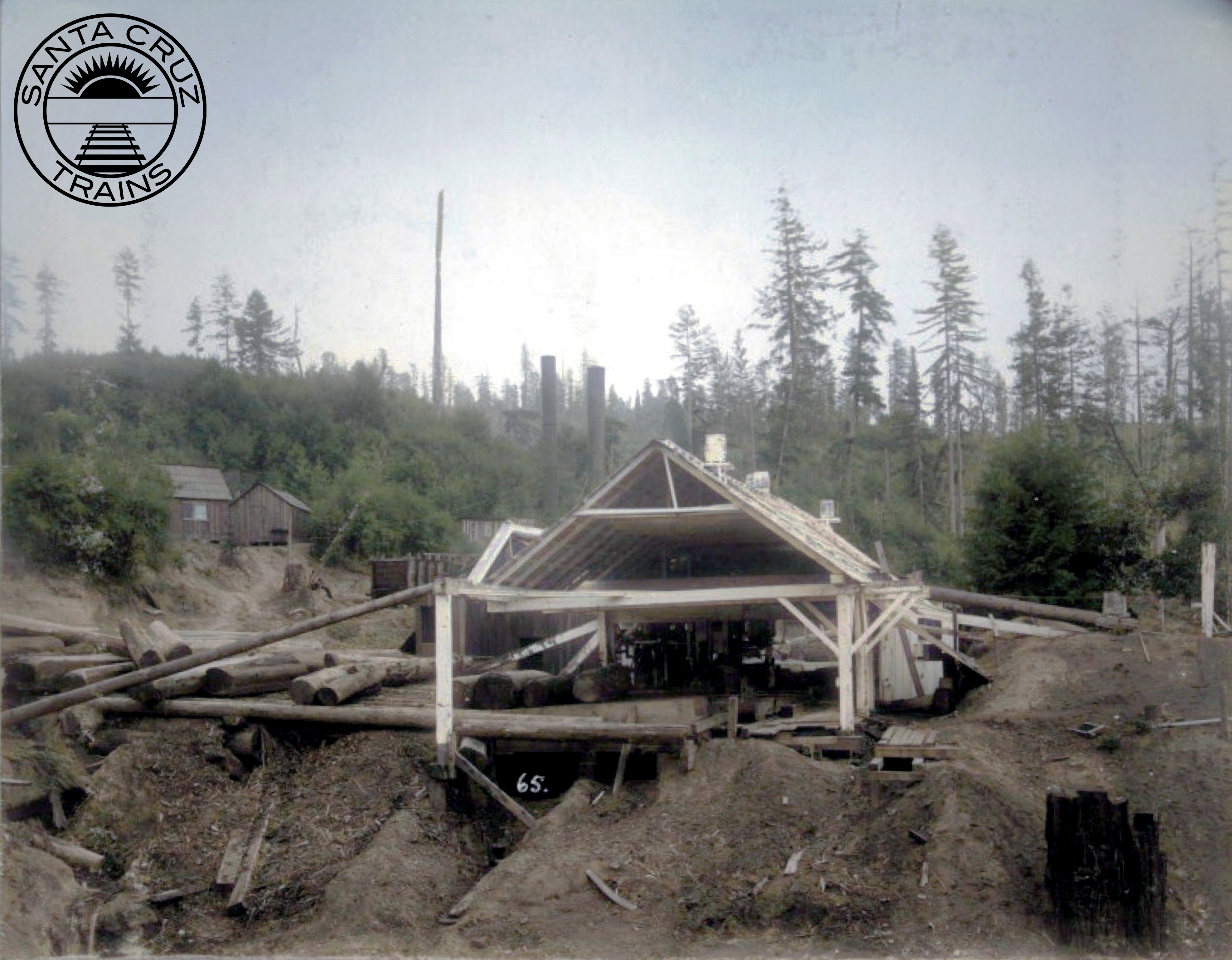
Logging operations in the hills above Watsonville were a slower affair than similar harvesting efforts in the San Lorenzo Valley and along Aptos Creek and its tributaries. Yet that did not dissuade William “Bill” DeHart from giving the matter his full attention. DeHart moved to Santa Cruz County in 1869 after a colorful career in the U.S. Army and Marines during the Civil War. Following the war, he became a blacksmith in Vicksburg, Mississippi, bringing that trade with him to Whiskey Hill, now Freedom. In 1875, he bought a 160-acre farm and became an orchardist growing pears, apricots, and peaches. But the hills were calling.

Unidentified lumber mill in the Santa Cruz Mountains, ca 1890. [University of California, Santa Cruz – colorized using MyHeritage]

In late 1887, DeHart partnered with Edward White, an early resident of Watsonville, in purchasing milling equipment to erect a sawmill on Mt. Madonna near Watsonville. For the task, White had acquired two large lots encompassing Banks Canyon, through which Casserly Creek flows, located due east of the old toll road to San José, now Mt. Madonna Road. Today, this is located in the part of Mount Madonna County Park that was transferred from Santa Cruz County to Santa Clara County in 1971. The tracts had an estimated yield of 7,000,000 board feet of lumber and the mill, under the supervision of DeHart, had a capacity of 15,000 board feet per day. The partners specialized in splitstuff, such as shingles and shakes, and made fruit boxes for customers throughout the Central Coast. Success came quickly—they incorporated their business relationship on November 2, 1889 as the White & DeHart Company. Yet fears were mounting that most of the remaining old growth timber on the hills would soon be harvested, ending an industry that had helped put Watsonville on the map.

Advertisement for White & DeHart's lumber mill in the Salinas Daily Journal, published June 9, 1889.

After three years in Banks Canyon, White & DeHart relocated to the Thompson Tract at Mill Canyon near Casserly Ridge, about five miles from Watsonville. Mill crews worked fast to move the machinery and erect the new mill, finishing the job sometime in mid June 1891. Meanwhile, fellers in the surrounding forest cleared several acres in preparation for the first season at the new site. Despite two lucrative harvests, White & DeHart’s second mill shut down permanently following the 1892 season due to lack of available timber.

Sanborn Fire Insurance plan showing the original layout of the White & DeHart Company's box factory on Walker Street before improvements and expansion, 1902. [Library of Congress]

Without timber to harvest and with a slumped lumber market, the partners pivoted to box-making for all of the fruit growers in the Pajaro Valley. They leased property on Walker Street near the Southern Pacific Railroad’s Watsonville Depot and built a box factory and feed mill. The mill produced a wide range of agricultural products, including fruit boxes, berry crates, and baskets, as well as a small production of lumber and feed. During the busy months, up to fifty people were employed to make tens of thousands of baskets and boxes a day. Without a direct source of timber, the company relied on redwood and pine imported from elsewhere in California for its products.

Advertisement for White & DeHart Company's box factory in The Pajaronian, published October 5, 1893.

After a six season hiatus, White & DeHart returned to milling in February 1899 and purchased stumpage rights to M. J. Hughes’ property on Rancho Salsipuedes along Hughes Creek, which the firm estimated had about 3,000,000 board feet of lumber. The narrow canyon, located about midway between the company’s previous two mills, would take no more than two seasons to harvest and the difficulty of moving a mill to the site for such a small return led the partners to focus primarily on extracting splitstuff to construct their boxes. Earlier, in November 1896, the partners had reincorporated, possibly in preparation for Edward White’s departure in 1899. White had worked with DeHart for over a decade but sold his interest to his partner, who in turn made his son, Joseph, secretary of the firm.

Sanborn Fire Insurance map showing the full extent of the White & DeHart Company box mill on Walker Street following expansions, October 1908 (updated 1911). [UC Santa Cruz]

Under the control of the DeHart family, the company expanded quickly and purchased five adjacent lots around 1900 to support its operations. The box mill vastly increased its output to support the rapidly-growing apple trade. The feed mill was moved to a new two-story building with storage for 15,000 sacks of grain. The small lumber mill on site was completely overhauled and its equipment replaced with higher capacity and heavier duty machinery. Another two-story building was devoted exclusively to manufacturing berry baskets and storing apple boxes. And at the back of the property, a blacksmith shop continuously produced wire, nails, and other material required for the factory. The company kept its corporate office on Second Street beside the mill and several staff cottages were located on nearby streets to lessen the commute.

On May 13, 1904, White and DeHart reunited as directors of the Hatfield Lumber Company alongside D. W. Johnston, J. W. Forgeus, and William J. McGrath. The group had acquired an untouched tract of redwoods on Hatfield Creek, a tributary of Pescadero Creek north of Chittenden on lands owned by the Casserly and Kelly families. Despite assurances in The Pajaronian that the firm was separate from White & DeHart, the editor clarified that the firm “will cut, haul and saw the logs for the Hatfield company,” suggesting a close relationship. By early June, the company was already contracted to ship 100 carloads of lumber, with a new 689-foot-long spur installed beside the Southern Pacific station at Chittenden. Most of the cut timber was taken to the White & DeHart box factory in Watsonville where it was turned into lumber. It then went to a newly-built Santa Clara Valley Mill & Lumber Company yard in Watsonville to be sold.

Hatfield Lumber appears to have initially met with bad luck early in its operation. A forest fire in early November burned its way through Pescadero Creek canyon, damaging equipment and ruining timber. The area was severely impacted in 1906 by the earthquake, as well, with the San Andreas fault passing almost directly through the canyon. High demand for lumber from the people of San Francisco, however, led the company to resume operations in March 1907 on Hatfield Creek. White & DeHart built a 30,000 board feet capacity sawmill near Chittenden station, thereby eliminating the need to ship logs to Watsonville on flatcars. The first commercial load was sent to Watsonville on July 4, 1907.

A rift formed at Chittenden near Soda Lake with the southern Santa Cruz Mountains in the distance, 1906. Photo by Harold W. Fairbanks. [UC Berkley, Bancroft Library – colorized using MyHeritage]

Operations on Hatfield Creek and elsewhere on Pescadero Creek continued with only minor problems for the next three seasons. In 1908, the Independent Lumber Company purchased most of the lumber for sale at its yard in Pajaro, with the remaining timber sent to the Santa Clara Valley Mill & Lumber Company yard in San José. Operations along Hatfield Creek ended in November 1909 with insufficient timber left to justify another season. DeHart dismantled the mill and shipped the mill and remaining lumber to Watsonville. Hatfield continued to cut splitstuff on the property for two more years, with White & DeHart taking over from December 1911. Nonetheless, the closure of the lumber mill signalled the end of large-scale logging at the southernmost end of the Santa Cruz Mountains.

The White & DeHart Company lingered a few more years at its Walker Street location. Tragedy struck the DeHart family in July 1914 when Joseph DeHart, secretary and son of William, died of a lung infection. The next year, a fire broke out on August 5 and rapidly consumed the company’s box factory. DeHart did not rebuild and allowed the business to lapse in February 1924. The property was purchased by the Pajaro Valley Cold Storage Company around 1919. The company’s tracts on Pescadero Creek, taken over by White & DeHart from the Hatfield company sometime in the early 1910s, were leased to the Mohawk Oil Company for drilling and prospecting in 1920. William DeHart died on May 20, 1928 at his home in Watsonville. Edward White, meanwhile, became the Commissioner for Immigration under President Woodrow Wilson in 1914 and was dismissed by President Warren Harding in 1923. He died in San Francisco on May 17,1931 at the age of 80.

Citations & Credits:

  • Clark, Donald Thomas. Santa Cruz County Place Names: A Geographical Dictionary, Second Edition. Scotts Valley, CA Kestrel Press, 2008.
  • Guinn, James Miller. History of the State of California and Biographical Record of Santa Cruz, San Benito, Monterey and San Luis Obispo Counties. Chicago Chapman Publishing, 1903.
  • Hatch, Andrew J. "Official Map of Santa Cruz County." A. J. Hatch: San Francisco, 1889.
  • Southern Pacific Railroad Company. Miscellaneous records.
  • Various articles from the Pajaronian, Salinas Daily Journal, San Benito Advance, San Juan Mission News, Santa Cruz Evening News, Santa Cruz Sentinel, and Santa Cruz Surf.

Thursday, June 26, 2025

Companies: Coast Drum and Box Company

In the decade after the closure of the San Vicente Lumber Company plant at the northwestern boundary of the City of Santa Cruz, several small agricultural-oriented businesses sprang up along the Davenport Branch on the West Side between Natural Bridges Drive and Almar Avenue. One of the earliest was the Coast Drum and Box Company.

The Coast Drum and Box Company factory on Mission Street on fire, September 4, 1953. [Santa Cruz Sentinel-News – colorized using MyHeritage]

From early in its history, the business had a close relationship with the Half Moon Bay Drum and Box Company, which was incorporated in February 1923 in San Francisco as a packaging material maker catering to vegetable growers operating along the San Mateo County coastline. The business was initially run by Louis G. Pardini, A. Bartolozzi, R. Tomei, and C. Raffanti. Not much is known of the firm in the 1920s, but its main facility was located on Battery Street until March 1930, when a catastrophic fire leveled the three-story building. The firm rebuilt in Daly City, where it operated a large factory until May 1939, when it too burned down. Though the company continued to exist, it shifted its focus to the south.

The Half Moon Bay Drum and Box Company and Colma Vegetable Packing Association plants on fire in Daly City, May 28, 1939. [San Francisco Examiner – colorized using MyHeritage]

Meanwhile, in Santa Cruz County, the agricultural industry, especially along the North Coast, was growing rapidly. Artichoke and Brussels sprout, along with peas, had taken off as an industry in 1915. By the 1920s, it required its own packaging plants and related industries. Thus, sometime in the late 1920s, a group of farmers formed the Coast Drum and Box Company in Davenport beside the tracks of the Southern Pacific Railroad. The purpose of the business was to make drums, crates, boxes, and hampers for local growers, a task that employed seven men during the harvesting season. In August 1932, the group completed construction on a much-enlarged plant on property they had purchased property from Gilbert Caiocca. This was located on the east side of Davenport across from the main village and was erected by Palmer & Balsiger of Santa Cruz for $1,700. Archie Marracci of San Francisco served as manager of the plant during this time.

Things became more corporate in January 1934 when R. Willis of San Francisco took over the company. While daily operations did not change, new blood from the Bay Area was brought in that shifted the focus of the business. In 1935, Ed Marracci became owner of the company. Yet elsewhere, the Half Moon Bay Drum and Box Company was making inroads. Louis Pardini was named an officer of the Coast Drum and Box Company by September 1935. In May 1937, he took over, turning the company into a subsidiary of his own firm. Pardini appointed himself president while Albert A. Axelrod became secretary. Feeling that there was too much competition on the North Coast with the nearby Davenport Drum and Box Company, Pardini made the decision to move the company’s operations south.

Aerial photograph of the Coast Drum and Box Company factory, showing the railroad spur with boxcars and the new additions to the original plant, 1940. Photograph by Fairchild Aerial Surveys, Inc. [Courtesy University of California, Santa Cruz – colorized using MyHeritage]

Pardini immediately set to work finding a site for a new drum and box factory within the Santa Cruz city limits, ultimately settling on a site near Swift Street on Mission Street beside the railroad tracks. He hired Wilson & Castagnola, a local firm, to build a new plant for $15,762.50. The new drum-making facility and packing plant was jointly run by the company and farmers of the Santa Cruz Artichoke Growers’ Association, who had been advocating for a new plant closer to their fields. As a result, the facility catered to customers from West Side Santa Cruz to Laguna Creek—the boundary of the Coast Dairies property. In early September 1937, the Santa Cruz City Council authorized the installation of a spur across Swift Street to cater to the packing house. The facility was formally opened on September 19, 1937, and Thomas McCambridge, manager of the packing house in Seabright, was given management of this new plant as well.

The Coast Drum and Box Company did well on the West Side. Within just two years, it petitioned the City Council to build a $10,000 annex that more than doubled the size of the existing facility. The new buildings provided space for a dedicated box factory and a paraffin house where Brussels sprouts could be sealed. Due to the destruction of Pardini’s facility in Daly City in May 1939, the Half Moon Bay Drum and Box Company merged its operations with the Coast Drum and Box Company in Santa Cruz. This led to the year 1939 becoming the Santa Cruz-based company’s biggest year yet, with all of the artichoke and sprout harvest from Half Moon Bay to Santa Cruz packed and shipped from the Mission Street plant. The company employed around 80 workers that fall, making it seasonally one of the largest employers in the county. Each day, four to five boxcars left from the company’s siding on the Davenport Branch. The cars were loaded with hampers and containers made out of strips of basswood, each of which contained a bushel of vegetables.

The company was it its peak in the 1940s, with few events of note happening other than small fires breaking out occasionally at the plant. A minor addition to the complex was the erection of a machinery shed detached from the other buildings, which cost $5,000 when it was built in 1944. A small addition to the main building, costing $1,500, was made in November 1945. The company broke away from the Half Moon Bay company that same month, with Axelrod elected president and Gladys C. Okerstrom and R. J. Hecht joining as officers. Pardini stayed on as general manager until his death in 1951. A larger, albeit unremarkable addition to the complex came in April 1947, this one costing the firm $9,000. When Maywood Manufacturing Company relocated to Santa Cruz in December 1949, it leased space from Coast Drum and Box until it was forced out in mid-1951 to make room for corporate offices relocated from San Francisco.

More fires and lawsuits over workplace injuries and other incidents dominated the news throughout the 1950s. Emil C. Nissen of the American Box and Drum Corporation succeeded Axelrod as president of the company, effectively turning the business into a subsidiary of another firm. Daniel A. Whitehead, his son-in-law, became vice president and took over as general manager following Pardini’s death. By August 1953, the partners had managed to buy the shares of the Capurro, Chiappari, Falco, Marracci, and Church families, giving them an 80% controlling interest, with Margaret Bard the only notable holdout. Shortly afterwards, a catastrophic fire erupted in a warehouse at the factory causing $25,000 in damages, primarily to nailing machines, two cranes, a small lumber mill, and the warehouse itself. Fortunately, the plant was insured and the warehouse was quickly rebuilt.

A log being prepared for processing at the lumber mill inside the Santa Cruz Veneer Products factory on Mission Street, published in the Santa Cruz Sentinel on June 17, 1956. [Colorized using MyHeritage]

In December 1954, the company changed its name to the Santa Cruz Veneer Products Company. By this point, Nissen seems to have left the business and Whitehead was in full control. Nissen passed away in May 1967. In 1959, Whitehead made another expansion to the buildings, a $3,000 addition to the main complex to increase its lumber-making capacity to 45,000 board feet per day. This resulted in high quantities of basket bottoms, with excess timber being used for lumber, which was sold commercially. Despite the shift in focus getting the reluctant approval by the city planning commission, the lumber products failed to find a market. Whitehead listed the machinery for auction in 1961.

Aerial photograph of the Santa Cruz Veneers Products facility at its maximum extent, 1965. Photograph by Clyde Sunderland. [Courtesy UC Santa Cruz – colorized using MyHeritage]

Santa Cruz Veneer Products Company ceased to operate sometime in late 1966 following repeated complaints by neighbors over trash smoke and a slump in the labor market . Whitehead trialed running the business exclusively as a veneer manufacturer but this proved unprofitable. He went on to found Dan Whitehead Travel Agency, which he ran with his wife until his death in June 1981. In June 1967, the Santa Cruz Veneer Products property was listed for rent, with the railroad spur included as an incentive. The expansive yard in front of the building was soon leased for storing mobile homes, trailers, campers, and boats. With no patronage, the railroad spur was cut back around 1970 to the edge of the property, only catering to the adjacent Mondo Brothers warehouse. In June 1976, the City Planning Department rezoned the complex from industrial to commercial use, but few seemed interested in using the buildings on a long-term basis. Finally, in September 1983, Mission Industrial Lands, Inc, acquired the property and began its slow transition into a creative arts venue. In 1994, it was rebranded Mission Industrial Studios and began hosting art studios and workshops. Several arts and crafts businesses now use the space for woodworking, sewing, metalworking, sculpting, glass working, and art conservation.

Citations & Credits:

  • Los Angeles Times, Oakland Tribune, San Francisco Recorder, San Mateo Times, Santa Cruz Evening News, Santa Cruz Sentinel, and Santa Cruz Sentinel–News, various dates 1923–1994.

Thursday, April 24, 2025

Curiosities: Stagecoach Lines

Before the arrival of the railroad to the Monterey Bay, people used other modes of transportation to traverse the Santa Cruz Mountains and reach San Francisco. For some, the primary methods were steamships that traveled up and down the California coastline. For others, the security of solid ground led them to choose the stagecoaches that regularly crossed the mountains. In the 1850s and early 1860s, stage travel was almost exclusively via Watsonville, San Juan, Gilroy, and Santa Clara, but the completion of the San Francisco and San Jose Railroad in January 1864 made the prospect of a shorter route directly from Santa Cruz to San José more promising.

An example of a six-horse Concord stage, at New Almaden, 1896. Courtesy Laurence E. Bulmore Collection, History San José – colorized using MyHeritage]

By 1860, a turnpike ran from Los Gatos to the Summit, which prompted Santa Cruz locals to invest in two rival turnpikes on the Santa Cruz County side. The older one, operated by Charles “Mountain Charlie” McKiernan and Hyram Scott, meandered down the Summit via Bean Creek and Branciforte Creek. The other followed Soquel Creek to Soquel and then continued along the county road to Santa Cruz. The earliest known stagecoach drivers to run on these roads were H. W. Pope and a Mr. Rockefeller. William H. Hall, owner of a San José stage line, soon hired both drivers and set the cost of travel at $5.00 per passenger. The slightly shorter distance and the higher patronage led to the abandonment of the Soquel Turnpike and its conversion into a free road, with little public funding to maintain it. Stages left Santa Cruz three days a week at 1 a.m. to meet the steamer Sophie McLean at Alviso, where it would transport passengers for San Francisco.

Stereograph of the Pacific Ocean House in Santa Cruz, with a buggy and 4-horse Concord stagecoach outside, 1866. Photography by Lawrence and Houseworth. [Courtesy California State Library – colorized using MyHeritage]

The completion of the San Francisco and San Jose Railroad caused Hall to rethink his business. Why take a steamer from Alviso to San Francisco when you could take the train? George T. Bromley saw the potential of such a relationship. In 1865, Bromley had served as the manager of the Continental Hotel on Market Street in San José. This brought him into regular contact with railroad customers traveling between San Francisco and San José, and also presumably with people wishing to continue over the mountains to Santa Cruz, where ocean swimming in the summer months was beginning to take off and walks through the redwoods were all the rage. His position as a successful proprietor caught the interest of influential people in Santa Cruz, who hired him in March 1866 to become the first manager of the Pacific Ocean House on Pacific Avenue. The hotel opened on April 4 with a grand ball attended by all of the city’s elite.

Advertisement for the San Jose Stage Line, published in the Santa Cruz Sentinel March 2, 1867.

The difficulty remained bringing people to Santa Cruz, and although Bromley claimed that the hotel was never in want of customers, he still saw the potential of a stage line. He worked with Hall and William Reynolds of the Auzerais House in San José to organize the San Jose Stage Line, which would use the Pacific Ocean House as its southern terminus. Reynolds acquired three Concord coaches for the line and 40 horses, divided into nine teams of six each, plus spares, which would be stationed at waypoints along the line to ensure no horse became overworked on the run. For those seeking higher class accommodation on the journey, Reynolds also contracted with local coach suppliers to rent higher-quality coaches. Service began in mid-February 1867. Coaches left Santa Cruz daily at 7:30 a.m. for Santa Clara or San José, where passengers would meet the 6:00 p.m. train to San Francisco. Through fare was set at $5.00 for First Class travel on the train, or $3.00 for Second Class, with a set amount of $3.00 for travel via stage just to San José or Santa Clara.

Advertisement for the San Jose Stage Line, published in the Santa Cruz Sentinel May 4, 1867.

On May 1, the line was rebranded the San Francisco and Santa Cruz Railroad and Stage Line. Two coaches now traveled daily in each direction across the Summit. Coaches in Santa Clara received passengers from the 8:10 a.m. train and brought them to Santa Cruz by 5:30 p.m. Passengers heading the opposite direction caught the stage at the Pacific Ocean House at 9:00 a.m. and arrived in time for the 4:00 p.m. train in Santa Clara. An advertisement on May 4 noted that the ticket agent at the Santa Clara railroad depot was H. D. Polhemus, while the agent in San Francisco in the General Stage Office was William G. Roberts. Although the names of most of the drivers are unknown, the Sentinel noted in February 1868 that George Heller was a cautious and responsible driver.

The Pacific Ocean House passed through several owners from November 1867 throughout 1868, but Hall remained owner and Reynolds superintendent of the stage line. The business, however, appears to have suffered over the year and likely shut down for an extended period over the winter. Service resumed in May, but Hall allowed the reputation of the business to deteriorate. Reynolds became injured at some point and Hall took direct leadership over the firm, during which time several accidents occurred and customer satisfaction reached an all-time low. No longer interested in running the company, Hall sold the firm for $10,000 in December 1869 to William E. McFarland, an experienced stagecoach driver and manager.

Advertisement for the San Francisco, San Jose and Santa Cruz Railroad and Stage Line, published in the Santa Cruz Sentinel December 11, 1869.

McFarland restored the company’s relationships with the San Francisco and San Jose Railroad and the Pacific Ocean House, via its new proprietor Henry Skinner, and renamed the company the San Francisco, San Jose and Santa Cruz Railroad and Stage Line. Regular service resumed immediately under the capable hands of David R. Green and Con. R. De Nise. In April 1870, a half interest in the firm was acquired by a W. J. Conner, formerly of the Watsonville Stage Company.

Advertisement for the Stage and Express Company, published in the Santa Cruz Sentinel June 3, 1871.

As McFarland’s company was finding its footing, a rival appeared on January 8, 1870. This new firm was formally incorporated as the Santa Cruz and San Jose Stage and Express Company, a joint stock company, in May. The company hired as its drivers Heller and Silas Cambridge, two “old and experienced stagemen” who “have never met with an accident, are temperate men, and faithful to their profession.” Henry Whinnery served as superintendent of the line, with S. A. Bartlett appointed president and Edward Bender secretary. McFarland’s line ceased operating in October 1870, likely for the winter season, but it never resumed and appears to have been acquired by its rival. In a notice regarding delinquent subscribers to the Stage and Express Company published in the Sentinel in March 1871, McFarland is named, suggesting he had thrown in with the competition. Other subscribers included Hyram Scott, Charles McKiernan, and the Porter brothers. At a meeting on August 12, McKiernan replaced Bartlett as president and Peter Hinds took over for Whinery as superintendent.

Advertisement for Paddack's Opposition Stage Line, published in the Santa Cruz Sentinel January 28, 1871.

Opposition to the Stage and Express Company arose in early January 1871 from Isaac E. Paddack, owner of the hotel in Lexington. Tired of the high prices charged by the stage line, he purchased 29 horses and a few Concord coaches and began running Paddack’s Opposition Stage Line between Santa Cruz and Santa Clara via the Soquel Turnpike. He hired as drivers Josh W. Gray and Tom Mann, who both had worked for trans-mountain stage lines in the past. Paddack’s plan worked—by the end of the month, the Stage and Express Company had ceased running passenger coaches over the hill. The situation was resolved quickly, though, when Hall returned to the business a third time and purchased both lines in early February. The Opposition line survived under that name until April 1, when all advertisements for any stage service disappeared from Santa Cruz newspapers.

Advertisement for the Watsonville Stage Company, published in The Pajaronian March 3, 1870.

There was less drama between the stagecoach lines that ran between Santa Cruz and Watsonville. In the early years, this route was the only feasible means of traveling from Santa Cruz to San Francisco until steamships almost entirely displaced this method of travel in the late 1850s. Throughout the 1860s, ships and stagecoaches over the mountains negated the need for a Santa Cruz to Watsonville stage line, though one did exist. The Watsonville Stage Company, initially run by F. C. Adams, began service around 1861. By 1870, it ran stages to San Juan, Monterey, Salinas, and other locations in Monterey County. Gilroy, however, was the primary destination for travelers because it was there that the Santa Clara and Pajaro Valley Railroad ended from March 1869. W. J. Conner managed the company at this time.

Advertisement for the Watsonville Stage Company, published in the Santa Cruz Sentinel June 20, 1874.

In December 1870, the Watsonville Stage Company was reincorporated under the same name, with ownership passing to H. F. Jackson, A. W. Billings, and W. T. Warren. On November 27, 1871, the Southern Pacific Railroad reached Pajaro. Tom Sutton was the best-known driver on the line and its popularity earned it the nickname “The People’s Line.” A. J. Jennings served as both Pajaro Depot agent and secretary of the firm. A stakeholder, Scott & Company, took sole control in April 1873, at which time the Pacific Ocean House became the Santa Cruz agency for the company.

Advertisement for the Santa Cruz Railroad Stage Line, published in the Watsonville Pajaronian April 15, 1875.

In March 1874, an opposition line, capitalizing on the popularity of the railroad, was formed named the Santa Cruz Railroad Stage Company. The Pajaronian only mentioned one driver for this line, Syd Conover. The stage left from the St. Charles Hotel in Santa Cruz at 7:30 a.m. daily to meet with the morning north- and southbound trains, and would return in the afternoon upon the arrival of the late train from San Francisco. Through tickets from Santa Cruz to San Francisco were available at the hotel from the company’s office. The presence of rival lines kept prices down but there simply was not enough traffic to warrant both lines. In mid-April 1875, the Santa Cruz Railroad Stage Company and the Watsonville Stage Company were purchased by Danforth Porter, who merged them into one service. He continued running stages until May 1876 when the completed Santa Cruz Railroad rendered the stage service unnecessary.

Advertisement for the Pioneer Stage Company, published in the Santa Cruz Sentinel September 2, 1871.

The completion of the railroad to Pajaro and the stages that connected Santa Cruz to Pajaro briefly stole the thunder from the trans-mountain stage line and forced it to lower costs and reduce frequence. Nevertheless, people still wanted a line through the mountains. In August 1871, McFarland joined with George L. Colgrove (or Colegrove), a driver on one of the old lines, and J. B. Crandall, a veteran of California staging, to form the Pioneer Stage Company. While lacking a relationship with the Southern Pacific Railroad, the new company put up a fierce competition. They ran their stages over the Soquel Turnpike rather than Mountain Charlie’s toll road, and operated out of the Santa Cruz House and the New York Exchange Hotel in San José. Tickets were set at one dollar. In January 1872, George Colgrove & Company took over management of the Stage and Express Company and the two businesses combined, running as the Pioneer Stage and Express Company. The Pacific Ocean House, still run by Skinner, became the southern terminus with stops at Paddack’s hotel for dinner on all northbound stages. The business also acquired the United States Mail contract for the Summit and Scott’s Valley.

Advertisement for the Pioneer Stage and Express Company, published in the Santa Cruz Sentinel June 20, 1874.

Colgrove’s business remained steady for the next eight years. He and his partner and co-driver, H. Ward, used three Troy coaches, an older and smaller style more suitable to narrow mountain roads with tight turns. The route shifted over the years. In 1873 after the merger, it turned to Mountain Charlie’s toll road. Then, in March 1875, the partners began a second route from Felton to Santa Clara via Boulder Creek and Lexington, with the main route moving back to Soquel and then running to Patchen on the Summit and Alma, before joining at Lexington with the other route. They abandoned this ambitious dual system in September due to low ridership and reverted to the Mountain Charlie route. Around this time, Colgrove hired another driver, John Dowd, he remained with the company until the end.

Advertisement for the Pioneer Stage and Express Company, published in the Santa Cruz Sentinel August 24, 1878.

Advertisements for the Pioneer Stage Line disappeared after June 3, 1876, but service continued nonetheless. Late in the same month, Ward and Colgrove supplemented their usual coaches with pleasure carriages, more akin to railroad cars than traditional stagecoaches, though less weather resistant. These allowed passengers a broad view of the scenic landscape as they meandered through the Santa Cruz Mountains. On June 1, 1878, the company shifted its northern station to Los Gatos, where the South Pacific Coast Railroad had established its southern terminus as construction began through the mountains. Colgrove worked closely with railroad management to turn his stage line into a replacement service for the incomplete section of track, running dual stages to Santa Cruz and Soquel. Ward had left the business by this time and Chris C. Coffin had taken over as co-owner and driver.

Advertisement for the Pioneer Stage and Express Company, published in the Santa Cruz Sentinel April 26, 1879.

The company shifted its terminus further south to Alma House near Lexington in August, and then moved it to Wright’s Station in April 1879, thereby making the travel time between San Francisco and Santa Cruz only six hours. All coaches ran via Soquel after this point due to the terminus’s closer proximity to the Soquel Turnpike. This would be the last change in the route for the Pioneer Stage Line. With the impending completion of the South Pacific Coast Railroad in May 1880, Coffin sold his stock and left the company. Colgrove, meanwhile, became a conductor for the railroad. The last regular stagecoach over the mountains ran on May 14, 1880, after which the only scheduled service left in Santa Cruz County was the regular stage to Pescadero.

Citations & Credits:

  • Various articles from the Pacific Sentinel, Santa Cruz Sentinel, and Watsonville Pajaronian, 1857–1880

Thursday, March 27, 2025

Companies: Maywood Manufacturing Company

Everett W. Eyer liked the name of his hometown so much that he brought it with him to Santa Cruz. In 1931, he began producing commercial-grade unfinished furniture from a small workshop in the south Los Angeles suburb of Maywood. The Great Depression caused prices for finished goods soar making do-it-yourself furniture a popular alternative. Maywood at the time was a hive of activity with small-scale industries. But by the end of the World War II, Eyer found himself crowded out. He decided it was time to find a more spacious venue for his business.

Everett Eyer inspecting an unfinished chair with Ed Scofield, plant superintendent, published in the Santa Cruz Sentinel August 3, 1955. [Colorized using MyHeritage]

It is not known why Eyer chose Santa Cruz over other options, but upon his arrival in December 1949, he rented space in the newly-enlarged Coast Drum & Box Company warehouse on Mission Street near Swift Street. This site was ideal since it already had a Southern Pacific freight spur, allowing him to ship out products quickly and frequently. However, his rental agreement was only for a short time and by early 1951, the Coast Drum & Box Company wanted him out. Eyer, dependent on railroad access for the profitability of his venture, began searching for a new home along the line.

Maywood Manufacturing's new complex under construction on Thompson Avenue, published in the Santa Cruz Sentinel–News August 9, 1951. [Colorized using MyHeritage]

After a few fruitless months of searching, Fred Morris, a member of the Santa Cruz Chamber of Commerce, convinced Eyer that it would be better to build a custom warehouse beside the tracks. Eyer recruited new partners in his venture—George S. Morden, Reginald Moore “Pat” Booker, and Mannis N. Dick—who together incorporated Maywood Manufacturing Company, Inc. They purchased 5.5 acres of land at 1115 Thompson Avenue in Live Oak from Albert Knauer. The location had room for a 13,200 square foot warehouse and plant, as well as a small lumber mill. A railroad spur was installed around September, directly paralleling the main warehouse. The entire facility cost the firm around $30,000 to build.

Workers preparing a workshop within the new Thompson Avenue facility, published in the Santa Cruz Sentinel–News August 9, 1951. [Colorized using MyHeritage]

The company picked up a new partner in July 1952 in the form of Lottie Henry. Only three years later, though, in April 1955, Morden and Dick left the firm leading Eyer, Booker, and Henry to divide it into three entities: Maywood Manufacturing, Maywood Properties, and Maywood Milling Company. Shortly afterwards, an entirely new board of directors took over, including Kenneth Ferguson, Robert J. Pedder, George A. Andrews, Jr., A. L. McDonnell, and H. R. Ketterbaugh. Eyer remained as manager, guiding the company through its first decade in Santa Cruz. He ran a staff of around 70 employees and produced about 350 separate items, including chairs, desks, cabinets, and dressers. In August 1955, he oversaw a massive $75,000 expansion that saw the addition of over 30,000 additional square feet of space for a conveyor belt system, processing rooms, and a painting annex. The company also expanded into select finished products.

Maywood Manufacturing advertisements, published in the Santa Cruz Sentinel February 10, 1970 (left) and February 28, 1971 (right).

In March 1959, William H. Raley took over all three companies as president and manager. He remained at the helm for nearly two decades. By this point, Maywood was producing over 50,000 pieces of furniture a year and selling from more than 600 stores across Central and Northern California. Raley expanded distribution to Hawaii and Alaska, and began trialing plastic lamination techniques. While most products were produced using ponderosa pine, Raley began importing hardwood from Taiwan for use in stools.

L. S. Melindy and Dale Shultz working a machine at Maywood Manufacturing, published in the Santa Cruz SentinelAugust 3, 1955. [Colorized using MyHeritage]

Maywood was not immune to problems. The company suffered countless burglaries and several fires, though none of them were overly successful or damaging. By the mid-1970s, people were turning away from do-it-yourself furniture. Cheap imported furniture and increased family incomes meant that the target market for Raley’s firm was no longer profitable. On September 2, 1977, he sold the business to two couples, James H. and V. Joyce Elliot, and John T. and Caroline K. Shook, all of San José, but they could not keep it afloat. In early 1980, Maywood went bankrupt and all of its equipment and chattel was put up for auction.

A Maywood Manufacturing worker preparing a dresser for shipment, published in the Santa Cruz Sentinel February 2, 1968. [Colorized using MyHeritage]

In February 1981, Tom Bowers purchased the property and turned the warehouse into Bowers Park, a light industrial business park. It was probably at this time or shortly afterwards that the railroad spur was removed. Among the first occupants of the former warehouse were SAE Automotive Enterprises, Microalgae International Sales Corp (Miscorp), Light Force Spirulina Company, and Santa Cruz Cabinets.

Geo-Coordinates & Access Rights:
36.968, -121.971
1115 Thompson Avenue, Live Oak

The site of the Maywood Manufacturing Company freight spur began at the end of Thompson Avenue and went west alongside the south side of the warehouse still located at 1115. All evidence of the spur has been either removed or buried beneath dirt and asphalt. Bowers Park remains in use today and is home to several light industrial firms.

Citations & Credits:

  • Santa Cruz Evening News, Santa Cruz Sentinel, Santa Cruz Sentinel–News, and The Daily Breeze, 1931–1981.
  • Southern Pacific Railroad records.

Thursday, June 8, 2023

Companies: Union Mill & Lumber Company

The story of the Union Mill & Lumber Company shares its origin with the Alpine Lumber Company in that both began with Hubbard Wilson McKoy, an early settler in the Felton area. In 1871, McKoy’s daughter Sierra Nevada married the bartender of his Felton Hotel, Thomas Benton Hubbard. This link soon brought their two families into business together, prompting seventeen years of collaboration.

Hubbard & Carmichael Bros. mill on Oil Creek, one of the headwaters of Pescadero Creek, late 1890s. [UC Santa Cruz Digital Collections – colorized using MyHeritage]

The Hubbard family had migrated from Missouri and were led by Thomas’s father, Daniel Campbell Hubbard, who went into business with McKoy in 1875. The following year, Thomas began working at George Treat’s mill near the toll house south of Felton, giving him both experience in the industry and a connection with an influential local capitalist. On September 5, 1876, Thomas joined McKoy to form McKoy & Hubbard. For the next three years, the partners ran a mill north of Felton on the line of the San Lorenzo Valley Flume. During this time, they owned a lumber yard near the Railroad Wharf and briefly partnered with Nathaniel Manson and Charles Cummins of Lompoc, operating together as the Santa Cruz Lumber Company. But Manson, Cummins, and Hubbard all wanted more direct control over their operations and eventually went their separate ways in spring 1879.

H. W. McKoy's Central Hotel in Felton, mid-1870s. [UC Santa Cruz Digital Collections – colorized using MyHeritage]

Hubbard soon joined forces with another son-in-law of McKoy, Isaac Newton Hayes, and together they purchased stumpage rights to the lands of H. E. Makinney and T. H. Peterson on Marshall Creek in a gulch soon named after Hubbard. Their mill opened the week of May 22, 1880, and was placed under the management of veteran lumbermen Joseph W. Peery and J. W. Basham. At the end of the year, Hubbard was appointed to the Santa Cruz County Board of Supervisors to replace James F. Cunningham, who had resigned his post. Despite his unexpected shift into local politics, he remained focused on his lumber projects.

Hayes & Hubbard's mill on Marshall Creek, ca 1881. [UC Santa Cruz Digital Collections – colorized using MyHeritage]

In May 1881, Hayes & Hubbard sold its mill on Marshall Creek to the Independent Lumber Company of San José, which planned to run the mill until the end of the summer and then relocate the machinery to Soquel Creek. Only two months later, Hubbard partnered with David Lynd Kent, William Armstrong, Isaac B. Kent, and Nathan Robbins Bowes to incorporate the Union Mill & Lumber Company. That same month, the firm opened its first mill a quarter mile upstream of Hubbard’s previous mill. Joe Nichols oversaw construction of the new facility, which had a capacity of 20,000 board feet of lumber per day. The mill opened the last week of August and employed 30 to 40 people.

D. L. Kent's General Merchandise store in Felton, ca 1880. [UC Santa Cruz Digital Collections – colorized using MyHeritage]

Union Mill’s operations in Hubbard Gulch lasted for three seasons. During that time, the mill ran at peak efficiency but the San Lorenzo Valley Flume could not handle its increased output, so the company was forced to transport lumber to Felton by wagon on the County Road (Highway 9). Once in Felton, it was loaded onto waiting South Pacific Coast Railroad flatcars. This was an inefficient system, one that the company hoped to avoid at its next venue. In February 1883, the company bought 400 acres of timberland along Lompico Creek from Peter C. Van Allen for $6,000.

While its Hubbard Gulch mill ran for one last season, the Union Mill & Lumber Company set up a new facility near the confluence of Lompico Creek and Zayante Creek using machinery purchased from the late William Waddell’s defunct mill near Point Año Nuevo. Construction was slow, particularly because the basin was extremely narrow. Crews used this to their advantage and installed a 35-foot-high dam that allowed the millpond to snake up the creek for half a mile. At the top of this, they installed a 330-foot-long canal, which served as a catchment for logs pulled or lowered from above. Once completed, the mill had a capacity of 50,000 board feet of lumber per day, more than double the output of the Hubbard Gulch mill. Probably in early autumn 1884, the South Pacific Coast Railroad extended a 0.4-mile-long narrow-gauge spur to the mill. Ownership and maintenance of the track was split between the lumber company and the railroad, with Zayante Road marking the dividing line. Empty cars were lowered to the mill using gravity and brakes, while horses pulled loaded cars up to the railroad grade. An access road was extended from the mill to Zayante Road in September 1884, and the mill was ready for operation in October.

Sanborn Fire Insurance map of downtown Felton, showing the dilapidated Union Mill & Lumber Company's planing mill between the end of the Old Felton Branch of the South Pacific Coast Railway and the San Lorenzo River, 1895. [Library of Congress]

Around the same time the Lompico mill was being erected, the Union Mill & Lumber Company also erected a planing mill behind the old Santa Cruz & Felton Railroad’s freight depot on the west side of the San Lorenzo River. The steam-powered facility had a capacity of 8,000 board feet of lumber per day, and, in May 1884, it shipped five carloads of wood products every day. This planing mill was responsible for processing rough lumber, splitstuff, and other wood products that could not be manufactured at the Lompico site.

Fellers and piecemakers of the Union Mill & Lumber Company posing around a felled tree above Lompico Creek, ca 1886. [UC Santa Cruz Digital Collections – colorized using MyHeritage]

A Sentinel reporter visited the Lompico mill in October 1885 and reported on the operations there:

This mill is running light at present, with a force of twenty-five men, and turns out about 12,000 feet of lumber per day, though its full capacity is 50,000 feet. This mill can boast of having the largest engine used in any saw-mill in the country, being one hundred horse-power. The system of bringing logs from the woods is different from all other mills in this part of the State, and has resulted in a great saving to the company, who formerly used sixteen yoke of oxen, while at present only four yoke are engaged in hauling the logs to a dam on the Lumbago creek, down which they are floated to within about one hundred feet of the mill, when they are attached to a chain and pulled by the huge engine to the saw. It is very interesting to watch this process, which is a well contrived plan and a much more rapid means of moving logs than was the old system.

Most of the wood products produced at the mill were sent to San José, where Hubbard moved in January 1885 to work as the primary sales agent for the Bay Area.

On January 20, 1886, there was a change in leadership at the Union Mill & Lumber Company when H. W. McKoy was elected president. McKoy had spent the previous three years running the Central Hotel in Felton, but he had been a principal an investor in the lumber company when it first formed five years earlier. As president, he moved to San José and took over the company’s yard there. He only remained in his position for two years, however. In January 1888, he sold his shares in the company and permanently left the lumber industry. He returned to running his hotel until a fire on October 20, 1889, burned much of Felton to the ground. He rebuilt, christening the new structure the Grand Central Hotel, and continued to run the hostelry until his death on August 22, 1895.

Not long after McKoy took over the Union Mill & Lumber Company, the firm acquired 356 acres of additional land in the Lompico basin from the estate of Charles McLaughlin via a judicial ruling. This solidified the company’s hold over the timber in the Lompico Creek basin. The next year, in July 1887, the company announced plans to build a new mill on San Pedro Street in San José for $32,000. There is some evidence to suggest that it was actually built. The company also acquired timberland four miles north of Boulder Creek and was operating a mill there in March 1887, though no further details of this operation can be found.

Hubbard’s relationship with the company after this point becomes murky, primarily because local newspapers had a habit of blurring the names of local businesses with the names of their owners. What is clear is that Hubbard was likely in charge of the planing mill in Felton during this time. That planing mill was scheduled to relocate to Lompico in March 1887, but it is unclear if it ever moved since it was still operating somewhere in Felton in February 1888. That same year in October, Hubbard entered into a new partnership with Daniel and Neil Carmichael of Saratoga to harvest timber along Oil Creek, a tributary of Pescadero Creek at the northernmost point of Santa Cruz County.

Hubbard & Carmichael Bros. first mill on Oil Creek, ca 1890. [Santa Cruz Public Libraries – colorized using MyHeritage]

The Union Mill & Lumber Company must have gone inactive at around this time since the Sentinel notes that Hubbard & Carmichael Bros. relocated the Union Mill’s machinery to its new operation on Oil Creek prior to July 1890. Charles C. Smith is named as president of the Union Mill & Lumber Company in April 1889, but the firm is not mentioned against in newspapers after this date. It may have suffered during the economic downturn of 1893, which severely impacted the local lumber industry, and never recovered. What ultimately happened to the Union Mill & Lumber Company remains a mystery, but it was finally dissolved on December 14, 1905.

The former Union Mill on Union Creek within Big Basin, ca 1901. Photo by Andrew P. Hill. [History San José – colorized using MyHeritage]

The story of Hubbard and the physical remains of the Union Mill take different paths from this point. Hubbard & Carmichael Bros. sold the old mill structure and machinery to Henry L. Middleton in March 1895, who moved it to Little Basin northwest of Boulder Creek. Middleton employed around 40 workers at the mill during the three years that it operated there. He then moved the mill further north onto a 160-acre tract on today’s Union Creek within Big Basin that he harvested from 1898 to 1900 at a reduced capacity. This threat posed by this mill, along with a few others owned by Middleton, finally convinced the State of California to purchase land that would become the California Redwood Park in 1902. Following the sale, the mill was dismantled and removed to Boulder Creek in November. Joseph Grahamer later leased the site in 1904 and established the Union Mill Camp and Tavern, one of the earliest campgrounds at Big Basin. Unfortunately, the site was destroyed by fire on September 7, only a few months after it opened.

A Hubbard & Carmichael Bros. water wagon on Big Basin Road, ca 1901. Batista 'Bat' Mevin is driving. Photo by Andrew P. Hill. [History San José – colorized using MyHeritage]

Hubbard & Carmichael Bros., meanwhile, continued their operations on Oil Creek. The company may have closed the mill for a few years from 1893, which explains why the Union Mill was sold to Middleton during this time. When business resumed around 1896, the partners shifted operations downstream of their original mill site into San Mateo County. The mill was moved 0.75 miles off Saratoga Gap to a clearing beside Oil Creek. To get the cut lumber and other wood products to the top of the ridge, where the lumber yard was located, the company built a funicular cable railroad, the first of its type in the county. Horses pulled wagons full of lumber from the mill to the bottom of the incline, where they were attached to a cable and hauled up the grade to the yard. Once in the yard, crews would load wagons and send the material off to Saratoga and San Jose. The mill at this time employed around 50 men and cut 20,000 board feet of lumber per day. The Oil Creek mill remained in operation at this site for at least two seasons.

The original Hubbard & Carmichael Bros. mill on West Santa Cruz Street in San José, mid-December 1901. [San José Daily Mercury – colorized using MyHeritage]

In January 1900, Hubbard & Carmichael Bros. opened a new retail mill and yard on West Santa Clara Street in San José. It would remain the most stable aspect of the firm for the next three decades. The mill on Oil Creek shut down after the 1899 season and relocated to the Morrell Ranch on Two Bar Creek. But it only remained there for two years, shifting back to a new site on Oil Creek in July 1902. The mill resumed using the funicular railroad to bring lumber to Saratoga Gap, but the company’s primary focus had shifted to the hillside west of the mill, with felled trees dragged via cable to the millpond below. Hubbard & Carmichael Bros. finally ended its operations on Oil Creek at the end of the 1905 season, after which it relocated to Waterman Creek just below the California Timber Company’s property.

Hubbard & Carmichael Bros. workers in San Jose celebrating 100% union membership, ca 1913 [San José State University – colorized using MyHeritage]

During this time and for at least two more decades, Hubbard & Carmichael Bros. became a pillar of the San José lumber scene. The company briefly incorporated as Carmichael Bros. on October 27,1909, perhaps reflecting changes to the firm caused by the San Francisco Earthquake. This entity went out of business on April 13, 1914. Yet four years later, the older Hubbard & Carmichael Bros. was reincorporated and remained a legal entity until December 18, 1944. Not unexpectedly, Thomas Hubbard did not live to see the final end of his lumber empire. He died on November 23, 1917, after which his son Albert L. Hubbard succeeded him as president of the firm. From his start as a bartender in the upstart hamlet of Felton, Thomas became over forty years one of the most prominent lumbermen in Santa Cruz and Santa Clara Counties, whose legacy lives on in the gulch named after him in Ben Lomond.

Citations & Credits:

  • California Office of the Secretary of State. bizfile Online.
  • San Jose Evening News and Herald. Various articles.
  • Santa Cruz Sentinel, Weekly Sentinel, Daily Sentinel, Morning Sentinel, and Evening Sentinel. Various articles.