Showing posts with label Santa Clara County. Show all posts

Thursday, February 19, 2026

Railroads: Failed Saratoga and New Almaden Railroads

The Bay Area was in the midst of railroad fever in the 1880s, with the South Pacific Coast Railroad driving interest in other niche lines to various locales, and Southern Pacific exploring potentially profitable branch lines. Interest in a railroad to the New Almaden quicksilver mines south of San José was surprisingly late in coming, but once investors realized the wealth that could be gained by connecting the mines to San Francisco, interest skyrocketed. Two companies in succession were formed to build standard-gauge railroad lines between Mountain View and New Almaden. Curiously, their stories, written a year apart, were almost identical, with some of the cast of the first even returning for roles in the second.

Farmers building a fence along a road in Sunnyvale, circa 1890s. [Courtesy Michelle Jacobson Collection, California History Center – colorized using MyHeritage]

San Francisco & New Almaden Railroad (1884–1887)

Articles of incorporation for the first New Almaden railroad project were filed on March 19, 1884, for the San Francisco & New Almaden Railroad. While the final destination was intended to be the New Almaden mines, the start point for this line was set at San Francisco. This was a bit of a trick, though, as the first leg south would be by steamship across the bay. The company set its place of business as San José, suggesting a more southern outlook. It was capitalized at $500,000. The board of directors included N. Doyley, D.M. Carman, H.E. Bullock, S.B. Morey, and J.W. Dodge. Morey held the most shares at 2,000, with Carman a distant second at 958. At the first meeting of the directors on April 3, it was decided that the railroad run from Mountain View to Ravenwood (east Saratoga) to Lovelady’s (Campbell) and finally New Almaden. Today, that route would largely follow Pastoria Avenue south from the Union Pacific Railroad tracks to and down the length of Hollenbeck Avenue and Stelling Road and then closely follow UP’s Permanente Branch to Quito Road, after which the planned route to New Almaden is uncertain.

A woman standing outside Martin Murphy, Jr.'s "Bay View" home at Murphy's Station, circa 1880s. [Courtesy California History Center – colorized using MyHeritage]

The new railroad hired J.S. Antionello, known for building several East Coast railroads, to build the first ten miles of the line, construction for which began May 12. Antonelli hired 150 men for the job, who began the line just south of the Mountain View station on the Southern Pacific Railroad. On May 13, the directors met and elected D.M. Carman as president and Joseph A. Crawford as general superintendent, with R.L. Niggins and C.W. Quilty filling places left vacant by departing members of the initial board. A week after construction began, the San Jose Herald recounted that “two hundred men have been employed and all the trains that can be made available. The road will be completed to Saratoga and Quito road by the 10th of July, a distance of 12 or 15 miles, and this point is half-way from the place of commencement to the terminus. One week from to-day 100 more men will be put at this point and will work to meet the men starting at Mountain View. After the completion of this part of the road the balance will be finished on to Almaden as speedily as possible. This new railroad is meeting with much favor through the country which it runs and will open up a splendid territory in the western part of our valley.” Yet the promised boost never came.

The old Murphy's Station freight depot at Sunnyvale, circa 1910s. [Courtesy Sunnyvale Historical Society – colorized by MyHeritage]

Problems arose almost immediately. A complaint was filed by S.D. Hosmer and W.P. Paul on May 17, alleging that the railroad had encroached upon the narrow Hollenbeck Lane, which was heavily used by locals and would be too crowded if the railroad installed track along it. Other locals, such as the Sullivan family, also blocked access or asked for high prices for the right-of-way. Shortly afterwards, on May 28, all work on the railroad halted. Three miles of operable—though not operating—track had been installed between Murphy’s Station and Collins School (today’s Homestead Road). Crawford threatened lawsuits to condemn the properties, but this only made matters worse. A few days later, Carman stated, “The truth of the matter is, that the payment for land of such price as have been demanded for the right of way would bankrupt any company that was not backed by large capital. We simply couldn’t pay the rates that were asked, and we propose to rest quietly until the producers of the region through which the road is projected open their eyes to the true condition of affairs as affecting their own interests. The tools of the contractor’s large force of men are lying on the roadside, so that work can be resumed on very short notice, when the difference respecting the right of way shall have been adjusted.” But Carman was not being entirely honest. While it is true that the San Francisco & New Almaden Railroad was not backed by large investors, Carman, who also served as treasurer, was not helping the matter.

The first real sign of trouble came in June 1884, when contractor C.D. Rhodes sued Morey for failing to pay him is $236.83 consulting fees. To enforce his claim, he put a lien on the company’s office furniture and railroad ties. This action ensured that no further construction would occur on the railroad line until December 11, when the case was dismissed. By that date, internal politics were at a bursting point. In March 1885, Crawford asked the police to put out a warrant for the arrest of Carman. He revealed to the Oakland Tribune that Carman had orchestrated an internal coup on May 13, 1884, removing several of the original investors in favor of his friends, who together promised to finance the construction of the railroad. Crawford sided with Carman and was given a seat on the board. Over the next two weeks, six miles of track was graded and laid by Antionello’s crew before he asked for funds to pay his workers. Crawford as superintendent requested the money and Carman tried to remove Crawford from the board, demanding all of his shares before he would pay the workers. Crawford began a counter-coup to remove Carman and his cronies from the board. This is why work stopped—it was not due to property claims but because of the disfunction of the board.

Several lawsuits followed by Antionello and others, seeking compensation for work and land. Crawford then discovered that Carman had been stealing funds from the company. After several confrontations over the matter, Carman fled to Mexico, leading to the warrant for his arrest. Crawford paid Antionello out of pocket but calls to liquidate the company came at the same time. Carman, though, was not finished. Fighting accusations of embezzlement, he claimed he had only gone to Mexico to acquire more funds to finance the railroad. Nobody at the company believed him. At the annual stockholders’ meeting on March 23, Carman was ousted and J.H. Mahoney elected president. J.A. Crawford remained as general manager, with J.C. Winans secretary, and F.M. Smith and A.F. Shearer directors. The place of business moved to San Francisco and the directors promised to resume construction by June 1st. They never did.

Comparison map showing the routes of the Sa Francisco & New Almaden Railroad (left) and the Saratoga & Almaden Railroad (right), with the Southern Pacific Railroad's mainline and the location of Murphy's Station (top).

Saratoga & Almaden Railroad (1885–1886)

Four months after the collapse of its predecessor, on July 15, 1885, the Saratoga & Almaden Railroad was incorporated. Its proposed 20-mile-long standard-gauge route was from Murphy’s Station, just south of Mountain View, to Saratoga and then New Almaden. In other words, it followed almost precisely the route of the San Francisco & New Almaden Railroad. Its directors were not unique either. While the president was D.M. Pyle and the other newcomers included Lewis A. Sage, Peter Ball, and J.K. Carter, the final director was J.C. Winans, the former secretary of the earlier railroad, who became secretary and treasurer of the new line. Capital stock was set at $200,000, significantly less than the prior company, with the place of business registered as San Francisco. Henry A. Brainard, a veteran who designed the West Shore Railroad, was hired as engineer, with Jackson R. Myers hired as contractor for the grading and building of the line.

Saratoga & Almaden Railroad Company stock certificate, issued September 3, 1885. [WorthPoint]

Like the earlier railroad, the Saratoga & Almaden Railroad made several mistakes early on. The first of these was hiring J.A. Crawford to superintend the line. He promised in late August that a depot at Murphy’s Station would be built and cars running to Saratoga by the beginning of 1886. But he used brute force to build the line. In October, R. E. Collins, a property owner on the right-of-way, sued the railroad for $1,000 in damages for violently trespassing on his property on September 28, cutting down trees in his orchard. The court filed an injunction against the railroad pending trial. This injunction was resolved in early November.

Despite the legal difficulties, construction of the line continued through October. Five miles were graded by October 20, with track laying begun that day. Pyle optimistically stated that the railroad to Saratoga would be operational by December 1. On October 27, it was revealed that, while track laying had begun and a large amount of rail and ties had been delivered to Murphy’s Station on the Southern Pacific line, the railroad had not actually purchased all of the right-a-way that it had graded. Southern Pacific had granted space for a small yard and transfer station, as well as for the company to install a switch, but if the company did not pay for the right-of-way by an unspecified date, its franchise would be forfeited. By early November, all obstacles to building the first five miles were reportedly removed and construction resumed. A train turned onto the line at Murphy’s for the first time on December 2, hauling construction material to the end of the line to resume work. Work continued throughout December and early January, with around 200 Chinese workers grading and installing the line.

Completed route of the Saratoga & Almaden Railroad, northern end, 1886, surveyed by H. A. Brainard. [Courtesy San José Public Libraries]

In January 1886, J.B.J. Portal and J.F. Thompson, who owned vineyards along the west bank of Calabazas Creek, sued the railroad for damages to their property caused by the grading crews as well as the future damage the railroad may cause to their crops. The trial ran for three days, concluding on January 29. In the final decision, Judge Spencer and the jury ruled largely in favor of the property owners, leveling six judgments on the railroad, including for the properties themselves, physical and hypothetical damages sustained by the owners, and requirements to install fencing and cattleguards through said properties. The total cost was set at $3,271.50 between the two plaintiffs. Yet the railroad also won since the costs were reduced from what they had feared and the jury ruled that the route was a public necessity and should be built. The plaintiffs, dissatisfied with the result, filed a bill of exceptions against Judge Spencer for three failures to follow proper procedure, but this appeal seemed to go nowhere.

All these delays and legal costs put a damper on celebrations. More problematic for the company, though, was the announcement that the South Pacific Coast Railroad was going to build a branch line from Lovelady’s (Campbell) to New Almaden, undermining any need for the Saratoga & Almaden Railroad to exist. Construction on the branch began on February 13, 1886. Less than two weeks later, on February 26, Southern Pacific announced its own plans to build a branch line, incorporating it as the San Jose and Almaden Railroad. Despite this sudden change in fortunes, work briefly resumed on the Saratoga & Almaden Railroad in early February. Yet the disheartened company seems to have reduced its ultimate goal to Saratoga. Regardless, work halted permanently on February 21, 1886, due to a growing number of lawsuits.

Completed route of the Saratoga & Almaden Railroad, southern end, 1886, surveyed by H. A. Brainard. [Courtesy San José Public Libraries]

On March 2, Quong Lee Kee & Company of San Francisco, which had supplied the Chinese workers used to construct the line, filed a lien on the railroad’s right-of-way to the sum of $5,470.25 for labor and materials furnished, with an additional $500 lawsuit for damages due to the failure of the railroad to fulfill its contract. This failure was due to the fact that the railroad had not, in fact, secured all the necessary property needed to construct the line and therefore did not have the funds to pay for the workers it had hired to construct said line. Things only got worse from there. On March 5, Myers also filed a lien and suit for damages with interest for $11,969.40, and the Pacific Rolling Mill Company sued for $1,004.70 in overdue payment for spikes and bolts furnished to the railroad. Crawford, who had stayed loyal to both companies throughout their troubles, finally jumped ship on March 18. He sold his considerable interest in the company to Thomas H. Cordell, who represented the Pacific Improvement Company, a Southern Pacific subsidiary. On May 28, Cordell transferred his interest back to the Saratoga & Almaden Railroad with the agreement that the Pacific Improvement Company would take control of it shortly. Meanwhile, in June the South Pacific Coast Railroad completed its branch line to New Almaden.

Chinese migrants posing for the camera near Sunnyvale, 1890s. [Sunnyvale Historical Society and Museum Association – colorized using MyHeritage]

Although the truncation of the line and the previous lawsuits certainly put a strain on the Saratoga & Almaden Railroad, it was a suit by C.T. Ryland that ultimately killed the enterprise. Ryland had advanced money to the company in 1885 and had the iron rails of the railroad set as collateral. In April, the railroad lost the suit and Ryland was awarded $1,635.90, as well as $150 in counsel fees and costs. Since the railroad could not afford this fine, the judge ordered the sale of the collateral on June 3. The earnings from this alone did not satisfy the award and so another auction was held on October 18. In both cases, Ryland had the winning bid and effectively bought his own award in scrap metal.

In June, a lawsuit by the Pacific Rolling Mill Company began. This trial dragged into the defense the California Safe Deposit & Trust Company, which oversaw the railroad’s finances. The railroad lost the suit and a sheriff’s auction was called to sell the entirety of the 4.5 miles of laid track and roadbed that had been completed. The auction was held on November 10, where the property was purchased for $1,336 by Z. Burns. Most of the funds went to the plaintiff to cover their award and costs. Kwong Lee Kee & Company belatedly sued the company for $2,496.88 in unpaid wages in December, but this seems to have gone nowhere. Myers, who also held a lien on the company, sued shortly afterwards but it was too late—the company had almost nothing of value left. In a second auction held in May 1887 to satisfy the remaining amount owed to the Pacific Rolling Company, Thomas Moran of Oakland paid $1,482.86 for the liens against the company and, in return, received the railroad’s last item of value: approximately 600 tons of iron. Moran purportedly sold it as scrap for eight times the amount that he paid. As a final nail in the coffin, R.G. Bixbee acquired the railroad’s franchise in August and sold it for $5 to the Pacific Land Investment Company, a South Pacific Coast Railroad affiliate.

Sunnyvale Depot, circa 1911. [Courtesy Historical Society – colorized using MyHeritage]

Following the failure of the Saratoga & Almaden Railroad, Crawford partnered with William Farrington in April 1887 and proposed yet another railroad, this time from San José to Saratoga. Their prospectus was published in the San Jose Daily Mercury on May 5 and a committee was formed to investigate the proposal. Despite campaigning for it for several years and reportedly broad support by people living along the proposed line, no railroad was ever incorporated and the plan fizzled. Crawford’s untimely death at the age of 38 on July 12, 1890, put a damper on the project, though it never completely went out of mind of San Joseans and Saratogans. It would be another twelve years before the San Jose and Los Gatos Interurban Railway Company was founded and finally began the work to connect San José to Saratoga.

Citations & Credits:

  • Various newspaper articles from the Daily Alta California, The Daily Examiner, The Daily Herald, The Los Gatos Weekly News, The Morning Call, The Morning Times, The Oakland Daily Times Oakland Tribune, Sacramento Daily Bee, The Sacramento Union, San Francisco Chronicle, San Jose Daily Mercury, San Jose Weekly News, and the Santa Cruz Daily Sentinel.

Thursday, July 24, 2025

Company: White and DeHart Company

Logging operations in the hills above Watsonville were a slower affair than similar harvesting efforts in the San Lorenzo Valley and along Aptos Creek and its tributaries. Yet that did not dissuade William “Bill” DeHart from giving the matter his full attention. DeHart moved to Santa Cruz County in 1869 after a colorful career in the U.S. Army and Marines during the Civil War. Following the war, he became a blacksmith in Vicksburg, Mississippi, bringing that trade with him to Whiskey Hill, now Freedom. In 1875, he bought a 160-acre farm and became an orchardist growing pears, apricots, and peaches. But the hills were calling.

Unidentified lumber mill in the Santa Cruz Mountains, ca 1890. [University of California, Santa Cruz – colorized using MyHeritage]

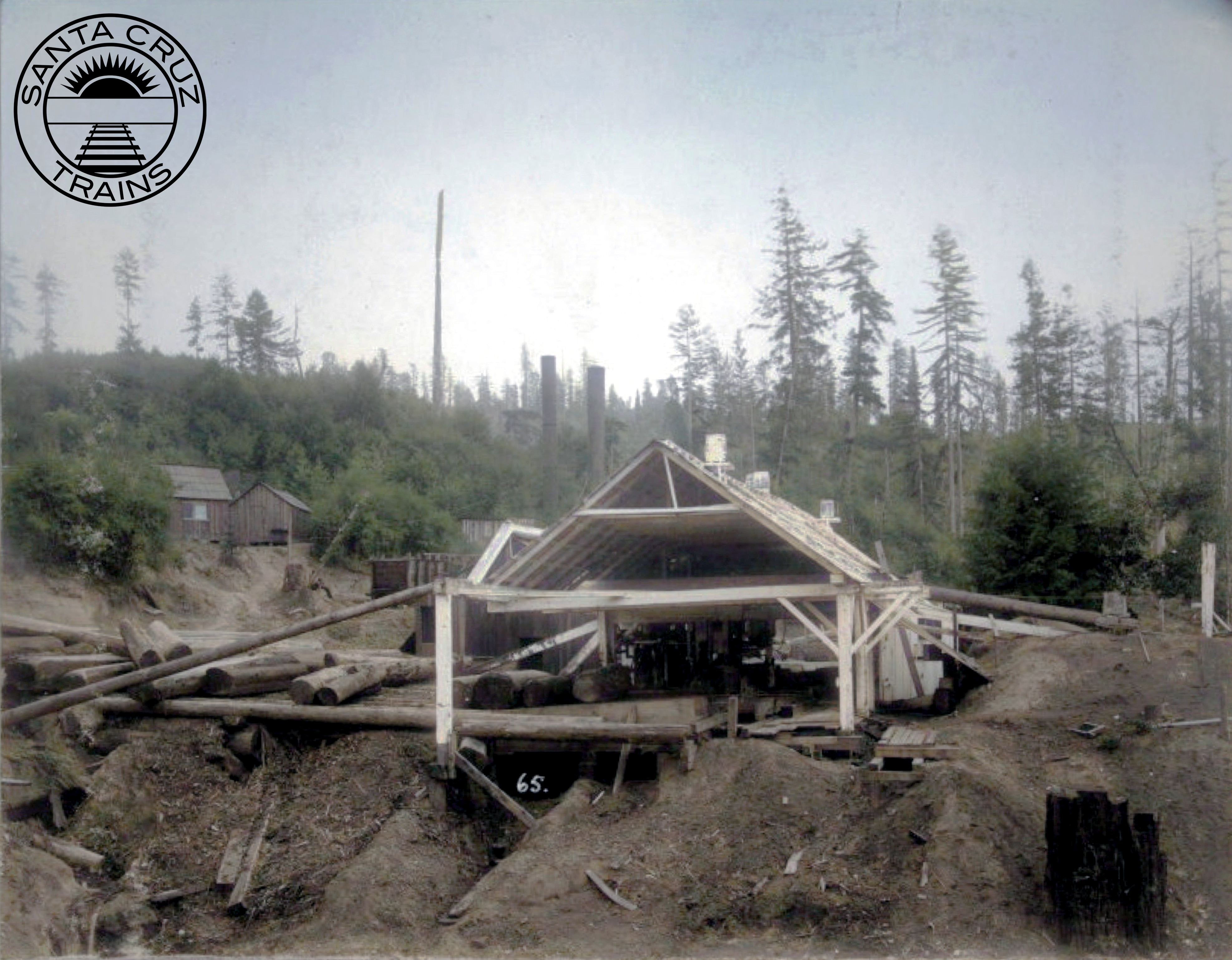
In late 1887, DeHart partnered with Edward White, an early resident of Watsonville, in purchasing milling equipment to erect a sawmill on Mt. Madonna near Watsonville. For the task, White had acquired two large lots encompassing Banks Canyon, through which Casserly Creek flows, located due east of the old toll road to San José, now Mt. Madonna Road. Today, this is located in the part of Mount Madonna County Park that was transferred from Santa Cruz County to Santa Clara County in 1971. The tracts had an estimated yield of 7,000,000 board feet of lumber and the mill, under the supervision of DeHart, had a capacity of 15,000 board feet per day. The partners specialized in splitstuff, such as shingles and shakes, and made fruit boxes for customers throughout the Central Coast. Success came quickly—they incorporated their business relationship on November 2, 1889 as the White & DeHart Company. Yet fears were mounting that most of the remaining old growth timber on the hills would soon be harvested, ending an industry that had helped put Watsonville on the map.

Advertisement for White & DeHart's lumber mill in the Salinas Daily Journal, published June 9, 1889.

After three years in Banks Canyon, White & DeHart relocated to the Thompson Tract at Mill Canyon near Casserly Ridge, about five miles from Watsonville. Mill crews worked fast to move the machinery and erect the new mill, finishing the job sometime in mid June 1891. Meanwhile, fellers in the surrounding forest cleared several acres in preparation for the first season at the new site. Despite two lucrative harvests, White & DeHart’s second mill shut down permanently following the 1892 season due to lack of available timber.

Sanborn Fire Insurance plan showing the original layout of the White & DeHart Company's box factory on Walker Street before improvements and expansion, 1902. [Library of Congress]

Without timber to harvest and with a slumped lumber market, the partners pivoted to box-making for all of the fruit growers in the Pajaro Valley. They leased property on Walker Street near the Southern Pacific Railroad’s Watsonville Depot and built a box factory and feed mill. The mill produced a wide range of agricultural products, including fruit boxes, berry crates, and baskets, as well as a small production of lumber and feed. During the busy months, up to fifty people were employed to make tens of thousands of baskets and boxes a day. Without a direct source of timber, the company relied on redwood and pine imported from elsewhere in California for its products.

Advertisement for White & DeHart Company's box factory in The Pajaronian, published October 5, 1893.

After a six season hiatus, White & DeHart returned to milling in February 1899 and purchased stumpage rights to M. J. Hughes’ property on Rancho Salsipuedes along Hughes Creek, which the firm estimated had about 3,000,000 board feet of lumber. The narrow canyon, located about midway between the company’s previous two mills, would take no more than two seasons to harvest and the difficulty of moving a mill to the site for such a small return led the partners to focus primarily on extracting splitstuff to construct their boxes. Earlier, in November 1896, the partners had reincorporated, possibly in preparation for Edward White’s departure in 1899. White had worked with DeHart for over a decade but sold his interest to his partner, who in turn made his son, Joseph, secretary of the firm.

Sanborn Fire Insurance map showing the full extent of the White & DeHart Company box mill on Walker Street following expansions, October 1908 (updated 1911). [UC Santa Cruz]

Under the control of the DeHart family, the company expanded quickly and purchased five adjacent lots around 1900 to support its operations. The box mill vastly increased its output to support the rapidly-growing apple trade. The feed mill was moved to a new two-story building with storage for 15,000 sacks of grain. The small lumber mill on site was completely overhauled and its equipment replaced with higher capacity and heavier duty machinery. Another two-story building was devoted exclusively to manufacturing berry baskets and storing apple boxes. And at the back of the property, a blacksmith shop continuously produced wire, nails, and other material required for the factory. The company kept its corporate office on Second Street beside the mill and several staff cottages were located on nearby streets to lessen the commute.

On May 13, 1904, White and DeHart reunited as directors of the Hatfield Lumber Company alongside D. W. Johnston, J. W. Forgeus, and William J. McGrath. The group had acquired an untouched tract of redwoods on Hatfield Creek, a tributary of Pescadero Creek north of Chittenden on lands owned by the Casserly and Kelly families. Despite assurances in The Pajaronian that the firm was separate from White & DeHart, the editor clarified that the firm “will cut, haul and saw the logs for the Hatfield company,” suggesting a close relationship. By early June, the company was already contracted to ship 100 carloads of lumber, with a new 689-foot-long spur installed beside the Southern Pacific station at Chittenden. Most of the cut timber was taken to the White & DeHart box factory in Watsonville where it was turned into lumber. It then went to a newly-built Santa Clara Valley Mill & Lumber Company yard in Watsonville to be sold.

Hatfield Lumber appears to have initially met with bad luck early in its operation. A forest fire in early November burned its way through Pescadero Creek canyon, damaging equipment and ruining timber. The area was severely impacted in 1906 by the earthquake, as well, with the San Andreas fault passing almost directly through the canyon. High demand for lumber from the people of San Francisco, however, led the company to resume operations in March 1907 on Hatfield Creek. White & DeHart built a 30,000 board feet capacity sawmill near Chittenden station, thereby eliminating the need to ship logs to Watsonville on flatcars. The first commercial load was sent to Watsonville on July 4, 1907.

A rift formed at Chittenden near Soda Lake with the southern Santa Cruz Mountains in the distance, 1906. Photo by Harold W. Fairbanks. [UC Berkley, Bancroft Library – colorized using MyHeritage]

Operations on Hatfield Creek and elsewhere on Pescadero Creek continued with only minor problems for the next three seasons. In 1908, the Independent Lumber Company purchased most of the lumber for sale at its yard in Pajaro, with the remaining timber sent to the Santa Clara Valley Mill & Lumber Company yard in San José. Operations along Hatfield Creek ended in November 1909 with insufficient timber left to justify another season. DeHart dismantled the mill and shipped the mill and remaining lumber to Watsonville. Hatfield continued to cut splitstuff on the property for two more years, with White & DeHart taking over from December 1911. Nonetheless, the closure of the lumber mill signalled the end of large-scale logging at the southernmost end of the Santa Cruz Mountains.

The White & DeHart Company lingered a few more years at its Walker Street location. Tragedy struck the DeHart family in July 1914 when Joseph DeHart, secretary and son of William, died of a lung infection. The next year, a fire broke out on August 5 and rapidly consumed the company’s box factory. DeHart did not rebuild and allowed the business to lapse in February 1924. The property was purchased by the Pajaro Valley Cold Storage Company around 1919. The company’s tracts on Pescadero Creek, taken over by White & DeHart from the Hatfield company sometime in the early 1910s, were leased to the Mohawk Oil Company for drilling and prospecting in 1920. William DeHart died on May 20, 1928 at his home in Watsonville. Edward White, meanwhile, became the Commissioner for Immigration under President Woodrow Wilson in 1914 and was dismissed by President Warren Harding in 1923. He died in San Francisco on May 17,1931 at the age of 80.

Citations & Credits:

  • Clark, Donald Thomas. Santa Cruz County Place Names: A Geographical Dictionary, Second Edition. Scotts Valley, CA Kestrel Press, 2008.
  • Guinn, James Miller. History of the State of California and Biographical Record of Santa Cruz, San Benito, Monterey and San Luis Obispo Counties. Chicago Chapman Publishing, 1903.
  • Hatch, Andrew J. "Official Map of Santa Cruz County." A. J. Hatch: San Francisco, 1889.
  • Southern Pacific Railroad Company. Miscellaneous records.
  • Various articles from the Pajaronian, Salinas Daily Journal, San Benito Advance, San Juan Mission News, Santa Cruz Evening News, Santa Cruz Sentinel, and Santa Cruz Surf.

Thursday, April 24, 2025

Curiosities: Stagecoach Lines

Before the arrival of the railroad to the Monterey Bay, people used other modes of transportation to traverse the Santa Cruz Mountains and reach San Francisco. For some, the primary methods were steamships that traveled up and down the California coastline. For others, the security of solid ground led them to choose the stagecoaches that regularly crossed the mountains. In the 1850s and early 1860s, stage travel was almost exclusively via Watsonville, San Juan, Gilroy, and Santa Clara, but the completion of the San Francisco and San Jose Railroad in January 1864 made the prospect of a shorter route directly from Santa Cruz to San José more promising.

An example of a six-horse Concord stage, at New Almaden, 1896. Courtesy Laurence E. Bulmore Collection, History San José – colorized using MyHeritage]

By 1860, a turnpike ran from Los Gatos to the Summit, which prompted Santa Cruz locals to invest in two rival turnpikes on the Santa Cruz County side. The older one, operated by Charles “Mountain Charlie” McKiernan and Hyram Scott, meandered down the Summit via Bean Creek and Branciforte Creek. The other followed Soquel Creek to Soquel and then continued along the county road to Santa Cruz. The earliest known stagecoach drivers to run on these roads were H. W. Pope and a Mr. Rockefeller. William H. Hall, owner of a San José stage line, soon hired both drivers and set the cost of travel at $5.00 per passenger. The slightly shorter distance and the higher patronage led to the abandonment of the Soquel Turnpike and its conversion into a free road, with little public funding to maintain it. Stages left Santa Cruz three days a week at 1 a.m. to meet the steamer Sophie McLean at Alviso, where it would transport passengers for San Francisco.

Stereograph of the Pacific Ocean House in Santa Cruz, with a buggy and 4-horse Concord stagecoach outside, 1866. Photography by Lawrence and Houseworth. [Courtesy California State Library – colorized using MyHeritage]

The completion of the San Francisco and San Jose Railroad caused Hall to rethink his business. Why take a steamer from Alviso to San Francisco when you could take the train? George T. Bromley saw the potential of such a relationship. In 1865, Bromley had served as the manager of the Continental Hotel on Market Street in San José. This brought him into regular contact with railroad customers traveling between San Francisco and San José, and also presumably with people wishing to continue over the mountains to Santa Cruz, where ocean swimming in the summer months was beginning to take off and walks through the redwoods were all the rage. His position as a successful proprietor caught the interest of influential people in Santa Cruz, who hired him in March 1866 to become the first manager of the Pacific Ocean House on Pacific Avenue. The hotel opened on April 4 with a grand ball attended by all of the city’s elite.

Advertisement for the San Jose Stage Line, published in the Santa Cruz Sentinel March 2, 1867.

The difficulty remained bringing people to Santa Cruz, and although Bromley claimed that the hotel was never in want of customers, he still saw the potential of a stage line. He worked with Hall and William Reynolds of the Auzerais House in San José to organize the San Jose Stage Line, which would use the Pacific Ocean House as its southern terminus. Reynolds acquired three Concord coaches for the line and 40 horses, divided into nine teams of six each, plus spares, which would be stationed at waypoints along the line to ensure no horse became overworked on the run. For those seeking higher class accommodation on the journey, Reynolds also contracted with local coach suppliers to rent higher-quality coaches. Service began in mid-February 1867. Coaches left Santa Cruz daily at 7:30 a.m. for Santa Clara or San José, where passengers would meet the 6:00 p.m. train to San Francisco. Through fare was set at $5.00 for First Class travel on the train, or $3.00 for Second Class, with a set amount of $3.00 for travel via stage just to San José or Santa Clara.

Advertisement for the San Jose Stage Line, published in the Santa Cruz Sentinel May 4, 1867.

On May 1, the line was rebranded the San Francisco and Santa Cruz Railroad and Stage Line. Two coaches now traveled daily in each direction across the Summit. Coaches in Santa Clara received passengers from the 8:10 a.m. train and brought them to Santa Cruz by 5:30 p.m. Passengers heading the opposite direction caught the stage at the Pacific Ocean House at 9:00 a.m. and arrived in time for the 4:00 p.m. train in Santa Clara. An advertisement on May 4 noted that the ticket agent at the Santa Clara railroad depot was H. D. Polhemus, while the agent in San Francisco in the General Stage Office was William G. Roberts. Although the names of most of the drivers are unknown, the Sentinel noted in February 1868 that George Heller was a cautious and responsible driver.

The Pacific Ocean House passed through several owners from November 1867 throughout 1868, but Hall remained owner and Reynolds superintendent of the stage line. The business, however, appears to have suffered over the year and likely shut down for an extended period over the winter. Service resumed in May, but Hall allowed the reputation of the business to deteriorate. Reynolds became injured at some point and Hall took direct leadership over the firm, during which time several accidents occurred and customer satisfaction reached an all-time low. No longer interested in running the company, Hall sold the firm for $10,000 in December 1869 to William E. McFarland, an experienced stagecoach driver and manager.

Advertisement for the San Francisco, San Jose and Santa Cruz Railroad and Stage Line, published in the Santa Cruz Sentinel December 11, 1869.

McFarland restored the company’s relationships with the San Francisco and San Jose Railroad and the Pacific Ocean House, via its new proprietor Henry Skinner, and renamed the company the San Francisco, San Jose and Santa Cruz Railroad and Stage Line. Regular service resumed immediately under the capable hands of David R. Green and Con. R. De Nise. In April 1870, a half interest in the firm was acquired by a W. J. Conner, formerly of the Watsonville Stage Company.

Advertisement for the Stage and Express Company, published in the Santa Cruz Sentinel June 3, 1871.

As McFarland’s company was finding its footing, a rival appeared on January 8, 1870. This new firm was formally incorporated as the Santa Cruz and San Jose Stage and Express Company, a joint stock company, in May. The company hired as its drivers Heller and Silas Cambridge, two “old and experienced stagemen” who “have never met with an accident, are temperate men, and faithful to their profession.” Henry Whinnery served as superintendent of the line, with S. A. Bartlett appointed president and Edward Bender secretary. McFarland’s line ceased operating in October 1870, likely for the winter season, but it never resumed and appears to have been acquired by its rival. In a notice regarding delinquent subscribers to the Stage and Express Company published in the Sentinel in March 1871, McFarland is named, suggesting he had thrown in with the competition. Other subscribers included Hyram Scott, Charles McKiernan, and the Porter brothers. At a meeting on August 12, McKiernan replaced Bartlett as president and Peter Hinds took over for Whinery as superintendent.

Advertisement for Paddack's Opposition Stage Line, published in the Santa Cruz Sentinel January 28, 1871.

Opposition to the Stage and Express Company arose in early January 1871 from Isaac E. Paddack, owner of the hotel in Lexington. Tired of the high prices charged by the stage line, he purchased 29 horses and a few Concord coaches and began running Paddack’s Opposition Stage Line between Santa Cruz and Santa Clara via the Soquel Turnpike. He hired as drivers Josh W. Gray and Tom Mann, who both had worked for trans-mountain stage lines in the past. Paddack’s plan worked—by the end of the month, the Stage and Express Company had ceased running passenger coaches over the hill. The situation was resolved quickly, though, when Hall returned to the business a third time and purchased both lines in early February. The Opposition line survived under that name until April 1, when all advertisements for any stage service disappeared from Santa Cruz newspapers.

Advertisement for the Watsonville Stage Company, published in The Pajaronian March 3, 1870.

There was less drama between the stagecoach lines that ran between Santa Cruz and Watsonville. In the early years, this route was the only feasible means of traveling from Santa Cruz to San Francisco until steamships almost entirely displaced this method of travel in the late 1850s. Throughout the 1860s, ships and stagecoaches over the mountains negated the need for a Santa Cruz to Watsonville stage line, though one did exist. The Watsonville Stage Company, initially run by F. C. Adams, began service around 1861. By 1870, it ran stages to San Juan, Monterey, Salinas, and other locations in Monterey County. Gilroy, however, was the primary destination for travelers because it was there that the Santa Clara and Pajaro Valley Railroad ended from March 1869. W. J. Conner managed the company at this time.

Advertisement for the Watsonville Stage Company, published in the Santa Cruz Sentinel June 20, 1874.

In December 1870, the Watsonville Stage Company was reincorporated under the same name, with ownership passing to H. F. Jackson, A. W. Billings, and W. T. Warren. On November 27, 1871, the Southern Pacific Railroad reached Pajaro. Tom Sutton was the best-known driver on the line and its popularity earned it the nickname “The People’s Line.” A. J. Jennings served as both Pajaro Depot agent and secretary of the firm. A stakeholder, Scott & Company, took sole control in April 1873, at which time the Pacific Ocean House became the Santa Cruz agency for the company.

Advertisement for the Santa Cruz Railroad Stage Line, published in the Watsonville Pajaronian April 15, 1875.

In March 1874, an opposition line, capitalizing on the popularity of the railroad, was formed named the Santa Cruz Railroad Stage Company. The Pajaronian only mentioned one driver for this line, Syd Conover. The stage left from the St. Charles Hotel in Santa Cruz at 7:30 a.m. daily to meet with the morning north- and southbound trains, and would return in the afternoon upon the arrival of the late train from San Francisco. Through tickets from Santa Cruz to San Francisco were available at the hotel from the company’s office. The presence of rival lines kept prices down but there simply was not enough traffic to warrant both lines. In mid-April 1875, the Santa Cruz Railroad Stage Company and the Watsonville Stage Company were purchased by Danforth Porter, who merged them into one service. He continued running stages until May 1876 when the completed Santa Cruz Railroad rendered the stage service unnecessary.

Advertisement for the Pioneer Stage Company, published in the Santa Cruz Sentinel September 2, 1871.

The completion of the railroad to Pajaro and the stages that connected Santa Cruz to Pajaro briefly stole the thunder from the trans-mountain stage line and forced it to lower costs and reduce frequence. Nevertheless, people still wanted a line through the mountains. In August 1871, McFarland joined with George L. Colgrove (or Colegrove), a driver on one of the old lines, and J. B. Crandall, a veteran of California staging, to form the Pioneer Stage Company. While lacking a relationship with the Southern Pacific Railroad, the new company put up a fierce competition. They ran their stages over the Soquel Turnpike rather than Mountain Charlie’s toll road, and operated out of the Santa Cruz House and the New York Exchange Hotel in San José. Tickets were set at one dollar. In January 1872, George Colgrove & Company took over management of the Stage and Express Company and the two businesses combined, running as the Pioneer Stage and Express Company. The Pacific Ocean House, still run by Skinner, became the southern terminus with stops at Paddack’s hotel for dinner on all northbound stages. The business also acquired the United States Mail contract for the Summit and Scott’s Valley.

Advertisement for the Pioneer Stage and Express Company, published in the Santa Cruz Sentinel June 20, 1874.

Colgrove’s business remained steady for the next eight years. He and his partner and co-driver, H. Ward, used three Troy coaches, an older and smaller style more suitable to narrow mountain roads with tight turns. The route shifted over the years. In 1873 after the merger, it turned to Mountain Charlie’s toll road. Then, in March 1875, the partners began a second route from Felton to Santa Clara via Boulder Creek and Lexington, with the main route moving back to Soquel and then running to Patchen on the Summit and Alma, before joining at Lexington with the other route. They abandoned this ambitious dual system in September due to low ridership and reverted to the Mountain Charlie route. Around this time, Colgrove hired another driver, John Dowd, he remained with the company until the end.

Advertisement for the Pioneer Stage and Express Company, published in the Santa Cruz Sentinel August 24, 1878.

Advertisements for the Pioneer Stage Line disappeared after June 3, 1876, but service continued nonetheless. Late in the same month, Ward and Colgrove supplemented their usual coaches with pleasure carriages, more akin to railroad cars than traditional stagecoaches, though less weather resistant. These allowed passengers a broad view of the scenic landscape as they meandered through the Santa Cruz Mountains. On June 1, 1878, the company shifted its northern station to Los Gatos, where the South Pacific Coast Railroad had established its southern terminus as construction began through the mountains. Colgrove worked closely with railroad management to turn his stage line into a replacement service for the incomplete section of track, running dual stages to Santa Cruz and Soquel. Ward had left the business by this time and Chris C. Coffin had taken over as co-owner and driver.

Advertisement for the Pioneer Stage and Express Company, published in the Santa Cruz Sentinel April 26, 1879.

The company shifted its terminus further south to Alma House near Lexington in August, and then moved it to Wright’s Station in April 1879, thereby making the travel time between San Francisco and Santa Cruz only six hours. All coaches ran via Soquel after this point due to the terminus’s closer proximity to the Soquel Turnpike. This would be the last change in the route for the Pioneer Stage Line. With the impending completion of the South Pacific Coast Railroad in May 1880, Coffin sold his stock and left the company. Colgrove, meanwhile, became a conductor for the railroad. The last regular stagecoach over the mountains ran on May 14, 1880, after which the only scheduled service left in Santa Cruz County was the regular stage to Pescadero.

Citations & Credits:

  • Various articles from the Pacific Sentinel, Santa Cruz Sentinel, and Watsonville Pajaronian, 1857–1880

Friday, July 26, 2024

Infrastructure: Wyes

A wye is a common railroad track feature that can serve several different purposes. Usually triangular or Y-shaped, hence the name, the primary purpose of a wye is to allow a locomotive to reverse its orientation without the need of a turntable. Wyes can often be formed via the junction of three railroad branches or spurs, allowing trains coming from any direction to head in any direction. The benefit of a wye over a turntable is that it requires little more maintenance than a normal track switch and does not rely on a manual or mechanical turntable. The main downside is that a wye takes substantially more space than a turntable, especially if it includes a long spur to allow an entire train to reverse direction, as is sometimes the case. As a result, wyes can vary in size from relatively compact to encompassing an entire freight yard.

An excursion train returning from Davenport on the northwest leg of the Santa Cruz wye, July 21, 1951.
Photograph by Wilbur C. Whittaker. [Jim Vail – colorized using DeOldify]

The railroads of Santa Cruz County and the Santa Cruz Mountains have featured several wyes, though they were a later addition to local lines. None of the early narrow-gauge common carriers used wyes—they preferred turntables because they were more cost-effective and took substantially less space. Smaller locomotives were also easier to manually rotate on turntables than their larger brethren. There was also the issue of compatibility and competition. The Santa Cruz & Felton Railroad and Santa Cruz Railroad were rivals and did not have any formal connection between their lines, despite being the same gauge. Furthermore, both of their lines were linear, so only needed turntables at either end. This remained the case when the Santa Cruz & Felton Railroad was taken over by the South Pacific Coast Railroad in 1879. On the other side of the county, the narrow-gauge Santa Cruz Railroad was incompatible with the standard-gauge Southern Pacific tracks in Pajaro, so there was no opportunity to create a wye until the Santa Cruz Railroad was standard-gauged in 1883.

Aerial photograph of the Watsonville Junction freight yard with its wye, 1935. [UC Santa Cruz]

With the standard-gauging of the Santa Cruz Railroad, the first wye in the region was installed at Pajaro, later Watsonville Junction. This remains to this day the largest and most important wye in the region, switching trains between the Union Pacific Railroad's coastal track between San José and Salinas with trains from the Santa Cruz Branch Rail Line. The region's second wye may have been built as early as 1884, when the Loma Prieta Branch was constructed up Aptos Creek. However, the branch also had a turntable until some point before 1908, so it is possible that the wye replaced an earlier turntable between 1900, when Loma Prieta Station was closed, and 1908. This wye was located in Aptos across from the depot on the County Road (Soquel Drive), where a small yard was built to allow trains to move between the Loma Prieta Branch and the Santa Cruz Branch. It was bisected by the F. A. Hihn Company's apple warehouse spur, which also hosted the station's freight platform.

Sanborn Fire Insurance map showing the Aptos wye, 1908. [Library of Congress]

The largest wave of wye construction in the region happened between 1906 and 1909. During this time, a rivalry erupted between the upstart Ocean Shore Railway and the entrenched Southern Pacific Railroad. Along the coast, the Ocean Shore began building a route between San Francisco and Santa Cruz. In Santa Cruz, the company installed a wye within its maintenance yard paralleling Laguna Street on the West Side. North of Davenport, it built a second wye in 1907 at a place named Folger on the south bank of Scott Creek. This was intended to be a temporary turning point for trains until the route north was completed, which never happened. As such, two of its corners were stub spurs that only had enough space for the locomotive and tender to reverse. However, in 1908, the northeast corner of the wye was extended to Swanton to allow rail access to the San Vicente Lumber Company's timber holdings on Little Creek.

Aerial photograph showing the Davenport wye, 1928. [UC Santa Cruz]

Meanwhile, the Southern Pacific Railroad's Coast Line Railroad subsidiary built a wye at the Santa Cruz Union Depot. This was constructed for practical reasons rather than necessity—Santa Cruz already had a large mechanical turntable, but the wye allowed trains coming from Davenport to head either north through the Santa Cruz Mountains to the Bay Area or south to Salinas and Los Angeles. In Davenport, just north of the Santa Cruz Portland Cement Company refinery, a smaller wye was built to allow locomotives to turn around. Unlike all the other wyes in the region, this one never served any other purpose and included two stub spurs to allow the turning of the locomotive. At the same time Southern Pacific was building these wyes, they also built a wye at Vasona near Campbell to allow trains from Santa Cruz to take the Los Altos Branch (Mayfield Cut-off) to go directly to San Francisco, bypassing San José.

The southern leg of the Vasona Junction wye, circa 1958. [Charles Givens]

Further south, the Pajaro Valley Consolidated Railroad featured the region's only narrow-gauge wye at Moss Landing, which allowed sugar beet trains coming from both Watsonville and Salinas to collect or drop off freight at the seaport. The Southern Pacific Railroad, meanwhile, once had a wye at Castroville—or rather Del Monte Junction—allowing trains from the north and south to turn down the Monterey Branch. The Monterey Branch itself did not feature any wyes but it did host the region's only balloon loop track at Fort Ord. Much like a wye, a balloon loop allows a locomotive or train to reorient itself in the opposite direction. Such a feature typically takes even more physical space than a wye but only requires one switch and is designed to reposition an entire train, thereby simplifying the reversing process.

Aerial photograph of the Moss Landing wye, 1931. [UC Santa Cruz]

Gradually, all of the region's wyes have been disestablished with the exception of those at Santa Cruz and Watsonville Junction, both of which remain in regular use. The Ocean Shore Railroad's wyes were removed no later than 1923, when the entire Southern Division was disestablished and demolished. The Aptos wye was removed around 1928 when the Loma Prieta Branch was abandoned. The Davenport Branch was probably removed in the 1950s or 1960s once diesel locomotives allowed the trains to more easily reverse along the entire 11-mile Davenport Branch. Vasona Junction's wye was decommissioned in January 1964 when the Los Altos Branch was cut back and became the Permanente spur. More recently, the Watsonville Junction yard was reconfigured dramatically and reduced in size. As a result, the outer track of the wye that crossed Salinas Road to the west was removed and a new track installed through the center of the yard through the former site of the roundhouse, thereby creating a tighter wye.

Aerial photograph of the Santa Cruz wye and freight yard, 1931. [UC Santa Cruz]

There is still one last wye, as well as two more loops, in Santa Cruz County. Roaring Camp & Big Trees Railroad, a tourist excursion train service that runs up Bear Mountain in Felton, includes a wye just beside the park entrance, wrapping around the pump house. Furthermore, the main track wraps around the recreated town and picnic grounds, creating a loop that allows narrow-gauge steam trains to reverse direction and climb up the mountain. Similarly at the top of the mountain, a loop wraps around the upper picnic area at the summit, reorienting trains so they can properly descend the mountain. In contrast to Roaring Camp's route, all of the miniature railroads in the region have relied on turntables or loops to reverse their engines.

Southern Pacific Railroad (Monterey Bay and Santa Cruz Mountains):

The Ocean Shore Railway (Southern Division):
The Pajaro Valley Consolidated Railroad:
Roaring Camp & Big Trees Narrow-Gauge Railroad:

Thursday, June 8, 2023

Companies: Union Mill & Lumber Company

The story of the Union Mill & Lumber Company shares its origin with the Alpine Lumber Company in that both began with Hubbard Wilson McKoy, an early settler in the Felton area. In 1871, McKoy’s daughter Sierra Nevada married the bartender of his Felton Hotel, Thomas Benton Hubbard. This link soon brought their two families into business together, prompting seventeen years of collaboration.

Hubbard & Carmichael Bros. mill on Oil Creek, one of the headwaters of Pescadero Creek, late 1890s. [UC Santa Cruz Digital Collections – colorized using MyHeritage]

The Hubbard family had migrated from Missouri and were led by Thomas’s father, Daniel Campbell Hubbard, who went into business with McKoy in 1875. The following year, Thomas began working at George Treat’s mill near the toll house south of Felton, giving him both experience in the industry and a connection with an influential local capitalist. On September 5, 1876, Thomas joined McKoy to form McKoy & Hubbard. For the next three years, the partners ran a mill north of Felton on the line of the San Lorenzo Valley Flume. During this time, they owned a lumber yard near the Railroad Wharf and briefly partnered with Nathaniel Manson and Charles Cummins of Lompoc, operating together as the Santa Cruz Lumber Company. But Manson, Cummins, and Hubbard all wanted more direct control over their operations and eventually went their separate ways in spring 1879.

H. W. McKoy's Central Hotel in Felton, mid-1870s. [UC Santa Cruz Digital Collections – colorized using MyHeritage]

Hubbard soon joined forces with another son-in-law of McKoy, Isaac Newton Hayes, and together they purchased stumpage rights to the lands of H. E. Makinney and T. H. Peterson on Marshall Creek in a gulch soon named after Hubbard. Their mill opened the week of May 22, 1880, and was placed under the management of veteran lumbermen Joseph W. Peery and J. W. Basham. At the end of the year, Hubbard was appointed to the Santa Cruz County Board of Supervisors to replace James F. Cunningham, who had resigned his post. Despite his unexpected shift into local politics, he remained focused on his lumber projects.

Hayes & Hubbard's mill on Marshall Creek, ca 1881. [UC Santa Cruz Digital Collections – colorized using MyHeritage]

In May 1881, Hayes & Hubbard sold its mill on Marshall Creek to the Independent Lumber Company of San José, which planned to run the mill until the end of the summer and then relocate the machinery to Soquel Creek. Only two months later, Hubbard partnered with David Lynd Kent, William Armstrong, Isaac B. Kent, and Nathan Robbins Bowes to incorporate the Union Mill & Lumber Company. That same month, the firm opened its first mill a quarter mile upstream of Hubbard’s previous mill. Joe Nichols oversaw construction of the new facility, which had a capacity of 20,000 board feet of lumber per day. The mill opened the last week of August and employed 30 to 40 people.

D. L. Kent's General Merchandise store in Felton, ca 1880. [UC Santa Cruz Digital Collections – colorized using MyHeritage]

Union Mill’s operations in Hubbard Gulch lasted for three seasons. During that time, the mill ran at peak efficiency but the San Lorenzo Valley Flume could not handle its increased output, so the company was forced to transport lumber to Felton by wagon on the County Road (Highway 9). Once in Felton, it was loaded onto waiting South Pacific Coast Railroad flatcars. This was an inefficient system, one that the company hoped to avoid at its next venue. In February 1883, the company bought 400 acres of timberland along Lompico Creek from Peter C. Van Allen for $6,000.

While its Hubbard Gulch mill ran for one last season, the Union Mill & Lumber Company set up a new facility near the confluence of Lompico Creek and Zayante Creek using machinery purchased from the late William Waddell’s defunct mill near Point Año Nuevo. Construction was slow, particularly because the basin was extremely narrow. Crews used this to their advantage and installed a 35-foot-high dam that allowed the millpond to snake up the creek for half a mile. At the top of this, they installed a 330-foot-long canal, which served as a catchment for logs pulled or lowered from above. Once completed, the mill had a capacity of 50,000 board feet of lumber per day, more than double the output of the Hubbard Gulch mill. Probably in early autumn 1884, the South Pacific Coast Railroad extended a 0.4-mile-long narrow-gauge spur to the mill. Ownership and maintenance of the track was split between the lumber company and the railroad, with Zayante Road marking the dividing line. Empty cars were lowered to the mill using gravity and brakes, while horses pulled loaded cars up to the railroad grade. An access road was extended from the mill to Zayante Road in September 1884, and the mill was ready for operation in October.

Sanborn Fire Insurance map of downtown Felton, showing the dilapidated Union Mill & Lumber Company's planing mill between the end of the Old Felton Branch of the South Pacific Coast Railway and the San Lorenzo River, 1895. [Library of Congress]

Around the same time the Lompico mill was being erected, the Union Mill & Lumber Company also erected a planing mill behind the old Santa Cruz & Felton Railroad’s freight depot on the west side of the San Lorenzo River. The steam-powered facility had a capacity of 8,000 board feet of lumber per day, and, in May 1884, it shipped five carloads of wood products every day. This planing mill was responsible for processing rough lumber, splitstuff, and other wood products that could not be manufactured at the Lompico site.

Fellers and piecemakers of the Union Mill & Lumber Company posing around a felled tree above Lompico Creek, ca 1886. [UC Santa Cruz Digital Collections – colorized using MyHeritage]

A Sentinel reporter visited the Lompico mill in October 1885 and reported on the operations there:

This mill is running light at present, with a force of twenty-five men, and turns out about 12,000 feet of lumber per day, though its full capacity is 50,000 feet. This mill can boast of having the largest engine used in any saw-mill in the country, being one hundred horse-power. The system of bringing logs from the woods is different from all other mills in this part of the State, and has resulted in a great saving to the company, who formerly used sixteen yoke of oxen, while at present only four yoke are engaged in hauling the logs to a dam on the Lumbago creek, down which they are floated to within about one hundred feet of the mill, when they are attached to a chain and pulled by the huge engine to the saw. It is very interesting to watch this process, which is a well contrived plan and a much more rapid means of moving logs than was the old system.

Most of the wood products produced at the mill were sent to San José, where Hubbard moved in January 1885 to work as the primary sales agent for the Bay Area.

On January 20, 1886, there was a change in leadership at the Union Mill & Lumber Company when H. W. McKoy was elected president. McKoy had spent the previous three years running the Central Hotel in Felton, but he had been a principal an investor in the lumber company when it first formed five years earlier. As president, he moved to San José and took over the company’s yard there. He only remained in his position for two years, however. In January 1888, he sold his shares in the company and permanently left the lumber industry. He returned to running his hotel until a fire on October 20, 1889, burned much of Felton to the ground. He rebuilt, christening the new structure the Grand Central Hotel, and continued to run the hostelry until his death on August 22, 1895.

Not long after McKoy took over the Union Mill & Lumber Company, the firm acquired 356 acres of additional land in the Lompico basin from the estate of Charles McLaughlin via a judicial ruling. This solidified the company’s hold over the timber in the Lompico Creek basin. The next year, in July 1887, the company announced plans to build a new mill on San Pedro Street in San José for $32,000. There is some evidence to suggest that it was actually built. The company also acquired timberland four miles north of Boulder Creek and was operating a mill there in March 1887, though no further details of this operation can be found.

Hubbard’s relationship with the company after this point becomes murky, primarily because local newspapers had a habit of blurring the names of local businesses with the names of their owners. What is clear is that Hubbard was likely in charge of the planing mill in Felton during this time. That planing mill was scheduled to relocate to Lompico in March 1887, but it is unclear if it ever moved since it was still operating somewhere in Felton in February 1888. That same year in October, Hubbard entered into a new partnership with Daniel and Neil Carmichael of Saratoga to harvest timber along Oil Creek, a tributary of Pescadero Creek at the northernmost point of Santa Cruz County.

Hubbard & Carmichael Bros. first mill on Oil Creek, ca 1890. [Santa Cruz Public Libraries – colorized using MyHeritage]

The Union Mill & Lumber Company must have gone inactive at around this time since the Sentinel notes that Hubbard & Carmichael Bros. relocated the Union Mill’s machinery to its new operation on Oil Creek prior to July 1890. Charles C. Smith is named as president of the Union Mill & Lumber Company in April 1889, but the firm is not mentioned against in newspapers after this date. It may have suffered during the economic downturn of 1893, which severely impacted the local lumber industry, and never recovered. What ultimately happened to the Union Mill & Lumber Company remains a mystery, but it was finally dissolved on December 14, 1905.

The former Union Mill on Union Creek within Big Basin, ca 1901. Photo by Andrew P. Hill. [History San José – colorized using MyHeritage]

The story of Hubbard and the physical remains of the Union Mill take different paths from this point. Hubbard & Carmichael Bros. sold the old mill structure and machinery to Henry L. Middleton in March 1895, who moved it to Little Basin northwest of Boulder Creek. Middleton employed around 40 workers at the mill during the three years that it operated there. He then moved the mill further north onto a 160-acre tract on today’s Union Creek within Big Basin that he harvested from 1898 to 1900 at a reduced capacity. This threat posed by this mill, along with a few others owned by Middleton, finally convinced the State of California to purchase land that would become the California Redwood Park in 1902. Following the sale, the mill was dismantled and removed to Boulder Creek in November. Joseph Grahamer later leased the site in 1904 and established the Union Mill Camp and Tavern, one of the earliest campgrounds at Big Basin. Unfortunately, the site was destroyed by fire on September 7, only a few months after it opened.

A Hubbard & Carmichael Bros. water wagon on Big Basin Road, ca 1901. Batista 'Bat' Mevin is driving. Photo by Andrew P. Hill. [History San José – colorized using MyHeritage]

Hubbard & Carmichael Bros., meanwhile, continued their operations on Oil Creek. The company may have closed the mill for a few years from 1893, which explains why the Union Mill was sold to Middleton during this time. When business resumed around 1896, the partners shifted operations downstream of their original mill site into San Mateo County. The mill was moved 0.75 miles off Saratoga Gap to a clearing beside Oil Creek. To get the cut lumber and other wood products to the top of the ridge, where the lumber yard was located, the company built a funicular cable railroad, the first of its type in the county. Horses pulled wagons full of lumber from the mill to the bottom of the incline, where they were attached to a cable and hauled up the grade to the yard. Once in the yard, crews would load wagons and send the material off to Saratoga and San Jose. The mill at this time employed around 50 men and cut 20,000 board feet of lumber per day. The Oil Creek mill remained in operation at this site for at least two seasons.

The original Hubbard & Carmichael Bros. mill on West Santa Cruz Street in San José, mid-December 1901. [San José Daily Mercury – colorized using MyHeritage]

In January 1900, Hubbard & Carmichael Bros. opened a new retail mill and yard on West Santa Clara Street in San José. It would remain the most stable aspect of the firm for the next three decades. The mill on Oil Creek shut down after the 1899 season and relocated to the Morrell Ranch on Two Bar Creek. But it only remained there for two years, shifting back to a new site on Oil Creek in July 1902. The mill resumed using the funicular railroad to bring lumber to Saratoga Gap, but the company’s primary focus had shifted to the hillside west of the mill, with felled trees dragged via cable to the millpond below. Hubbard & Carmichael Bros. finally ended its operations on Oil Creek at the end of the 1905 season, after which it relocated to Waterman Creek just below the California Timber Company’s property.

Hubbard & Carmichael Bros. workers in San Jose celebrating 100% union membership, ca 1913 [San José State University – colorized using MyHeritage]

During this time and for at least two more decades, Hubbard & Carmichael Bros. became a pillar of the San José lumber scene. The company briefly incorporated as Carmichael Bros. on October 27,1909, perhaps reflecting changes to the firm caused by the San Francisco Earthquake. This entity went out of business on April 13, 1914. Yet four years later, the older Hubbard & Carmichael Bros. was reincorporated and remained a legal entity until December 18, 1944. Not unexpectedly, Thomas Hubbard did not live to see the final end of his lumber empire. He died on November 23, 1917, after which his son Albert L. Hubbard succeeded him as president of the firm. From his start as a bartender in the upstart hamlet of Felton, Thomas became over forty years one of the most prominent lumbermen in Santa Cruz and Santa Clara Counties, whose legacy lives on in the gulch named after him in Ben Lomond.

Citations & Credits:

  • California Office of the Secretary of State. bizfile Online.
  • San Jose Evening News and Herald. Various articles.
  • Santa Cruz Sentinel, Weekly Sentinel, Daily Sentinel, Morning Sentinel, and Evening Sentinel. Various articles.