Showing posts with label lumber companies. Show all posts

Thursday, July 24, 2025

Company: White and DeHart Company

Logging operations in the hills above Watsonville were a slower affair than similar harvesting efforts in the San Lorenzo Valley and along Aptos Creek and its tributaries. Yet that did not dissuade William “Bill” DeHart from giving the matter his full attention. DeHart moved to Santa Cruz County in 1869 after a colorful career in the U.S. Army and Marines during the Civil War. Following the war, he became a blacksmith in Vicksburg, Mississippi, bringing that trade with him to Whiskey Hill, now Freedom. In 1875, he bought a 160-acre farm and became an orchardist growing pears, apricots, and peaches. But the hills were calling.

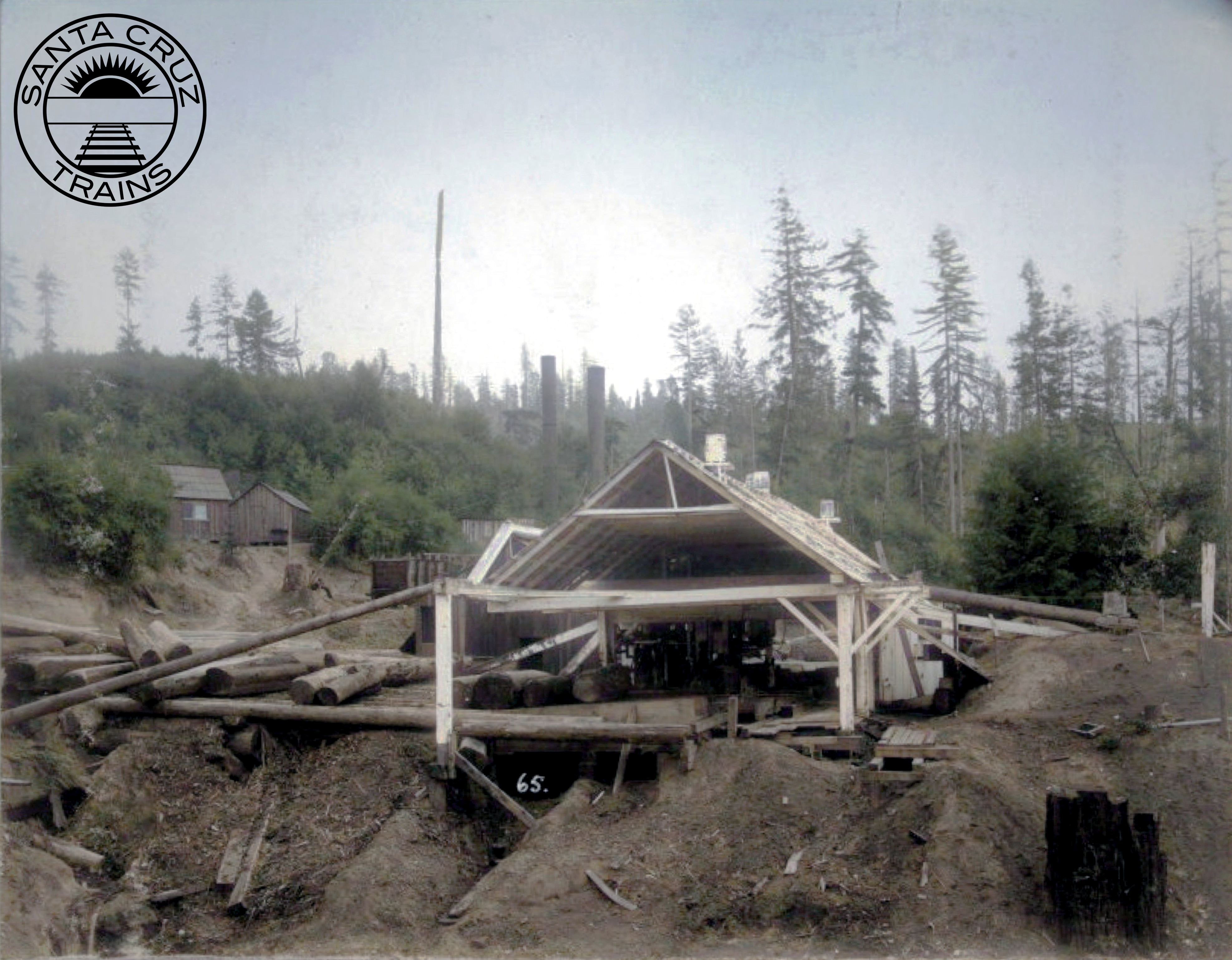
Unidentified lumber mill in the Santa Cruz Mountains, ca 1890. [University of California, Santa Cruz – colorized using MyHeritage]

In late 1887, DeHart partnered with Edward White, an early resident of Watsonville, in purchasing milling equipment to erect a sawmill on Mt. Madonna near Watsonville. For the task, White had acquired two large lots encompassing Banks Canyon, through which Casserly Creek flows, located due east of the old toll road to San José, now Mt. Madonna Road. Today, this is located in the part of Mount Madonna County Park that was transferred from Santa Cruz County to Santa Clara County in 1971. The tracts had an estimated yield of 7,000,000 board feet of lumber and the mill, under the supervision of DeHart, had a capacity of 15,000 board feet per day. The partners specialized in splitstuff, such as shingles and shakes, and made fruit boxes for customers throughout the Central Coast. Success came quickly—they incorporated their business relationship on November 2, 1889 as the White & DeHart Company. Yet fears were mounting that most of the remaining old growth timber on the hills would soon be harvested, ending an industry that had helped put Watsonville on the map.

Advertisement for White & DeHart's lumber mill in the Salinas Daily Journal, published June 9, 1889.

After three years in Banks Canyon, White & DeHart relocated to the Thompson Tract at Mill Canyon near Casserly Ridge, about five miles from Watsonville. Mill crews worked fast to move the machinery and erect the new mill, finishing the job sometime in mid June 1891. Meanwhile, fellers in the surrounding forest cleared several acres in preparation for the first season at the new site. Despite two lucrative harvests, White & DeHart’s second mill shut down permanently following the 1892 season due to lack of available timber.

Sanborn Fire Insurance plan showing the original layout of the White & DeHart Company's box factory on Walker Street before improvements and expansion, 1902. [Library of Congress]

Without timber to harvest and with a slumped lumber market, the partners pivoted to box-making for all of the fruit growers in the Pajaro Valley. They leased property on Walker Street near the Southern Pacific Railroad’s Watsonville Depot and built a box factory and feed mill. The mill produced a wide range of agricultural products, including fruit boxes, berry crates, and baskets, as well as a small production of lumber and feed. During the busy months, up to fifty people were employed to make tens of thousands of baskets and boxes a day. Without a direct source of timber, the company relied on redwood and pine imported from elsewhere in California for its products.

Advertisement for White & DeHart Company's box factory in The Pajaronian, published October 5, 1893.

After a six season hiatus, White & DeHart returned to milling in February 1899 and purchased stumpage rights to M. J. Hughes’ property on Rancho Salsipuedes along Hughes Creek, which the firm estimated had about 3,000,000 board feet of lumber. The narrow canyon, located about midway between the company’s previous two mills, would take no more than two seasons to harvest and the difficulty of moving a mill to the site for such a small return led the partners to focus primarily on extracting splitstuff to construct their boxes. Earlier, in November 1896, the partners had reincorporated, possibly in preparation for Edward White’s departure in 1899. White had worked with DeHart for over a decade but sold his interest to his partner, who in turn made his son, Joseph, secretary of the firm.

Sanborn Fire Insurance map showing the full extent of the White & DeHart Company box mill on Walker Street following expansions, October 1908 (updated 1911). [UC Santa Cruz]

Under the control of the DeHart family, the company expanded quickly and purchased five adjacent lots around 1900 to support its operations. The box mill vastly increased its output to support the rapidly-growing apple trade. The feed mill was moved to a new two-story building with storage for 15,000 sacks of grain. The small lumber mill on site was completely overhauled and its equipment replaced with higher capacity and heavier duty machinery. Another two-story building was devoted exclusively to manufacturing berry baskets and storing apple boxes. And at the back of the property, a blacksmith shop continuously produced wire, nails, and other material required for the factory. The company kept its corporate office on Second Street beside the mill and several staff cottages were located on nearby streets to lessen the commute.

On May 13, 1904, White and DeHart reunited as directors of the Hatfield Lumber Company alongside D. W. Johnston, J. W. Forgeus, and William J. McGrath. The group had acquired an untouched tract of redwoods on Hatfield Creek, a tributary of Pescadero Creek north of Chittenden on lands owned by the Casserly and Kelly families. Despite assurances in The Pajaronian that the firm was separate from White & DeHart, the editor clarified that the firm “will cut, haul and saw the logs for the Hatfield company,” suggesting a close relationship. By early June, the company was already contracted to ship 100 carloads of lumber, with a new 689-foot-long spur installed beside the Southern Pacific station at Chittenden. Most of the cut timber was taken to the White & DeHart box factory in Watsonville where it was turned into lumber. It then went to a newly-built Santa Clara Valley Mill & Lumber Company yard in Watsonville to be sold.

Hatfield Lumber appears to have initially met with bad luck early in its operation. A forest fire in early November burned its way through Pescadero Creek canyon, damaging equipment and ruining timber. The area was severely impacted in 1906 by the earthquake, as well, with the San Andreas fault passing almost directly through the canyon. High demand for lumber from the people of San Francisco, however, led the company to resume operations in March 1907 on Hatfield Creek. White & DeHart built a 30,000 board feet capacity sawmill near Chittenden station, thereby eliminating the need to ship logs to Watsonville on flatcars. The first commercial load was sent to Watsonville on July 4, 1907.

A rift formed at Chittenden near Soda Lake with the southern Santa Cruz Mountains in the distance, 1906. Photo by Harold W. Fairbanks. [UC Berkley, Bancroft Library – colorized using MyHeritage]

Operations on Hatfield Creek and elsewhere on Pescadero Creek continued with only minor problems for the next three seasons. In 1908, the Independent Lumber Company purchased most of the lumber for sale at its yard in Pajaro, with the remaining timber sent to the Santa Clara Valley Mill & Lumber Company yard in San José. Operations along Hatfield Creek ended in November 1909 with insufficient timber left to justify another season. DeHart dismantled the mill and shipped the mill and remaining lumber to Watsonville. Hatfield continued to cut splitstuff on the property for two more years, with White & DeHart taking over from December 1911. Nonetheless, the closure of the lumber mill signalled the end of large-scale logging at the southernmost end of the Santa Cruz Mountains.

The White & DeHart Company lingered a few more years at its Walker Street location. Tragedy struck the DeHart family in July 1914 when Joseph DeHart, secretary and son of William, died of a lung infection. The next year, a fire broke out on August 5 and rapidly consumed the company’s box factory. DeHart did not rebuild and allowed the business to lapse in February 1924. The property was purchased by the Pajaro Valley Cold Storage Company around 1919. The company’s tracts on Pescadero Creek, taken over by White & DeHart from the Hatfield company sometime in the early 1910s, were leased to the Mohawk Oil Company for drilling and prospecting in 1920. William DeHart died on May 20, 1928 at his home in Watsonville. Edward White, meanwhile, became the Commissioner for Immigration under President Woodrow Wilson in 1914 and was dismissed by President Warren Harding in 1923. He died in San Francisco on May 17,1931 at the age of 80.

Citations & Credits:

  • Clark, Donald Thomas. Santa Cruz County Place Names: A Geographical Dictionary, Second Edition. Scotts Valley, CA Kestrel Press, 2008.
  • Guinn, James Miller. History of the State of California and Biographical Record of Santa Cruz, San Benito, Monterey and San Luis Obispo Counties. Chicago Chapman Publishing, 1903.
  • Hatch, Andrew J. "Official Map of Santa Cruz County." A. J. Hatch: San Francisco, 1889.
  • Southern Pacific Railroad Company. Miscellaneous records.
  • Various articles from the Pajaronian, Salinas Daily Journal, San Benito Advance, San Juan Mission News, Santa Cruz Evening News, Santa Cruz Sentinel, and Santa Cruz Surf.

Thursday, June 8, 2023

Companies: Union Mill & Lumber Company

The story of the Union Mill & Lumber Company shares its origin with the Alpine Lumber Company in that both began with Hubbard Wilson McKoy, an early settler in the Felton area. In 1871, McKoy’s daughter Sierra Nevada married the bartender of his Felton Hotel, Thomas Benton Hubbard. This link soon brought their two families into business together, prompting seventeen years of collaboration.

Hubbard & Carmichael Bros. mill on Oil Creek, one of the headwaters of Pescadero Creek, late 1890s. [UC Santa Cruz Digital Collections – colorized using MyHeritage]

The Hubbard family had migrated from Missouri and were led by Thomas’s father, Daniel Campbell Hubbard, who went into business with McKoy in 1875. The following year, Thomas began working at George Treat’s mill near the toll house south of Felton, giving him both experience in the industry and a connection with an influential local capitalist. On September 5, 1876, Thomas joined McKoy to form McKoy & Hubbard. For the next three years, the partners ran a mill north of Felton on the line of the San Lorenzo Valley Flume. During this time, they owned a lumber yard near the Railroad Wharf and briefly partnered with Nathaniel Manson and Charles Cummins of Lompoc, operating together as the Santa Cruz Lumber Company. But Manson, Cummins, and Hubbard all wanted more direct control over their operations and eventually went their separate ways in spring 1879.

H. W. McKoy's Central Hotel in Felton, mid-1870s. [UC Santa Cruz Digital Collections – colorized using MyHeritage]

Hubbard soon joined forces with another son-in-law of McKoy, Isaac Newton Hayes, and together they purchased stumpage rights to the lands of H. E. Makinney and T. H. Peterson on Marshall Creek in a gulch soon named after Hubbard. Their mill opened the week of May 22, 1880, and was placed under the management of veteran lumbermen Joseph W. Peery and J. W. Basham. At the end of the year, Hubbard was appointed to the Santa Cruz County Board of Supervisors to replace James F. Cunningham, who had resigned his post. Despite his unexpected shift into local politics, he remained focused on his lumber projects.

Hayes & Hubbard's mill on Marshall Creek, ca 1881. [UC Santa Cruz Digital Collections – colorized using MyHeritage]

In May 1881, Hayes & Hubbard sold its mill on Marshall Creek to the Independent Lumber Company of San José, which planned to run the mill until the end of the summer and then relocate the machinery to Soquel Creek. Only two months later, Hubbard partnered with David Lynd Kent, William Armstrong, Isaac B. Kent, and Nathan Robbins Bowes to incorporate the Union Mill & Lumber Company. That same month, the firm opened its first mill a quarter mile upstream of Hubbard’s previous mill. Joe Nichols oversaw construction of the new facility, which had a capacity of 20,000 board feet of lumber per day. The mill opened the last week of August and employed 30 to 40 people.

D. L. Kent's General Merchandise store in Felton, ca 1880. [UC Santa Cruz Digital Collections – colorized using MyHeritage]

Union Mill’s operations in Hubbard Gulch lasted for three seasons. During that time, the mill ran at peak efficiency but the San Lorenzo Valley Flume could not handle its increased output, so the company was forced to transport lumber to Felton by wagon on the County Road (Highway 9). Once in Felton, it was loaded onto waiting South Pacific Coast Railroad flatcars. This was an inefficient system, one that the company hoped to avoid at its next venue. In February 1883, the company bought 400 acres of timberland along Lompico Creek from Peter C. Van Allen for $6,000.

While its Hubbard Gulch mill ran for one last season, the Union Mill & Lumber Company set up a new facility near the confluence of Lompico Creek and Zayante Creek using machinery purchased from the late William Waddell’s defunct mill near Point Año Nuevo. Construction was slow, particularly because the basin was extremely narrow. Crews used this to their advantage and installed a 35-foot-high dam that allowed the millpond to snake up the creek for half a mile. At the top of this, they installed a 330-foot-long canal, which served as a catchment for logs pulled or lowered from above. Once completed, the mill had a capacity of 50,000 board feet of lumber per day, more than double the output of the Hubbard Gulch mill. Probably in early autumn 1884, the South Pacific Coast Railroad extended a 0.4-mile-long narrow-gauge spur to the mill. Ownership and maintenance of the track was split between the lumber company and the railroad, with Zayante Road marking the dividing line. Empty cars were lowered to the mill using gravity and brakes, while horses pulled loaded cars up to the railroad grade. An access road was extended from the mill to Zayante Road in September 1884, and the mill was ready for operation in October.

Sanborn Fire Insurance map of downtown Felton, showing the dilapidated Union Mill & Lumber Company's planing mill between the end of the Old Felton Branch of the South Pacific Coast Railway and the San Lorenzo River, 1895. [Library of Congress]

Around the same time the Lompico mill was being erected, the Union Mill & Lumber Company also erected a planing mill behind the old Santa Cruz & Felton Railroad’s freight depot on the west side of the San Lorenzo River. The steam-powered facility had a capacity of 8,000 board feet of lumber per day, and, in May 1884, it shipped five carloads of wood products every day. This planing mill was responsible for processing rough lumber, splitstuff, and other wood products that could not be manufactured at the Lompico site.

Fellers and piecemakers of the Union Mill & Lumber Company posing around a felled tree above Lompico Creek, ca 1886. [UC Santa Cruz Digital Collections – colorized using MyHeritage]

A Sentinel reporter visited the Lompico mill in October 1885 and reported on the operations there:

This mill is running light at present, with a force of twenty-five men, and turns out about 12,000 feet of lumber per day, though its full capacity is 50,000 feet. This mill can boast of having the largest engine used in any saw-mill in the country, being one hundred horse-power. The system of bringing logs from the woods is different from all other mills in this part of the State, and has resulted in a great saving to the company, who formerly used sixteen yoke of oxen, while at present only four yoke are engaged in hauling the logs to a dam on the Lumbago creek, down which they are floated to within about one hundred feet of the mill, when they are attached to a chain and pulled by the huge engine to the saw. It is very interesting to watch this process, which is a well contrived plan and a much more rapid means of moving logs than was the old system.

Most of the wood products produced at the mill were sent to San José, where Hubbard moved in January 1885 to work as the primary sales agent for the Bay Area.

On January 20, 1886, there was a change in leadership at the Union Mill & Lumber Company when H. W. McKoy was elected president. McKoy had spent the previous three years running the Central Hotel in Felton, but he had been a principal an investor in the lumber company when it first formed five years earlier. As president, he moved to San José and took over the company’s yard there. He only remained in his position for two years, however. In January 1888, he sold his shares in the company and permanently left the lumber industry. He returned to running his hotel until a fire on October 20, 1889, burned much of Felton to the ground. He rebuilt, christening the new structure the Grand Central Hotel, and continued to run the hostelry until his death on August 22, 1895.

Not long after McKoy took over the Union Mill & Lumber Company, the firm acquired 356 acres of additional land in the Lompico basin from the estate of Charles McLaughlin via a judicial ruling. This solidified the company’s hold over the timber in the Lompico Creek basin. The next year, in July 1887, the company announced plans to build a new mill on San Pedro Street in San José for $32,000. There is some evidence to suggest that it was actually built. The company also acquired timberland four miles north of Boulder Creek and was operating a mill there in March 1887, though no further details of this operation can be found.

Hubbard’s relationship with the company after this point becomes murky, primarily because local newspapers had a habit of blurring the names of local businesses with the names of their owners. What is clear is that Hubbard was likely in charge of the planing mill in Felton during this time. That planing mill was scheduled to relocate to Lompico in March 1887, but it is unclear if it ever moved since it was still operating somewhere in Felton in February 1888. That same year in October, Hubbard entered into a new partnership with Daniel and Neil Carmichael of Saratoga to harvest timber along Oil Creek, a tributary of Pescadero Creek at the northernmost point of Santa Cruz County.

Hubbard & Carmichael Bros. first mill on Oil Creek, ca 1890. [Santa Cruz Public Libraries – colorized using MyHeritage]

The Union Mill & Lumber Company must have gone inactive at around this time since the Sentinel notes that Hubbard & Carmichael Bros. relocated the Union Mill’s machinery to its new operation on Oil Creek prior to July 1890. Charles C. Smith is named as president of the Union Mill & Lumber Company in April 1889, but the firm is not mentioned against in newspapers after this date. It may have suffered during the economic downturn of 1893, which severely impacted the local lumber industry, and never recovered. What ultimately happened to the Union Mill & Lumber Company remains a mystery, but it was finally dissolved on December 14, 1905.

The former Union Mill on Union Creek within Big Basin, ca 1901. Photo by Andrew P. Hill. [History San José – colorized using MyHeritage]

The story of Hubbard and the physical remains of the Union Mill take different paths from this point. Hubbard & Carmichael Bros. sold the old mill structure and machinery to Henry L. Middleton in March 1895, who moved it to Little Basin northwest of Boulder Creek. Middleton employed around 40 workers at the mill during the three years that it operated there. He then moved the mill further north onto a 160-acre tract on today’s Union Creek within Big Basin that he harvested from 1898 to 1900 at a reduced capacity. This threat posed by this mill, along with a few others owned by Middleton, finally convinced the State of California to purchase land that would become the California Redwood Park in 1902. Following the sale, the mill was dismantled and removed to Boulder Creek in November. Joseph Grahamer later leased the site in 1904 and established the Union Mill Camp and Tavern, one of the earliest campgrounds at Big Basin. Unfortunately, the site was destroyed by fire on September 7, only a few months after it opened.

A Hubbard & Carmichael Bros. water wagon on Big Basin Road, ca 1901. Batista 'Bat' Mevin is driving. Photo by Andrew P. Hill. [History San José – colorized using MyHeritage]

Hubbard & Carmichael Bros., meanwhile, continued their operations on Oil Creek. The company may have closed the mill for a few years from 1893, which explains why the Union Mill was sold to Middleton during this time. When business resumed around 1896, the partners shifted operations downstream of their original mill site into San Mateo County. The mill was moved 0.75 miles off Saratoga Gap to a clearing beside Oil Creek. To get the cut lumber and other wood products to the top of the ridge, where the lumber yard was located, the company built a funicular cable railroad, the first of its type in the county. Horses pulled wagons full of lumber from the mill to the bottom of the incline, where they were attached to a cable and hauled up the grade to the yard. Once in the yard, crews would load wagons and send the material off to Saratoga and San Jose. The mill at this time employed around 50 men and cut 20,000 board feet of lumber per day. The Oil Creek mill remained in operation at this site for at least two seasons.

The original Hubbard & Carmichael Bros. mill on West Santa Cruz Street in San José, mid-December 1901. [San José Daily Mercury – colorized using MyHeritage]

In January 1900, Hubbard & Carmichael Bros. opened a new retail mill and yard on West Santa Clara Street in San José. It would remain the most stable aspect of the firm for the next three decades. The mill on Oil Creek shut down after the 1899 season and relocated to the Morrell Ranch on Two Bar Creek. But it only remained there for two years, shifting back to a new site on Oil Creek in July 1902. The mill resumed using the funicular railroad to bring lumber to Saratoga Gap, but the company’s primary focus had shifted to the hillside west of the mill, with felled trees dragged via cable to the millpond below. Hubbard & Carmichael Bros. finally ended its operations on Oil Creek at the end of the 1905 season, after which it relocated to Waterman Creek just below the California Timber Company’s property.

Hubbard & Carmichael Bros. workers in San Jose celebrating 100% union membership, ca 1913 [San José State University – colorized using MyHeritage]

During this time and for at least two more decades, Hubbard & Carmichael Bros. became a pillar of the San José lumber scene. The company briefly incorporated as Carmichael Bros. on October 27,1909, perhaps reflecting changes to the firm caused by the San Francisco Earthquake. This entity went out of business on April 13, 1914. Yet four years later, the older Hubbard & Carmichael Bros. was reincorporated and remained a legal entity until December 18, 1944. Not unexpectedly, Thomas Hubbard did not live to see the final end of his lumber empire. He died on November 23, 1917, after which his son Albert L. Hubbard succeeded him as president of the firm. From his start as a bartender in the upstart hamlet of Felton, Thomas became over forty years one of the most prominent lumbermen in Santa Cruz and Santa Clara Counties, whose legacy lives on in the gulch named after him in Ben Lomond.

Citations & Credits:

  • California Office of the Secretary of State. bizfile Online.
  • San Jose Evening News and Herald. Various articles.
  • Santa Cruz Sentinel, Weekly Sentinel, Daily Sentinel, Morning Sentinel, and Evening Sentinel. Various articles.

Thursday, March 10, 2022

Companies: Molino Timber Company

Now you can hear it!
Or watch it!

Rancho Soquel Augmentation still had thousands of acres of unharvested old growth redwood trees in the spring of 1910. Yet the Loma Prieta Lumber Company, which owned the land, had spent the better part of the past decade failing to harvest anything other than the most accessible acreage. Conservative in its outlook and methods, the company hesitated when it should have asserted. By 1910, it had abandoned operations in Hinckley Gulch and its small mill on Mill Creek north of Davenport was quickly running out of usable timber. If the company was to remain viable going forward, it needed help.

The Molino Timber Company's locomotive backing a train of empty wagons into the forest above Hinckley Gulch, 1910s. [Woods Mattingly Collection, Aptos Museum – colorized using DeOldify]

Assistance came from Alfred Williams, Oscar E. Chase, Albretto "Bert" Stoodley, Fred Daubenbiss, and Fred Severance, who on May 31, 1910 joined forces to incorporate the Molino Timber Company. All of the men were employees of the Loma Prieta Lumber Company and retained their positions within the firm. The stated goal of the new company was to harvest difficult-to-access timber on behalf of the Loma Prieta Lumber Company so that the latter could eventually plant eucalyptus trees throughout its properties within the Augmentation. What the directors lacked in money they made up for in ambition and vision. Their first task was to send crews along Aptos Creek to chop up abandoned and overlooked trees for firewood. This would generate some initial revenue from which they could further invest in equipment. Then, in late 1910, the company was made a subsidiary of the Loma Prieta Lumber Company and given the contract for harvesting the remaining timber in Hinckley Gulch.

The flooded remains of the Loma Prieta Lumber Company's Hinckley Gulch mill following the 1906 San Francisco Earthquake. [Aptos Museum – colorized using DeOldify]

This narrow, remote tributary of the East Branch of Soquel Creek had eluded thorough timber harvesting since 1901. The canyon was difficult to access and vulnerable to natural disasters such as flooding, landslides, and earthquakes. On April 18, 1906, several lumbermen and a Chinese cook were killed in a massive landslide triggered by the San Francisco Earthquake. The Loma Prieta Lumber Company never recovered from this loss and eventually gave up on the gulch and its millions of board feet of timber. But the Molino Timber Company had some ideas that were more risky and the Loma Prieta Lumber Company was keen to make money.

Narrow-gauge tracks on the old Loma Prieta Branch right-of-way, 1910s.  [Woods Mattingly Collection, Aptos Museum – colorized using DeOldify]

The Molino directors reasoned that the only way to profitably extract the timber was via a railroad. But the Loma Prieta Branch of the Southern Pacific Railroad had recently been cut back to the old village of Loma Prieta, far south of where any line to Hinckley Gulch would need to be located. Meanwhile, a route up Bridge Creek could potentially get to Hinckley Gulch, but at too high of an elevation to be useful. The conclusion the directors of the company came to was that any useful railroad would have to run along China Ridge, which was substantially higher in elevation than the current railroad grade. A 30-inch narrow-gauge railroad was the only affordable option and, in any case, would allow trains to make very sharp turns and pass through very narrow cuts. A switchback, meanwhile, could get the train to the top of the ridge. Unfortunately, over three miles of track would be needed to achieve this goal. In addition, another three miles would be needed to reach Hinckley Gulch, and four more miles to reach the heart of the the timberland. This was simply not practical.

The bottom of the Molino incline, 1910s. [The Forest of Nisene Marks State Park Collection, Aptos Museum – colorized using DeOldify]

After much debate, the directors finally agreed on building a 2,250-foot-long, steam-powered cable incline. It wasn't the first in the county—a similar incline had run at Waterman Switch north of Boulder Creek, but that operation did not have a railroad running within Waterman Gap. This incline would serve as the midpoint of a timber-cutting network that would operate in two sections, one at the top of China Ridge using a small 10.5-ton Shay locomotive, and one along Aptos Creek using first a modified gas-powered Maxwell automobile and later a Scott-Hall gasoline rail speeder. The product brought out of Hinckley would not be logs, but rather splitstuff such as railroad crossties, grape stakes, fence posts, and shingle and shake bolts. This would keep the carloads light and obviate the need for ballast. The splitstuff would be hauled to the railroad grade either on pack mules or via highlines, where it would be loaded into waiting wagons.

Piles of splitstuff lining the dual-gauge tracks at Molino Junction, 1910s. [Woods Mattingly Collection, Aptos Museum – colorized using DeOldify]

Splitstuff was also quick to produce. As a result, the railroad tracks from Loma Prieta to the southern boundary of the Augmentation were lined with stacks of splitstuff awaiting pickup by Southern Pacific trains. Even before the railroad was completed, the F. A. Hihn Company hired the Molino Timber Company to haul out splitstuff from its logging operation at the headwaters of Bridge Creek. Stacks of its splitstuff were placed side-by-side with Molino stacks, with the incline being used to haul both down to the Aptos Creek grade. It was the duty of the lumberjacks to keep straight which piles of splitstuff were Molino's and which were Hihn's.

The Molino train passing beside a water tower along the Molino grade, 1910s. [The Forest of Nisene Marks State Park Collection, Aptos Museum – colorized using DeOldify]

Construction of the line began in spring 1912. Southern Pacific readily agreed to allow a third rail to be added to its tracks between the end of the Loma Prieta Branch at the village of Loma Prieta and the former Schilling's Camp (today's Porter Picnic Area in The Forest of Nisene Marks State Park). For the first time, the private switch at Molino, which had initially split off for the Molino shingle mill in 1884 and later for the main Loma Prieta mill from 1886, was upgraded to a formal stop by Southern Pacific. A former county engineer, Arnold Baldwin, was hired to build the line. Around 100 workers were employed that summer, half to build the railroad and the other half to cut splitstuff in the forest.

Molino workers posing for the camera at Camp No. 1, with the incline's cable hoist and the top of the incline in the center, 1910s. [Aptos Museum – colorized using DeOldify]

The Molino Timber Company's operation eventually had three camps and a waypoint along China Ridge. Camp No. 1 was at the top of the incline and included the massive donkey engine that operated the cable hoist, locomotive storage and repair facilities, homes for the hoist operators and mechanics, sidings for spare and under-repair rolling stock, a water tower and wood bunker to resupply the locomotive, a blacksmith shop, and other facilities for the small group of people that lived there. After 1912, no logging took place in the vicinity of Camp No. 1 and it only hosted a small population of workers.

Probably the F. A. Hihn Company's splitstuff camp at the headwaters of Bridge Creek below Sand Point, 1910s. [Woods Mattingly Collection, Aptos Museum – colorized using DeOldify]

In 1913, railroad construction crews reached Sand Point 3.5 miles beyond Camp No. 1, where Hinckley and China Ridges meet. It was here that the F. A. Hihn Company's splitstuff from the headwaters of Bridge Creek was hoisted up via highlines to the railroad grade for transfer to the incline and beyond. To support this effort, the location had at least two sidings to allow the loading of rolling stock. To reach Sand Point, ten bridges and numerous half-bridges were needed to cross all the gullies above Bridge Creek. These were crude structures made of stacks of logs and splitstuff and held together with the same. Unlike the Loma Prieta Branch, which was built to Southern Pacific standards, this route was a remote logging railroad and the Molino Timber Company cut costs wherever possible. The one-mile route from Sand Point to Camp No. 2 was even more rugged, crossing over several deep gullies via six more bridges.

Camp No. 2 on the slopes of Santa Rosalia Ridge, ca 1915. [Aptos Museum – colorized using DeOldify]

It was at Camp No. 2, reached in late 1913, that the majority of the workers lived in crudely-built shacks atop the adjacent hill. The place had the unfortunate monicker of "Jap Camp" due to the high number of Japanese lumbermen who worked here during the high season. The camp had many worker cabins and a dormitory, a cookhouse, and small amenities to keep the men occupied in the evenings. Around 70 workers lived in the forest during the harvest season, with some chopping trees, some stripping them, others cutting them and preparing them for transport. At the end of the day, most returned to Camp No. 2 except for the most hardy cruisers, who ranged deep into the forest to identify potentially profitable groves. The railroad built two spurs at the camp to park rolling stock. A switchback to the top of the ridge was also built to more easily access timber near the summit.

Workers posing with a wagon on a trestle bridge along the Molino grade, 1910s.  [Woods Mattingly Collection, Aptos Museum – colorized using DeOldify]

The majority of the Molino Timber Company's logging operations were centered at Camp No. 2. Work crews took pack mules down into the gullies of Hinckley Gulch each day and returned in the evenings. Most splitstuff was cut on site and brought up to the railroad grade either by mule or via highlines that were suspended across the entire gulch, which spanned a mile from ridge-to-ridge. Larger logs were also sometimes hauled to the camp, where they were processed on site rather than in the gulch due to poor terrain for cutting. Most piecemakers—splitstuff cutters—worked by themselves or in tandem, and the Japanese workers in particular did not like working with each other. The railroad would make two to three runs on most days, hauling four to six cars per run. This system worked from late 1913 through mid-1916, when most of the available timber around Camp No. 2 was exhausted.

A wagon passing through a narrow cut along the Molino grade, 1910s. [Woods Mattingly Collection, Aptos Museum – colorized using DeOldify]

Beginning in late 1915, the railroad line was extended deeper into the forest toward the headwaters of Hinckley Gulch, but it did not reach Camp No. 3 until mid-1916. Part of the reason for this slow progress was the extreme terrain, which involved deep gullies, narrow cuts, and near-vertical drops. Another sixteen bridges and six deep cuts into the hillside were required to reach Camp No. 3, only two miles away from Camp No. 2. Once the camp was reached and the area prepared, Camp No. 2 shut down and the buildings and machinery were moved north. The large highline donkey engine was also relocated to the camp and work resumed.

Man pulling himself along the mile-long highline cable over Hinckley Gulch, ca 1916. [Woods Mattingly Collection, Aptos Museum – colorized using DeOldify]

In spring 1917, disaster struck the company when the mile-long highline snapped and all attempts at repairing it or replicating it with other lines failed to achieve profitable results. After nearly shutting down the operation permanently, management decided to extend the railroad further to the top of Hinckley Creek. However, it is unclear whether this decision was made by the directors or Timothy Hopkins, president of the Loma Prieta Lumber Company. To reach the new area, the railroad switchbacked twice before finally crossing the creek, where it terminated in two forks on the west bank. The landing here allowed cars to be loaded directly from nearby mule tracks, which reduced crews' reliance on highlines and donkey engines.

Workers posing for the cameraman at Camp No. 3, ca 1917. [Woods Mattingly Collection, Aptos Museum – colorized using DeOldify]

At the end of the 1917 season, all logging at the headwaters of Hinckley Creek ceased. It was a sudden decision sent by Hopkins after the workers had mostly left for the year. Although there was still useable timber in the area, it was deemed too difficult to extract and unlikely to generate sufficient profit. By the late autumn, Hopkins had sent in crews to remove most of the tracks beyond Camp No. 2 in order to use them on a new route the Loma Prieta Lumber Company was building along Bridge Creek. The track that remained continued to be used to remove splitstuff from the headwaters of Bridge Creek. It also supported a small group of pieceworkers that returned in spring 1918 to harvest the remaining timber on the slopes of Santa Rosalia Ridge, just to the north of Camp No. 2.

Molino locomotive somewhere along the line, 1910s. [Aptos Museum – colorized using DeOldify]

A disastrous storm in September 1918 severely damaged parts of the new track on Bridge Creek as well as the Molino Timber Company's grade and the tracks at the headwaters of Bridge Creek. The former F. A. Hihn Company's saddleback locomotive Betsy Jane was lost in the mayhem. As a result of the storm, the Loma Prieta Lumber Company salvaged what they could from what was available. The tracks along the ridge were pulled to replace the damaged tracks along the lower portion of Bridge Creek. In spring 1919, the Molino's Shay locomotive and the remaining rolling stock on the ridge were hauled down the incline. Crews then dismantled the remaining track and the incline. Lastly, the massive donkey engine that had run the cable hoist for the past seven years was lowered down to Aptos Creek. On December 1, 1919, the Molino Timber Company was voluntarily dissolved by its directors and all of its remaining assets were transferred to the Loma Prieta Lumber Company.

The Molino shay being lowered down the incline to the grade below, 1919. [Aptos Museum – colorized using DeOldify]

The legacy of the Molino Timber Company's route along China Ridge survives today in the form of the Aptos Creek Fire Road in The Forest of Nisene Marks State Park. After reaching the top of the switchback, hikers and bikers arrive at the site of Camp No. 1, the top of the incline. Continuing down the road, they follow the railroad right-of-way except where it originally deviated over bridges and half-trestles, remains of which can sometimes be found at the bottom of gullies. The Sand Point Overlook marks the start of the Hinckley Basin Fire Road, which once provided logging crews access to the headwaters of Bridge Creek. Continuing on along the main road, the railroad grade eventually veers off to the west while the road continues its climb north up the ridge. This is the site of Camp No. 2 and marked where the railroad first entered Hinckley Gulch. Because of the temporary nature of the camp, nothing survives today except the vague trace of a railroad grade disappearing into the forest.

Citations & Credits:

  • Powell, Ronald G. The Shadow of Loma Prieta: Part Three of the History of Rancho Soquel Augmentation. Santa Cruz, CA: Zayante Publishing, forthcoming.

Thursday, November 4, 2021

Companies: W. W. Waddell & Company

William White Waddell was one of Santa Cruz County’s most successful early capitalists. Born in Kentucky on January 31, 1818, he moved to Lexington, Missouri in 1837 where he became a successful merchant. Over the next fourteen years, he undermined his gains by investing in his friends’ endeavors, a practice that ultimately led him to lose everything in 1851. As a result, he moved to Santa Cruz County and started over.

Waddell's wharf at New Years' Point with New Years' Island in the distance, ca 1870. [Bancroft Library – colorized using DeOldify]

When precisely W. W. Waddell & Company was founded is not known with certainty—the first mention of it by name in local newspapers is 1864. Waddell built his first lumber mill on the Central Coast at Williams’ Landing at the mouth of Liddell Creek nine miles north of Santa Cruz. A few years later, he shifted his operations to somewhere within Rancho la Cañada del Rincón along the San Lorenzo River, and later still to Blackburn Gulch on Branciforte Creek. Finally, in 1861, in partnership with William A. Bowles, he established his largest and longest-surviving mill on a site approximately 2.5 miles up Waddell Creek north of Davenport.

Lithographic sketch of William W. Waddell, based on an original photograph, by McKean & Ort. From History of Santa Cruz County, California by E. S. Harrison (1892).

The first Waddell Creek mill built was a modest facility, though impressive for the time. The mill used steam power with water provided from the two branches of the creek, which formed the millpond just to the north of the mill. A substantial road was built to Waddell Beach, where a thousand-foot-long wharf was begun but never completed. During construction, solid rocks were encountered making it impossible for the pile-driver to install the wharf’s support piers. The expensive solution to this problem was to extend the road another three miles to Crescent Bay (Cove Beach), a small protected cove just east of New Years’ Point (Año Nuevo) where a 700-foot-long wharf could be erected. The road and wharf cost Waddell around $50,000 to build.

For the next three years, Waddell’s mill produced hundreds of thousands of board feet of lumber, mostly for the San Francisco market. Tall ships and steamships stopped at the New Years’ Point wharf regularly to pick up manufactured goods sent there from the mill. The facility had planing and shingle mills, and could produce railroad ties and grooved lumber, used in building construction.

All was going well when, on the evening of August 11, 1864, the entire complex burned to the ground. Although most of the machinery survived the inferno, the structures and around 75,000 board feet of lumber were destroyed amounting in a final loss of $8,000 for the company. Waddell wasted no time, though, in picking up the pieces and rebuilding. Just as Waddell was putting the finishing touches on the new mill, his wharf washed away in a heavy storm in late January 1865. That annoyance added an extra $7,500 expense to his account books and also meant that he could not ship lumber until the structure was replaced.

The Green Oak Dairy owned by J. C. Steele on New Years' Point, ca 1900. [University of California, Santa Cruz, Legacy Digital Collections – colorized using DeOldify]

These two disasters were likely the final factors motivating Waddell to build a small railroad between his mill and the wharf. The first mention of the idea was in April 1864, but it was only a concept at the time. The completed railroad was built entirely of redwood crossties with polished, hard oak rails. Although Waddell had hoped to buy a steam locomotive for the line, he was forced to rely instead on four horses that ran cars between the mill and the wharf twice per day. Each trip transported 5,000 to 20,000 board feet of lumber to a yard beside the foot of the wharf, not counting shingles and other manufactured products made at the mill. Several local farms and dairies also used the wharf and railroad to transport fruit, cheese, and butter.

The route of Waddell's Tramway within San Mateo County. From Map of the Southern Part of the Rancho Punta Del Año Nuevo, San Mateo County, California. Surveyed by W.B. Treadwell and published in March 1869. [Courtesy Antique Maps Inc.]

In 1868, Waddell petitioned the California State Assembly to formalize his railroad. Approval would grant him an exclusive 120-foot-wide right-of-way for the full six miles of the route and a monopoly on shipping at New Years’ Point for 25 years. After some debate over exclusivity, the legislature approved the request in late April, although it is unclear how much Waddell capitalized on this victory. Little more is said of the railroad except that the Santa Cruz Foundry produced its wheels and axles. Part of the wharf washed away during a storm in April 1871, but it was quickly repaired.

Remains of the Waddell mill's railroad right-of-way along the slide area north of Waddell Creek, ca 1900. [Santa Cruz Public Libraries – colorized using DeOldify]

The rebuilt mill was now capable of processing from 16,000 to 20,000 board feet of lumber per day, which made it the highest capacity mill in Santa Cruz County at the time. Waddell contracted out all steps of his business, with one group in charge of milling, another transportation to the wharf, and a third shipping from the wharf. This meant that all profits and risks were divided, and it also made the company more responsive to changes in the timber market.

The original Seaside School building on the bluff south of Waddell Creek, ca 1900. [UCSC Legacy Digital Collections – colorized using DeOldify]

All of this activity attracted settlers to the area. A school that initially went by the name El Jarro was founded there in February 1868. Later, David Post opened a post office under the name Seaside on May 15, 1873. The school changed its name to Seaside two years later. By 1890, over 130 residents called the settlement home. The name Seaside, however, never really stuck and most residents continued to call the settlement Waddell. The Seaside post office eventually shut down on June 24, 1881, but it reopened under the name Waddell on February 18, 1890, cementing Waddell’s legacy. But William Waddell never saw his namesake hamlet at its height.

Waddell’s life was cut short on October 7, 1875 when he died from wounds sustained six days earlier from a grizzly bear mauling. While out deer hunting with a friend near the mill, his dog ran into a bear and fled to his master. Waddell, panicking, lost his footing and fell. The bear grabbed him by the leg and shook him violently. Waddell attempted to stab the bear with a knife, but the bear struck him on the head and then left him for dead. Although his friend was able to extract Waddel from the location, he soon lost an arm to his wounds. His doctor was hopeful that Waddell could recover but an infection quickly sapped him of his strength, leading to his somewhat unexpected death.

Remains of the Waddell mill railroad's right-of-way along Waddell Creek, September 27, 1953. Photograph by Paul L. Henchey [University of California, Davis, Archives & Special Collections – colorized using DeOldify]

Because Waddell had divided responsibility over his milling operations, his death did not bring about an immediate end to the company. W. W. Waddell & Company leased the mill to Peter Werner in April 1878, who had the option to run the facility for the next five years. Unfortunately, the timber market collapsed in late 1878, leading to the closure of the mill. In April 1883, the company sold the mill’s machinery to the Union Mill & Lumber Company, operating on Lompico Creek north of Felton. Now abandoned, the remains of the mill burned down for a second time in September 1883, with the site further ravaged by a forest fire a week later. This time, it did not reopen.

The settlement named after Waddell endured to the end of the century, but it was no longer centered on the lumber industry. In any case, the opening of the California State Redwood Park (Big Basin) in 1902 ended any further timber prospecting up Waddell Creek. Eventually, the roads deteriorated and shipping mostly ceased along the windswept north coast. The Waddell post office permanently closed on May 8, 1891. The schoolhouse remained on the bluff just south of Waddell Creek, but in some years, it did not have enough students to operate. It finally moved to the hamlet of Swanton in 1907.

Citations & Credits:

  • Clark, Donald T. Santa Cruz County Place Names: A Geographical Dictionary. Second edition. Scotts Valley, CA: Kestrel Press, 2007.
  • Harrison, Edward S. History of Santa Cruz County, California. San Francisco: Pacific Press Publishing, 1892.
  • Various articles from the Santa Cruz Sentinel and San Francisco Examiner (1864-1883)
Download this article for your files:

Thursday, June 17, 2021

Companies: Alpine Lumber Company

The Alpine Lumber Company was the last in a series of lumber ventures in the Santa Cruz Mountains run by Andrew Dallas Duffey. Duffey was born in Canada on December 16, 1842 and arrived in Santa Cruz County in the mid-1870s. Newspaper records from throughout his life show how quickly he became a leader in the Santa Cruz County lumber industry. He first entered the scene on May 19, 1879, when he joined in partnership with Hubbard W. McKoy of Vermont, a former Felton hotelier and merchant who had run a mill alongside Thomas B. Hubbard for the previous three years. Later evidence suggests that Duffey served as mill manager, a role he took several more times over the ensuing decades.

The Harmon mill on Bear Creek, ca 1890, later purchased by the Alpine Lumber Company and used by the Enterprise Lumber Company. [University of California, Santa Cruz, Legacy Digital Collections – colorized using DeOldify]
In April 1880, Duffey became a partner in the short-lived Santa Cruz Lumber Association. The collective was primarily a union of the Grover family, which ran a mill in Soquel, and James W. Peery, who ran a mill in the south side of modern-day Boulder Creek. McKoy & Duffey were clearly minor players in the collective, with the only advantage of their small mill in Felton being its proximity to the South Pacific Coast Railroad line. In any case, the association only lasted a year, dissolving in April 1881. 

Duffey decided on April 8, 1882 to end his partnership with McKoy. The next few years of his life are difficult to follow. It seems likely that he worked as the mill manager for the Olive & Foster mill on Granger Gulch near Felton in 1884. This mill was moved to the headwaters of Laguna Creek in Bonny Doon on land purchased from James P. Pierce in 1885, and then shifted a half mile downstream in 1886. Duffey was certainly the manager that year, which was the last year that Olive & Foster operated.

The precise relationship Duffey had with Jared W. Comstock of Connecticut beginning in 1887 is unclear. At that time, Comstock & Company operated a mill on Hester Creek outside Soquel and Duffey worked for Comstock as a contractor. In October 1888, the two men appeared as equals when they negotiated a deal with Edward P. Reed to open a sawmill in the vicinity of Boulder Creek on the San Lorenzo River. This was Duffey’s first experience in the Boulder Creek milling scene, but it wouldn’t be his last. By the summer of 1889, the mill employed forty men and was cutting 15,000 board feet of lumber per day. However, tragedy struck in October when Comstock died following a sixteen-day illness of typhoid. Duffey set out once more to find a business partner.

In 1890, Duffey joined Frank W. Simmons of Maine in running a lumber mill on Two Bar Creek 3.5 miles north of Boulder Creek and 2 miles up the creek near the present Cougar Rock Road. A reporter for the Surf stated that “the mill is placed directly over the creek bed and though an attempt has been made to cover the stream with slabs in which the saw dust is dumped, yet an immense quantity of saw dust is poured into the water, coloring it as black as ink and poisoning the fish.” This mill had a capacity of 18,000 board feet of lumber per day and was also noted as being on Reed’s property, so it may have previously been the Comstock mill.

Although the Surf reporter noted that the Two Bar Creek mill would run for another year, the Sentinel stated on October 10, 1890 that it would close down and be relocated to a tract owned by Pierce on Love Creek. This new mill two miles to the north of Ben Lomond, which opened in May 1891, was actually not on Love Creek, however. It was located between Fritch Creek and the settlement of Clear Creek (Brookdale), probably near the end of Roberts Road or in the undeveloped Hillary Heights subdivision. It had an increased capacity of 20,000 board feet of lumber per day and the plan was to keep the mill running for three seasons. A boiler explosion on May 18 may have slowed operations, but Duffey and Simmons were able to replace it within days. Nonetheless, the partners shut down the mill permanently after the 1892 season and dismantled the structures and machinery. Duffey stored them in an empty lot in Ben Lomond until he found a new tract to harvest.

That new tract Duffey acquired was back on Laguna Creek (Bonny Doon) on land purchased from Pierce. Indeed, this remote tract on the backside of Ben Lomond Mountain was likely the same property sold by McKoy to Pierce back in January 1882. For this new venture, Duffey partnered with Roscoe Green Longley, a recent immigrant from Maine born in 1836. Longley proved to be Duffey’s longest lasting partner and they remained in business together for seven years. Their mill in Bonny Doon employed sixty men during the three years that it ran along Laguna Creek, and the partners employed the Ryder Brothers to transport the lumber to market.

The Laguna Creek mill closed in December 1894, but Duffey & Longley continued shipping lumber over the winter, only dismantling the mill around June 1895. By July 15, the mill had been moved to a new site 2 miles up Lompico Creek at the confluence of Mill Creek. A reporter for the Evening Sentinel visited the mill in September 1896 and was welcomed by Edwin Roscoe Longley, a son of Roscoe Longley. The reporter revealed that Duffey & Longley employed fifty-six men at the mill and that the mill had a capacity of 25,000 board feet of lumber per day. The mill shipped twelve wagon-loads of lumber per day out from the South Pacific Coast Railway station at Eccles. The Lompico mill only operated for a year and a half, with the machinery and structures dismantled in November 1896 and stored in Felton. 
 
Sanborn Fire Insurance map showing the basic layout of the Duffey & Longley mill on Boulder Creek, 1897. [Library of Congress]
Duffey next venture in 1897 brought him back to Boulder Creek, where he and Longley erected the mill on the Logan tract near the confluence of Boulder and Jamison Creeks, 3 miles west of town. Like the previous mills, the new mill employed around sixty men and had a capacity of 30,000 board feet per day. Cruisers estimated that there was 12,000,000 feet of marketable timber on the tract, enough timber to last four years. Most of the lumber was shipped to the Santa Clara Valley, thereby bypassing the trade war occurring between various lumber companies in Santa Cruz. An average of two to three flatcars of lumber were shipped out of Boulder Creek daily during the milling season. 
 
Jamison Creek, July 1, 1887. [Bancroft Library – colorized using DeOldify]
The mill on Jamison Creek was the longest operating of Duffey’s mills in Santa Cruz County, running from 1897 through 1900. It also was his most successful. Perhaps due to a surplus of lumber, the partners opened a lumberyard in Ben Lomond in September 1898. Strangely, they sold it only two months later to Benjamin Lloyd. In April 1899, the Evening Sentinel announced that a 4-mile-long railroad was going to be built from the mill into the redwoods along Jamison Creek, although no other source mentions this and the total length of the creek is only about 2 miles. It is more likely that this railroad was the proposed route to Big Basin, along which the mill may have been a planned stop. 

A steam donkey on a sled on the fringe of Big Basin, 1901. Photograph by Andrew P. Hill. [Sempervirens Club – colorized using DeOldify]
Duffey and Longley dissolved their partnership on February 8, 1900, before the start of the milling season. The partners had planned to relocate to Mendocino County at the end of the year, but those plans were temporarily shelved. Duffey finished out the year cutting the remaining timber from the Jamison Creek property, as originally planned, although he rebranded his firm the Alpine Lumber Company. His next target, for the 1901 season, was the redwood grove at Big Basin. 
 
Newspaper advertisement for the Enterprise Lumber & Development Company mill on Pacific Avenue and Laurel Street, July 18, 1899.
Longley sold his half interest in Duffey & Longley to a new firm named the Enterprise Lumber & Development Company, which was little more than a front for the Santa Clara Valley Mill & Lumber Company. Enterprise had been founded on June 24, 1899 by Henry L. Middleton, James Dougherty, and three other investors as a holding company for various properties in the vicinity of Big Basin, including Middleton’s own timber tracts and property owned by the Bloom family. The company operated independently for a short time, albeit under the management of Middleton, and ran a lumber yard on Pacific Avenue in Santa Cruz in July and August 1899. Ultimately, the company made an arrangement with the Loma Prieta Lumber Company whereby the latter would run both yards. 
 
The Harmon mill on Bear Creek in its last year operating for the company, 1898. [UCSC Legacy Digital Collections – colorized using DeOldify]
At the end of the 1900 milling season, Alpine and Enterprise continued to work together for a short time. Enterprise established a mill at the headwaters of Scott Creek in the Little Basin, which it harvested for a year, most likely using Duffey’s old mill, which was nearby. At the end of the year, the mill was moved about a mile down Scott Creek to a property purchased from Grover & Company. Duffey was not involved with this operation. In December 1900, Enterprise purchased the former Harmon family estate on Bear Creek east of the town of Boulder Creek. Duffey joined the venture as mill manager, for which reason the place was called the Alpine mill by newspapers. The company hoped to move the mill to a site at the lower end of the property with plans to later relocate the Scott Creek mill to the upper part of the property. In the meantime, Duffy’s old mill continued to operate on Scott Creek under the management of Pryor & Lemieux. 
 
One of Henry Middleton's mills near Big Basin, 1901. Photograph by Andrew P. Hill [Sempervirens Club – colorized using DeOldify]
The partnership between Duffey and Enterprise ended in August 1902, when the Bear Creek tract was logged out. By this point, Enterprise had effectively consolidated into the Big Basin Lumber Company and Duffey wanted to focus more on his mill in Mendocino County. All of the properties of Enterprise were soon folded into the Big Basin firm, which itself became a part of the California Timber Company in April 1903. At the same time, Duffey’s old mill was moved to the top of Waterman Creek, a branch of Pescadero Creek, where it became the first lumber mill to operate for the new lumber company. After its second season, a new mill was constructed on Waterman Creek and the Duffey mill was moved to Newell Creek, where it operated from May to October 1905, when the complex burned down. 

Colorized postcard of the Alpine Lumber Company mill at Duffey near Fort Bragg, 1915. [California State Library]
In February 1902, Duffey’s Alpine Lumber Company purchased stumpage rights to a massive tract of land east of Fort Bragg from the Union Lumber Company. At the time, the Union Lumber Company's California Western Railway & Navigation Company (the Skunk Train) went about ten miles along the Noyo River into the untouched redwood forest. Duffey had the lumber company extend the railroad another eight miles to the bottom of what would become Alpine or Duffey Gulch, where the town of Alpine would quickly develop. Over the years, Alpine hosted a school, post office, hotels, and saloons. A branch line of the railroad was also extended up Alpine Gulch to the logging village of Duffey, where the Alpine Lumber Company’s primary mill was located from 1904 to 1912. The town of Alpine burned down in 1919 and was never rebuilt. Duffey died the same year on June 24 in Fort Bragg, where he was buried.

The Alpine Hotel in Duffey, 1904. [Sonoma County Library – colorized using DeOldify]
Edwin Longley, meanwhile, continued to work for the Enterprise Lumber Company and, after it was taken over, the Big Basin Lumber Company. Shortly after the creation of the California Timber Company, he was assigned manager of the Newell Creek mill until July 1905. After resigning due to poor health, Edwin and his father, Roscoe, tried to turn their home in Boulder Creek into a summer resort named Glendower, but the quickly gave up the idea and offered it to the Oddfellows instead in 1906. Edwin Longley returned to the lumber industry in 1906 when he purchased an interest in the McAbee Timber Company. The McAbee company was renamed the Southern Lumber Company in July 1906, soon after which Longley became general manager, a role that he held for the rest of his life. Andrew Longley died on November 22, 1915 at his home in Boulder Creek. His son, Edwin, lived another decade, dying on April 14, 1926 when he accidentally drove off the road near Brookdale and crashed into the San Lorenzo River. Both men were buried in Guerneville, California.

Citations & Credits:

  • Powell, Ronald G. The Reign of the Lumber Barons: Part Two of the History of Rancho Soquel Augmentation. Santa Cruz, CA: Zayante Publishing, 2021.
  • Stevens, Stanley D., ed. Great Register of the County of Santa Cruz, California, for 1890. Santa Cruz, CA: SC Public Libraries Local History, 2019.
  • Wallen, Robert. A Riders Guide to The Skunk Line: Willits to Ft. Bragg. Robert Wallen Publications, 1986.
  • Whaley, Derek R. Santa Cruz Trains: Railroads of the Santa Cruz Mountains. Santa Cruz, CA, 2015.
  • Various articles from the Weekly Sentinel, Sentinel, Evening Sentinel, Evening News, Surf, Mountain Echo, Mendocino Coast Beacon, and Bakersfield Morning Echo, 1876–1926.
Download this article for your files: