Showing posts with label Railroad companies. Show all posts

Thursday, April 25, 2024

Railroads: San Vicente Lumber Company Railroad

Far up Santa Cruz County’s north coast, Scott Creek winds inland from the Pacific Ocean along a gradually climbing path up to its source near Little Basin. Less than two miles from the coast is a tributary, Little Creek, a comparatively shorter stream than its neighbor, Big Creek. Passing through a narrow canyon, Little Creek runs 2.8 miles to the northeast in the direction of Bonny Doon. And it was atop this strange mountain plateau created by the headwaters of Little Creek, Big Creek, and San Vicente Creek that the San Vicente Lumber Company focused its effort to harvest over 615,000,000 board feet of timber beginning in the summer of 1908.

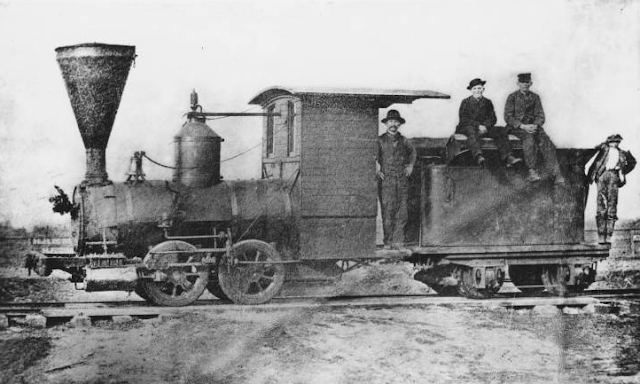
One of the San Vicente Lumber Company's shay locomotives with crews loading logs onto flatcars above Swanton, with a large steam donkey at left, 1909-1922. [Margaret Koch Collection, Santa Cruz Museum of Art & History – colorized using MyHeritage]

The San Vicente Lumber Company was incorporated on May 8, 1908, and immediately contracted with the Ocean Shore Railroad to extend a track along Scott Creek between Folger near the coast and Swanton 1.4 miles inland. The Pratchner Company was hired to install the tracks and, according to the Santa Cruz Evening News, had a crew composed of a dozen teams to build the line. On June 19, a new railroad company, the Scott Creek Railway, was founded as an Ocean Shore subsidiary to extend the new line from San Vicente Junction south of Swanton 2.5 miles up Little Creek to the site of Camp No. 2. At the junction, several spurs and sidings were installed to park flatcars for use on the line up Little Creek.

A hand-drawn survey map based on observations and GPS recordings by George Pepper and Rick Hamman.

Construction of the Scott Creek Railway finished sometime before mid-March 1909. Camp No. 1 was established a mile east of Swanton at the confluence of Little Creek and its largest tributary, Chandler Creek. Here ox teams and steam donkeys hauled cut timber from along Chandler Gulch to the railroad grade. Camp No. 2, the site of the worker village, required a switchback to climb up roughly 500 feet in elevation to Stoney Point and then a further mile east to a flat clearing, where timber from upper Little Creek and the headwaters of Berry Creek could be pulled over the ridge via steam donkey. The extension of the line beyond Camp No. 2 was a task done by the lumber company rather than the railroad company. The mill itself was erected in Moore’s Gulch at the western limits of Santa Cruz and was completed around March 22, 1909. Yard tracks were not installed at the facility until the weeks before it opened, and no logs were shipped over the route until March 23.

The main San Vicente Lumber Company forest crew, ca 1912. [UC Santa Cruz – colorized using MyHeritage]

The company employed around 225 men annually, over half of whom worked in the forest and lived in the camps. They were an eclectic mix of Italians, Greeks, Irish, Swedes, and other people of mostly European descent. In its first year, Camp No. 2 hosted around 50 cottages, which supported both workers and their families. Famed California reporter Josephine Clifford McCrackin visited Camp No. 1 in late September 1909. She reported that “the company has built very pretty cottage for its employees… At the general store goods are sold at Santa Cruz prices; and at the market meats and vegetables can be bought just as in Santa Cruz.” In addition, the camp featured a boarding house for visitors, a cookhouse, and a bunkhouse for single men. The anticipated influx of children led to Seaside School moving from Gianone Hill to Swanton. Swanton, too, grew when it became the northern terminus of the Southern Division of the Ocean Shore Railway. Its hotel became the transfer point for Ocean Shore-sponsored buses heading to the southern end of the Northern Division at Tunitas, and a few commercial businesses may have arisen around the old Laurel Grove Hotel.

One of the San Vicente Lumber Company's shay locomotives running up a grade above Swanton, ca 1915. [UC Santa Cruz – colorized using MyHeritage]

The San Vicente Lumber Company’s railroad used two Shay locomotives for its logging operations, although Ocean Shore Railway trains ran irregularly to Camp No. 2 to provide passenger and switching services. 36-foot-long flatcars with air brakes were used to haul full logs from the hills to the mill. Several spurs were kept at Camp No. 2 for yarding and storage, and photographs show that several boxcars were converted into makeshift buildings for the company. Beyond Camp No. 2, bridges were built as needed using available resources—namely felled pine trees—and some of these bridges rose up to 90 feet in height. Because the area was prone to slides and heavy rainfall, bridges and half-trestles were preferred over fills, and both switchbacks and tight curving trestles were used to achieve quick increases the gradient in confined spaces. Nonetheless, gradients of up to 8% were not unknown on this railroad.

A section of the original Scott Creek Railway trackage between Swanton and Camp No. 2, July 1918. [Mattei Family Collection, Santa Cruz MAH – colorized using MyHeritage]

Logging was continuous but probably did not move into the San Vicente Creek watershed until 1912. The first major extension of the railroad took it up Little Creek and over it in a tight loop in order to gain elevation. It then switch-backed and continued to the headwaters, where another switchback allowed the route to finally exit the Little Creek watershed and climb atop the plateau at the top of the grade. From there, the track swung to the south and curved around a hill, on the other side of which Camp No. 3 was established. The camp was placed here since it intersected with a rugged county road between Davenport and Bonny Doon, the southern part of which is today’s Warrenella Truck Trail. Camp No. 3 was established to gather timber from the West and East Forks of San Vicente Creek.

Two women standing beside the San Vicente Lumber Company's tracks, probably between Camp Nos. 1 and 2, July 1918. [Mattei Family Collection, Santa Cruz MAH – colorized using MyHeritage]

Tracks were slowly extended beyond Camp No. 3, probably between late 1912 and 1913. On one of the tightest curves on the railroad, known as the Bear Trap, the track crossed the West Fork of San Vicente Creek and then headed south until stopping just before the creek’s fork with its other branches. Here a switchback brought the track alongside the Middle Fork. As before, crews used donkey engines here to pull out logs from the surrounding forest, loading them onto flatcars and sending them down the line.

The impressive series of trestles spanning the Bear Trap above the West Fork of San Vicente Creek, ca 1912. [UC Berkeley – colorized using MyHeritage]

When the West and Middle Forks were harvested, the railroad moved again, this time north around the headwaters of the West Fork to Camp No. 4, known as White House Camp because of the presence of an abandoned whitewashed house at the site. This move likely happened in 1914 and was perhaps the shortest-lived camp. It focused on harvesting the headwaters of the West and Middle Forks, and may have also pulled down material from atop the ridge that separated the San Vicente Creek and Big Creek watersheds.

A high lead and gin pole above the San Vicente Lumber Company's tracks above Swanton, ca late 1910s. [Fritz–Metcalf Collection, UC Berkeley – colorized using MyHeritage]

Around 1915 or 1916, the track was extended to the east between the Middle and East Forks of San Vicente Creek, with a substantial curve and switchback in the middle of the route to lower the grade and avoid a hill. The track then continued south, bringing it directly opposite the main settlement area of Bonny Doon. Camp No. 5 was, therefore, appropriately named Bonny Doon Camp. This camp was responsible for harvesting all of the timber within Rancho San Vicente from the East Branch of the creek—the property boundary—and the Middle Fork. These operations likely wrapped around 1918, perhaps delayed by World War I and the influenza pandemic that followed.

Three women standing on a steam donkey platform probably near Camp No. 6 during the final phase of harvesting, July 1918. [Mattei Family Collection, Santa Cruz MAH – colorized using MyHeritage]

Following the war, the company pursued its final drive to harvest timber to the northwest along the headwaters of Big Creek. A new switchback was built near the headwaters of Little Creek with the tracks heading to the west around several short hills and gulches. It finally reached a pond in a high clearing, where Camp No. 6 was established just above Big Creek. The main track wrapped around the camp from the south and descended to the creek via a single switchback. It then continued along the creek through Deadman Gulch and up the East Branch of Big Creek before terminating near its headwaters. Presumably San Vicente Lumber only had rights to harvest timber east of Big Creek’s main course, and it spent its last four years harvesting this dense forestland from above and below.

Members of the Mattei family and friends posing beside a cottage, probably at Camp No. 2, with converted train car cottages and permanent cottages in the background, July 1918. [Mattei Family Collection, Santa Cruz MAH – colorized using MyHeritage]

It is not entirely clear whether Camp No. 2 remained the main camp for families or if the entire camp relocated every few years. Logically, it makes sense if the camp remained in place throughout this time. Camp No. 2 marked the end of the Scott Creek Railway and Ocean Shore trains could still reach it to shuttle children between the camp and the school in Swanton. It would also be directly connected with southbound trains so people and camp businesses could easily resupply. Rick Hamman, however, states that the camp moved each time, with the cabins loaded onto flatcars and then placed on the ground at each new location. This seems a rather large burden to do every two years, though, and there is no evidence that this was in fact done. What was done, though, is the removal and reinstallation of track as the line moved. Whenever a section was cleared of usable timber, the rails and ties would be pulled and reused, when possible, to build the next extension. The downside of this is that a new section of track could not be built while an old section was still being used.

An Ocean Shore Railroad passenger car separated from its wheel truck by presumably a runaway flatcar that crashed into it, ca 1920. [Mattei Family Collection, Santa Cruz MAH – colorized using MyHeritage]

Because of the steep grades, sharp turns, and switchbacks, the railroad was prone to many incidents. The number one issue was runaway rolling stock. Both of the Shay locomotives escaped the engineers’ control on several occasions, and flatcars escaped constantly. Fortunately, most incidents at worst resulted in the stock in question crashing into a hillside at the end of a switchback or tearing of the ties after derailing. Many of the switchbacks, however, we designed in such a way that they rose up near the end to decelerate runaways without damaging the stock. Most of the time, operations along the railroad ran remarkably smoothly considering all the compromises that had to be made. The same cannot be said of the workers, who were frequently injured on the job resulting in several maimings and a few deaths.

Four women posing beside a section of cut forest with the San Vicente Lumber Company's railroad tracks heading into the distance, July 1918. [Mattei Family Collection, Santa Cruz MAH – colorized using MyHeritage] 

The San Vicente Lumber Company’s railroad outlasted the Ocean Shore Railroad, that had helped build and support it. Around the end of 1920, the company bought the Southern Division of the Ocean Shore, which had effectively gone defunct in October following a worker strike. As part of the deal, they acquired Ocean Shore engine no. 4, which they used as their primary locomotive to transport logs to the mill. The railroad continued to haul logs until the end of the 1922 season, at which point the company began wrapping up its operations. In January 1923, the mill was shut down and crews began dismantling the railroad and workers’ village. Henry G. Stoddard of the Nibley–Studdard Lumber Company continued to run the company’s lumber yard for about eight months, but all other operations at the mill ended in February and the large plant was partially dismantled with usable parts destined for a new mill at Cromberg, California.

A woman shyly posing beside a San Vicente Lumber Company locomotive crew at Swanton, July 1918. [Mattei Family Collection, Santa Cruz MAH – colorized using MyHeritage]

Much of the former rights-of-way survived in the mountains, with a few repurposed as private access roads or county park trails. Others have degraded into nearly unrecognizable paths, with the August 2020 fires destroying some of the last artifacts from the age of logging in the area. Prior to the fires, George Pepper and Chuck Ryder carefully hiked the hills with a GPS recorder to identify the former railroad grades, making several corrections to Hamman’s map. The entire area remains private property, but the Santa Cruz Land Trust is working on creating a trail network within the area, called San Vicente Redwoods, some of which trails will closely follow the rights-of-way of the former San Vicente Lumber Company’s railroad.

Citations & Credits:

  • Articles of incorporation for the Scott Creek Railway Company. Courtesy Santa Cruz Museum of Art & History.
  • Hamman, Rick. California Central Coast Railways. Second edition. Santa Cruz, CA: Otter B Books, 2002.
  • Pepper, George, and Chuck Ryder. Personal correspondence.
  • Santa Cruz SentinelSurf, and Evening News, 1908-1923.
Thursday, December 16, 2021

Railroads: Hihn's Early Railroad Schemes

Railroads did not appear in Santa Cruz County overnight. Between the first whisper of a local railroad published in the Santa Cruz Sentinel in December 1862 and the completion of the county's first railroad in October 1875, several plans were made and companies incorporated to build a railroad somewhere within the county. Without question, the most enthusiastic promotor of local railroad schemes was Frederick A. Hihn, whose wealth, vast land holdings, political influence, and general popularity afforded him much leverage in pursuing his grand vision for the county. Following a brief debate published in the Sentinel over several weeks in January 1866, Hihn pushed forward with his plan to build a standard-gauge railroad that would connect Santa Cruz County to the San Francisco & San José Railroad, which had opened January 16, 1864. Surveys were undertaken and public forums were held to compare the merits of a route to San Francisco via the San Lorenzo Valley—promoted by "Sayante" (probably Thomas S. Farmer)—versus a route along the coast and up the Pajaro Valley to San José. It took over a year for two rival companies to materialize. The San Lorenzo Railroad formed first on June 20, 1867. Two days later, on June 22, Hihn incorporated his own company with the aim of linking Watsonville to San José via Gilroy.

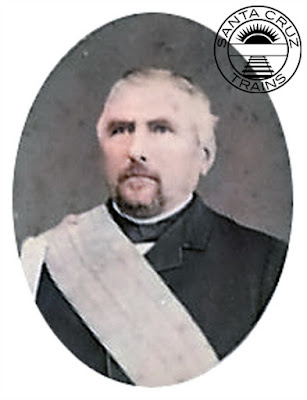
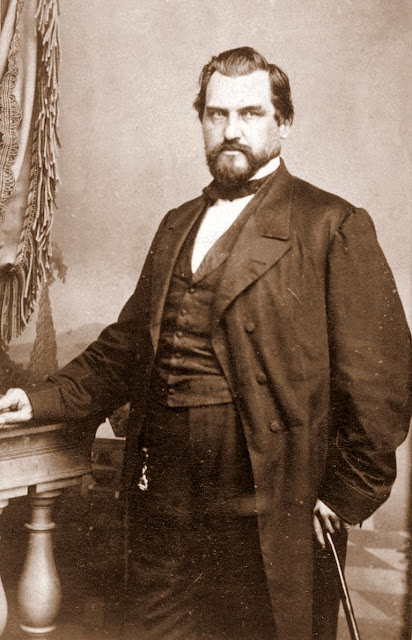
Frederick A. Hihn wearing a Society of California Pioneers sash, 1880s. [University of California, Santa Cruz — colorized using DeOldify]

California Coast Railroad Company (1867 – 1870)

The California Coast Railroad was financed by a great many members of Watsonville and Pajaro Valley society, including Nathaniel Chittenden, Charles Ford, Lucian Sanborn, and James Sargent. It was a bold but plausible plan with a moving target that hoped to connect with the nascent Southern Pacific Railroad wherever it was convenient. At the time, the exact plans for the Southern Pacific Railroad were unclear except that it hoped to construct a railroad south from San José through Gilroy. Two options from there were to continue down the San Benito Valley and cross into the San Joaquín Valley at the first opportunity. Alternatively, the route could turn down the Pajaro River and continue south via the Salinas River. Most surveyors at the time favored the former option, and indeed the Southern Pacific Railroad did initially attempt that before changing its mind and taking the Pajaro Valley route. In any case, that was in the future. Hihn and his colleagues wanted to ensure that they got their connection regardless of Southern Pacific's eventual decision.

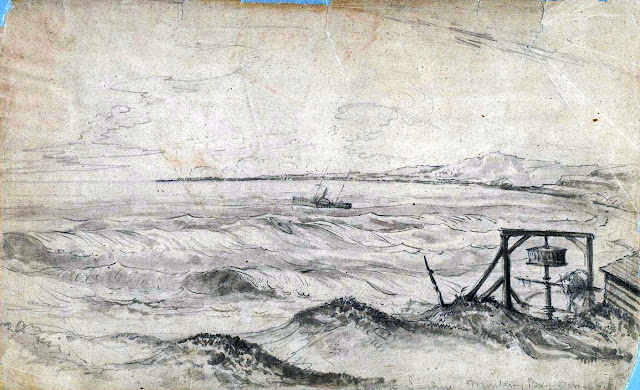
Sketch of Pajaro Landing, October 1856, by William Birch McMurtrie. [Bancroft]

Surveys were conducted throughout late 1867 but little more progress was made and subscriptions were not actively solicited outside the initial backers. However, once construction of the Santa Clara & Pajaro Valley Railroad between San José and Gilroy began in February 1868, Hihn began selling stocks as widely as he could reasonably advertise them. His plan did not go as well as he had hoped. Trying to gather funds from the initial contributors was difficult enough, and the Pajaro Valley was not yet populated or wealthy enough to attract as heavy of an investment as was required. The stated capital stock was listed at the astronomical amount of $400,000 for only about 20 miles of relatively level track. Thus, the project languished even as the railroad to Gilroy was completed on April 10, 1869.

A gathering of the Society of California Pioneers on Admission Day, 1880s. [Santa Cruz Public Libraries – colorized using DeOldify]

Unperturbed, Hihn included the railroad into his autumn 1869 campaign for a seat in the California State Assembly. After winning the election, Hihn held several controversial and contentious public meetings. The result was a bill that would allow public funds to finance $8,000 per mile of the route, as well as branch lines up the San Lorenzo Valley (via the existing San Lorenzo Railroad Company) and Soquel Creek. Late during the drafting stage, the Southern Pacific Railroad incorporated the California Southern Railroad Company on January 22, 1870. This new railroad intended to build a route between Gilroy and Salinas and beyond—a total proposed length of 250 miles. In other words, it would follow the already-proposed route of the California Coast Railroad, and nobody in Santa Cruz County would have to finance it. As a result, Hihn inserted the California Southern into his railroad bill on March 5, 1870, and the California Coast Railroad was promptly forgotten.

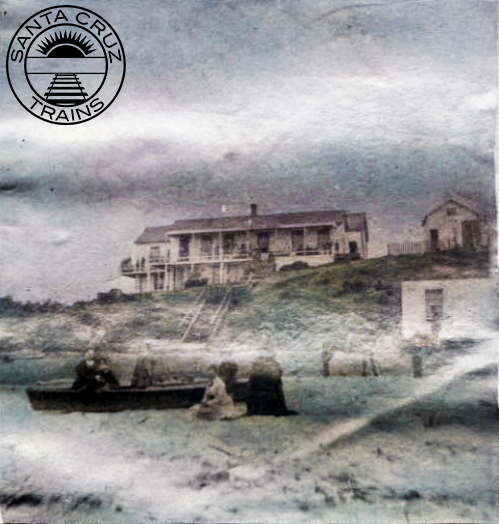
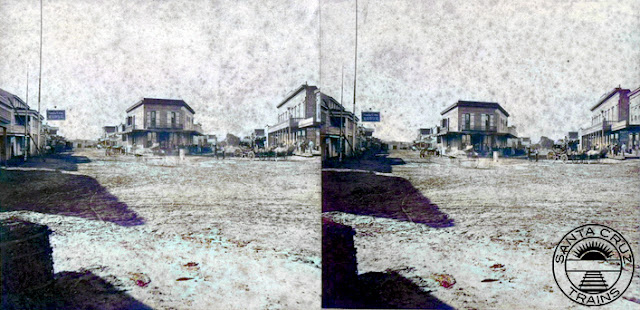
Stereograph of the Pacific Ocean House, 1866. Photo by Lawrence & Houseworth. [California State Library – colorized using DeOldify]

Despite incorporation and the collapse of the earlier scheme, nothing happened for over a year. Southern Pacific resumed construction of its line south from Gilroy—nominally the Southern Pacific Railroad's mainline—but it stopped just outside Tres Pinos near Hollister. Hihn grew disappointed and began planning again. While his railroad bill had failed due to a veto from the governor, there was still public support for it and his plans. Thus, as his two years in the assembly were coming to an end, Hihn began an ambitious new plan to get the ball rolling once more concerning railroads in Santa Cruz County.

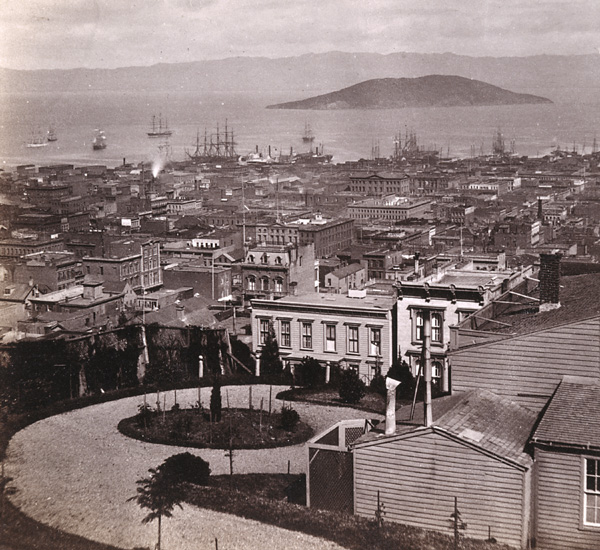
San Francisco from the corner of California and Powell Streets, looking northeast, ca 1870. Photo by Lawrence & Houseworth. [Society of California Pioneers]

Narrow Gauge Railroad Company (1870 – 1872)

Hihn's next scheme was not entirely his own. Part of the reason for the failure of his first plan was its extraordinary cost, which was simply beyond the financial ability of the county. But in 1870, the idea of narrow-gauge railroads invaded the Central Coast and inspired Hihn. With a narrower footprint, lower-grade rails and crossties, and tighter curves, narrow-gauge trains could be built at nearly half the cost of standard-gauge stock. Thus, when the Narrow Gauge Railroad Company was incorporated on November 15, 1870, Hihn made sure that he was one of its directors. The company was led by a British man, L. L. Robinson, and was managed from San Francisco. It had the lofty goal of building a narrow-gauge transcontinental railroad and as such had an initial $1,000,000 capital stock.

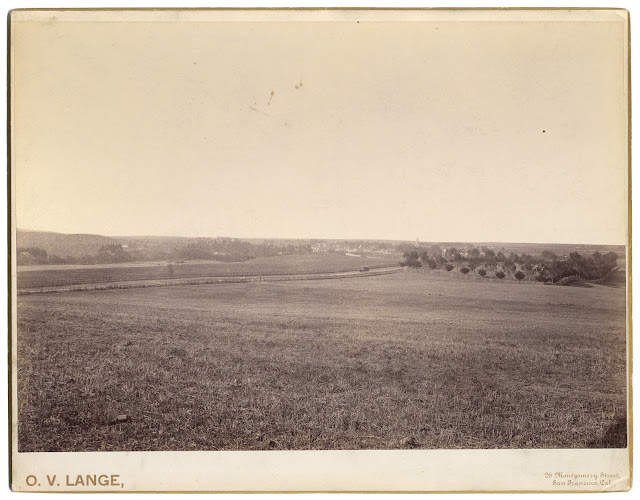
Open fields near Half Moon Bay, 1880s. Photo by O. V. Lange. [California State Library]

The company proposed as its initial route a narrow-gauge railroad down the coast from San Francisco through Santa Cruz County, with the trackage within Santa Cruz County the first to be constructed. However, the railroad was not alone in this goal—on March 23, the Southern Coast Railroad proposed a similar route. A week later, a third railroad, the San Francisco, Santa Cruz and Watsonville Railroad, also incorporated. Comparing all three, they appear to have been completely different firms with the latter two presumably standard gauge. None were promoted by the Southern Pacific Railroad and, notably, none ever succeeded in doing any more than surveying its proposed route. Surveyors for the Narrow Gauge Railroad passed through Santa Cruz County in May 1871 and were never heard from again, the project presumably failing not long afterwards. The only legacy the railroad may have left behind is its survey report, which was likely used by Hihn in later years to help plan the course of his later projects through the county. Undaunted, Hihn moved onto his next plan.

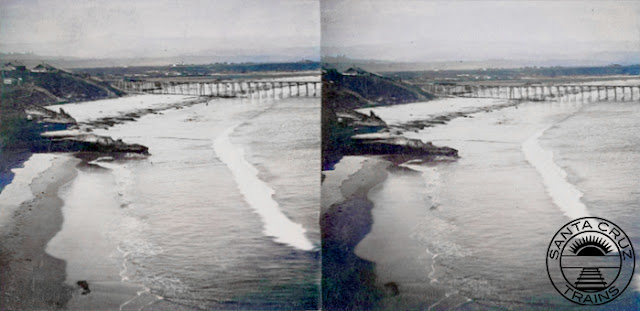
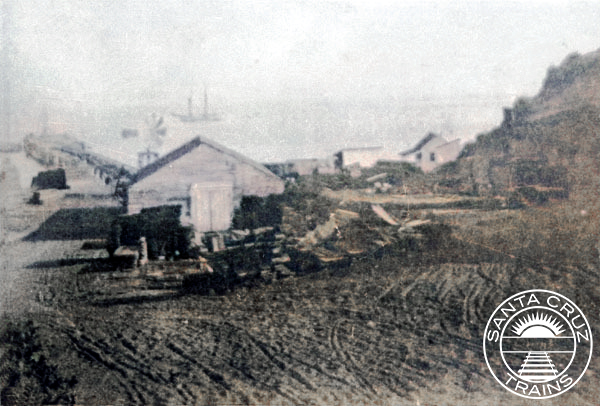
Streograph showing the Santa Cruz Main Beach showing the Powder Works Wharf, 1866. Photo by Lawrence & Houseworth. [California State Library – colorized using DeOldify]

San Lorenzo Valley Railroad Company (1871 – 1874)

Although initially reluctant to support a San Lorenzo Valley railroad scheme, he ended up adding it to his railroad bill in 1869–1870 as a way of drawing more support from the local community. The citizens of Santa Cruz in particular were supportive of it since it meant more revenue would pass through the town. It also would potentially put the Davis & Cowell lime company in its place, since the firm was aggressively blocking several smaller lime companies from getting their products to the wharves at the Santa Cruz Beach. Such was the reason why all progress on the earlier San Lorenzo Railroad had come to a halt. A lawsuit by Davis & Cowell had deprived the railroad of its funding due to legal fees and both firms were fighting a long battle in the courts to determine once and for all whether the railroad company could build a right-of-way through the lime company's lands without their permission.

The flatiron building at the corner of Pacific Avenue and Front Street in Santa Cruz, 1866. Hihn ran all of his later railroad ventures from the second story of this building. [Santa Cruz Public Libraries – colorized using DeOldify]

Hihn waded into this fight assertively while still serving in the state assembly when he incorporated the San Lorenzo Valley Railroad Company on March 11, 1871. It was an opportunistic plan in that it hoped to draw on local demand for the route while inadvertently undermining the efforts of the company that had already formed for the purpose. As expected, the attempt did not succeed. Capitalized at $300,000, the board of directors was composed mostly of San Lorenzo Valley men but only one member of the old firm joined the group. The planned route was almost identical: sixteen miles up from Santa Cruz to Boulder Creek and beyond. The only substantial difference was that Hihn's proposed railroad would be narrow gauge, clearly taking inspiration from his earlier investment.

Stereograph of a woodcutter in the Santa Cruz Mountains, ca 1877. Photo by J. D. Strong. [California State Library – colorized using DeOldify]

Just like 1867, when the earlier company was formed, the Sentinel gushed about the plans, acting almost like the previous four years hadn't happened. It speculated that the route would eventually continue across the mountains to some point in the Bay Area. It discussed likely stops in the mountains, how popular the line would be with tourists, and how commuters could make a roundtrip journey to San Francisco in a day. Surveying for the new route began at the end of March 1871, suggesting that the partially-graded line of the San Lorenzo Railroad would not necessarily be used. Indeed, surveyors found a new short-cut under the Hogsback near the California Powder Works that could potentially reduce the route by 1.5 miles. The length of the proposed tunnel—1,100 feet—suggests that the line was still much closer to the San Lorenzo River than the route later taken by the Santa Cruz & Felton Railroad in 1874. The survey was completed at the end of April 1871. Efforts to associate the line with a proposed railroad in San José were ongoing.

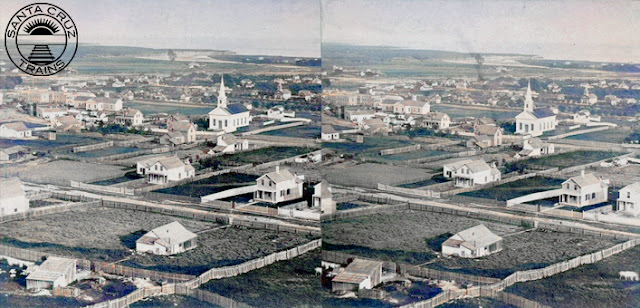
Stereographic view of Santa Cruz, 1866. Photo by Lawrence & Houseworth. [California State Library – colorized using DeOldify]

Speculation continued into 1872 but little more was done. The value of the company's stock remained stable and land speculators began clearing property in Boulder Creek at the proposed terminus of the railroad. Like with the San Lorenzo Railroad three years earlier, the idea of a railroad to Boulder Creek was enough to lead to the town's development. Nonetheless, when the San Lorenzo Railroad lost its case in the California Supreme Court on January 1, 1874, so too died the dreams of the San Lorenzo Valley Railroad. Both schemes were linked to the same idea: that a railroad could be built through Davis & Cowell's lands without its permission and without due compensation. When the case failed, all confidence in such a line collapsed and local investors pulled out. Hihn continued to act as chairman of the board but he may have lost interest in the project as early as August and was certainly looking at other options by early 1872. When the Santa Cruz & Felton Railroad formed in November 1874, it was financed entirely by outside investors who worked with Davis & Cowell to secure a right-of-way to its liking.

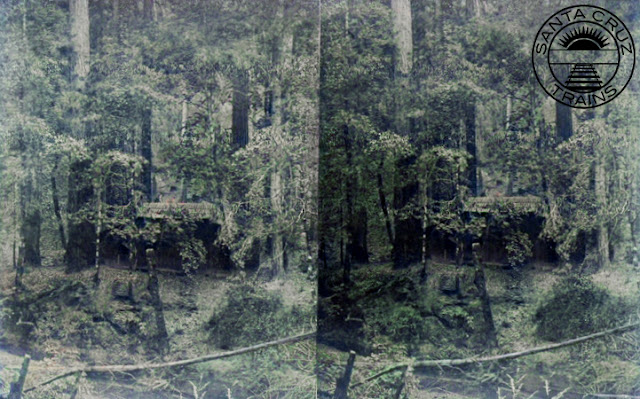
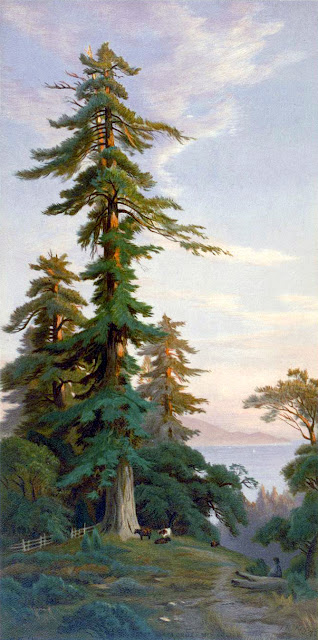
Redwood trees in the Santa Cruz Mountains, ca 1874. Painting by John Ross Key. [Bancroft – colorized using DeOldify]

San Jose & Santa Cruz Railroad Company (1871)

Hihn remained undaunted and began planning his next railroad scheme. Several investors in the Santa Clara Valley had continued to express interest in a route across the mountains and Hihn felt that it was time to push forward a plan he had promoted since September 1869: a railroad up the East Branch of Soquel Creek and down Los Gatos Creek. This route was of personal interest to him since he owned vast tracts of timberland at the headwaters of Soquel Creek and had struggled to economically harvest it since he had acquired it in the mid-1850s. Any route up Soquel Creek would be profitable to him, but he wanted to ensure he had a say in its construction. Thus, after four months of heavy speculation in newspapers and the completion of a survey of the route in May 1871, Hihn incorporated the San Jose & Santa Cruz Railroad Company on July 25, 1871.

Soquel Landing in Capitola, 1870s. [Santa Cruz Public Libraries – colorized using DeOldify]

The proposed narrow-gauge railroad would be 38 miles in length and run from Santa Cruz eastward to Capitola, where it would turn up Soquel Creek and snake along its East Branch until it found a reasonable location for a tunnel under the Summit to the headwaters of Los Gatos, probably near today's Lake Elsman. From there, it would more or less follow the route later built by the South Pacific Coast Railroad in 1878–1880, until the line arrived in San José. Capital stock was set at $500,000 and Hihn was appointed president.

Capitola Beach, ca 1875. Photo by Romanzo E. Wood. [California State University, Chico – colorized using DeOldify]

The nascent route was too little and too late. Indeed, why it was even incorporated is unclear since, on July 17—less than two weeks before—the Southern Pacific Railroad began construction on its long-delayed Watsonville Branch, which would initially extend from Gilroy to Pajaro or Watsonville, and eventually continue to Salinas. This branch line would partially resolve the stated reason for the San Jose & Santa Cruz Railroad since it would finally connect Santa Cruz County to the Santa Clara Valley by rail. While the task of linking Santa Cruz to the Monterey County line was still in the future, part of the decision had been taken away from Hihn and his investors pulled out. The Watsonville Branch was completed to Pajaro on November 26, 1871. Three years later, it was re-designated as the main trunk line of the Northern Division of the Southern Pacific Railroad after the former mainline to Tres Pinos was declared infeasible.

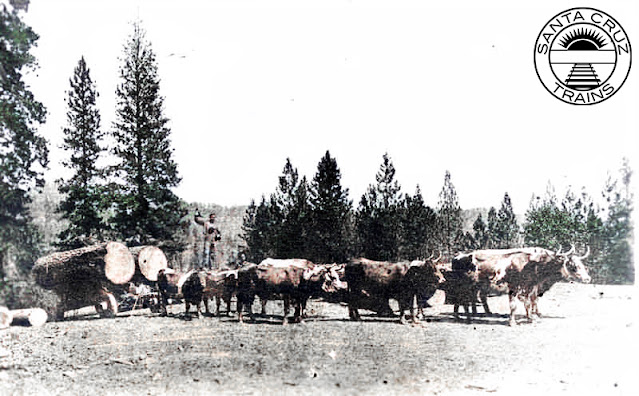
Logging with oxen above Soquel, 1870s. [San Joaquin Valley Library System – colorized using DeOldify]

Hihn's plans for a railroad along Soquel Creek, while possible from an engineering standpoint, was never built. He returned to the idea several times over the years, even reserving in 1889 a right-of-way through large sections of land he owned or purchased that still exists today under the name "Hihn Railroad Grade" on property maps. This route would likely have followed at least part of that surveyed in 1871. Hihn did eventually build a very small stretch of track at Laurel along the West Branch of Soquel Creek, but due to the steep grade from the South Pacific Coast Railway's right-of-way, it was only usable as part of an incline tramway.

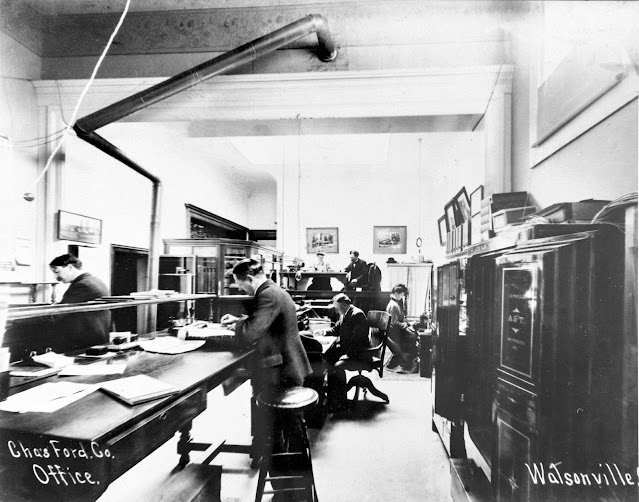
The offices of Charles Ford in Watsonville, 1890. Photo by George Menasco. [Watsonville Public Library]

Santa Cruz & Watsonville Railroad Company (1872 – 1873)

The prospect of a railroad actually reaching Santa Cruz County from San Francisco (via the Santa Clara Valley) excited everyone and Hihn seized the moment once again. Abandoning all of his previous projects, he put his effort into organizing a standard-gauge railroad that could connect Santa Cruz with the Southern Pacific tracks at Pajaro. In mid-December 1871, a ballot measure passed by a heavy margin granting a subsidy to build a railroad between the two points. Only Watsonville residents resisted the measure because they already considered themselves connected to the Southern Pacific network and saw little advantage in supporting a railroad to Santa Cruz. Following a month of discussion and planning, on January 18, 1872, the Santa Cruz & Watsonville Railroad Company was incorporated.

Stereograph of the intersection of Front Street and Pacific Avenue in Santa Cruz, with Hihn's flatiron building in the center, 1866. Photo by Lawrence & Houseworth. [California State Library – colorized using DeOldify]

The length of the route was set at 20 miles with it expected to follow the coastline closely. As with the previous two projects, Hihn was made president alongside several other local Santa Cruz entrepreneurs who had supported Hihn's previous schemes. Capital stock was set at the still optimistic $500,000, of which $100,000 was promised by the county at a rate of $5,000 per mile built. The county required construction to begin within six months and the entire line had to be completed by January 1874. On paper, everything seemed reasonable. Surveyors began their surveying and board members began soliciting subscribers.

Portrait of Leland Stanford, 1870s. [Bancroft]

It was in early April that Hihn made a fatal mistake. He met with Leland Stanford of the Southern Pacific Railroad in San Francisco, and during the meeting Stanford promised to conduct a survey in anticipation of taking over construction of the Santa Cruz & Watsonville Railroad. With such an important financier on board, the subscription drive collapsed. Why have locals pay for what the Southern Pacific would do itself? To complicate matters further, the Atlantic & Pacific Railroad sent surveyors into Santa Cruz County in June 1872 shortly after the incorporation of its subsidiary San Francisco & Atlantic Railroad. The company hoped to build a transcontinental route from San Francisco, from where it would follow the coast to Los Angeles before turning east to the Colorado River. That meant that two companies wanted to build standard-gauge railroads that would connect Santa Cruz to Watsonville—one by taking over the existing company, the other via an entirely new company with a grander vision. Both options seemed better than funding a railroad entirely on local funds and subscriptions.

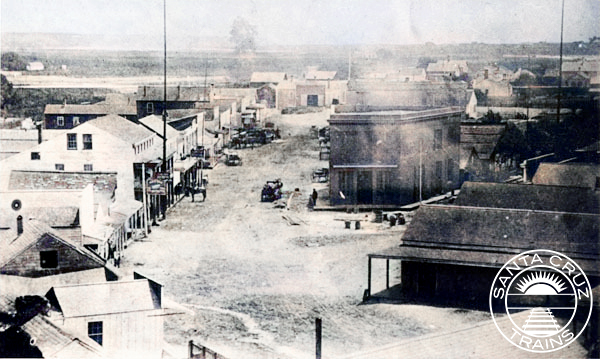
Streographic view of Santa Cruz from High Street, 1866. Photo by Lawrence & Houseworth [California State Library – colorized using DeOldify]

And so ended Hihn's penultimate attempt to build a railroad. The public was distracted and in the summer of 1872, they felt confident that somebody else would solve their railroad problem for them. But they were wrong. By early September, it was clear that the Southern Pacific had both blocked the Atlantic & Pacific's plans in the Bay Area and reneged on its agreement with Hihn to take over the Santa Cruz & Watsonville Railroad. Faced with high costs and few funds, Hihn pitched the idea of a 40-mile-long narrow-gauge railroad between the San Mateo County line and Pajaro, thereby leaving open the possibility of a future take-over of the route. In late November, Hihn convinced a joint Santa Cruz–San Mateo County railroad committee to agreeing in principal to funding the line at a cost of $250,000.

The Santa Cruz Railroad's Betsy Jane with its crew, ca 1875. [University of Southern California]

An annoying delay caused by yet another appearance by Stanford in late January 1873 led to more empty promises, but this time Hihn was prepared. He asked for a show of good faith. Stanford surprisingly delivered and brought in surveying crews to map the entire proposed route to Santa Cruz. However, financial instability began rolling out of Europe in the summer of 1873 and the Southern Pacific Railroad was forced to pull out of its expansion plans throughout the state. Hihn pushed on and began gathering subscriptions. On August 4, 1873, he and a small group of associates incorporated the narrow-gauge Santa Cruz Railroad Company. This time, his scheme finally bore fruit and Santa Cruz entered the age of the iron horse. The rest is history.

Citations & Credits:

Thursday, December 2, 2021

Railroads: San Lorenzo Railroad Company

In the beginning, there was a strong community desire to build a railroad from San Francisco to Santa Cruz. But how it would get there was always the issue for debate. The three most reasonable plans alternated between a route down the San Lorenzo Valley, a route through the Pajaro Valley, and a route up Los Gatos Creek and down Soquel Creek. A fourth option, a direct route eighty miles down the coast, was also mooted constantly although it was generally considered the most costly and least practical of the four options. Each had its champions: the San Lorenzo route was favored by lime sellers and lumber companies along the San Lorenzo River, the Pajaro Valley route was preferred by Watsonville ranchers and farmers, the Soquel route was closely associated with Frederick A. Hihn's optimistic plans for mid-county, and the coastal route was encouraged by coastal ranchers and resort promoters as well as wealthy East Coast visionaries.

Lithographic Birds' Eye View of the California Powder Works, slightly idealized, ca 1870, by Britton & Rey. Note the suspicious road following closely along the west bank of the San Lorenzo River that resembles a railroad grade, albeit one on the wrong side of the river. A later version of this scene, showing a thicker tree cover suggesting the passage of a few years, changed this road to be a flume. [Bancroft]

Debate between the first three routes began in earnest in January 1866 in a series of newspaper exchanges between Hihn and a mysterious author only known as "Seyante." Hihn at the time saw the most feasible route being through the Pajaro Valley, which would connect Watsonville to the San Francisco & San José Railroad via a standard-gauge line. He argued it would be the cheapest and cater to the most people, even though the route to San Francisco would be considerably longer. Seyante, in contrast, fought for a San Lorenzo (Rancho Zayante) route that would continue over the Santa Cruz Mountains and eventually reach Redwood City or Mountain View. He defended his choice by pointing out the many resources that would be tapped via this route, as well as the relatively easy grade along most of it despite the mountainous terrain.

Lithographic view of the Summit of the Santa Cruz Mountains, looking toward San José and Gilroy, 1863. Drawing by Edward Vischer. [Honnold Mudd Library, Claremont Colleges]

As an aside, while some have speculated that Seyante was none other than Hihn, his lack of support for a San Lorenzo route in 1867 suggests otherwise. Of the small circle of knowledgeable people familiar with the San Lorenzo Valley in January 1866, Thomas S. Farmer seems the most likely candidate. Farmer was an Englishman by birth, had lived in the Santa Clara Valley in the late 1850s and early 1860s, travelled briefly to Australia, and then moved to the San Lorenzo Valley around 1866, where he became heavily involved in the lumber and lime industries. As a lumber merchant, he would have had to travel throughout the valley to negotiate deals with timber felling crews and other mills. He also was a trained civil engineer and mechanic, which he put to use advocating for and helping design the the San Lorenzo River toll road between Felton and Santa Cruz. In 1869, on multiple occasions, he expressed his strong support for a railroad to Felton and beyond, and he had all of the requisite skills and experience to be the mysterious Seyante.

In any case, the debate between the two preferred routes sparked a year's worth of material for the Santa Cruz Sentinel and led to public meetings and action eventually taken in June 1867 by the incorporation of two rival but not mutually hostile companies. Hihn's first railroad venture, the California Coast Railroad Company, was incorporated on June 22, 1867 with the initial goal of continuing a standard-gauge railroad south from the southern terminus of the San Francisco & San José Railroad to Watsonville. Two days earlier, however, the San Lorenzo Railroad Company was established by a group of eager and excited railroad speculators with their own plans for linking Santa Cruz to San Francisco.

Stereograph of a footbridge across the San Lorenzo River north of Santa Cruz, 1865. [California State Library]

The champion of this route up the San Lorenzo Valley was Horace Gushee, a recent resident of Pescadero who had moved to the San Lorenzo Valley and promptly became involved in the gold trade along Gold Gulch. Other initial subscribers included three Santa Cruz residents, two San Franciscans, and three residents of Benicia. Future pledge drives attracted several more residents of these three cities. The railroad began as a bold but humble affair, with only $100,000 set for the capital stock and initial plans to only build a route to King's Ranch, about fifteen miles north of Santa Cruz. Contrary to popular belief, Hihn was in no way involved with this initial endeavor. The goal of the company's directors was to transport lumber, lime, granite and sand, and other resources out of the San Lorenzo Valley to the Powder Works Wharf (Gharkey's Wharf) in Santa Cruz. It would also serve as a public convenience—i.e., a passenger line—which was even more important at the time since Eben Bennett's toll road would not be built until the next year.

Lithographic view of Rancho Zayante and Captain Isaac Graham's mill on the San Lorenzo River, 1863. Drawing by Edward Vischer. [Honnold Mudd Library, Claremont Colleges]

A survey of the route was completed within a few months of incorporation and by December 1867, the directors were negotiating rights of way with property owners. Grading for a standard-gauge railroad began on May 11, 1868 in Felton near modern San Lorenzo Valley Elementary following a brief ceremony by the surveyor, Thomas W. Wright, and several of the directors. The town itself was brand new. It had begun life as Isaac Graham's lumber mill before it erupted into a boom town in the mid-1850s. Its population was focused initially on gold prospecting but subsequently became involved in the lime and lumber industries. Most of the downtown district was planned by Frederick Hihn, Horace Gushee, and Edward Stanley in 1867. By May 1868, Felton still had few permanent buildings and an itinerate populace, but it sat at the confluence of the river and Zayante Creek as well as served as the junction between Graham's Grade, Felton–Empire Grade, and the crude, meandering roads along the river and creek. It also hosted the valley's first post office and school.

Lithographic view of the San Lorenzo Paper mill and Mr. Sime's residence on the San Lorenzo River north of Santa Cruz, 1863. Drawing by Edward Vischer. [University of Southern California]

Rather than using cast iron rails for the line, the railroad would initially use oak rails with wrought iron caps. This was done only partially to save money. The Civil War had heavily depleted the West Coast's iron reserves and the iron trade to California had not yet resumed at sufficient levels to allow for a locally-funded, fifteen-mile-long railroad line. For most of its route south from Felton, the railroad would adhere to the western side of San Lorenzo Gorge. Two crossings were planned: the first would be below Davis & Cowell's lumber mill, where the right-of-way would cross to the east to make a broad curve around the Hogsback; the second would be south of the California Powder Works (today's Paradise Park Masonic Resort), although where precisely is currently unknown.

Stereograph of Troutdale Farm near Boulder Creek, ca 1875. Photo by Romanzo E. Wood [CSU Chico – colorized using DeOldify]

Although the stated intent of the company did not mention an extension to the Santa Clara Valley and the route was intended to be built in two sections—first between Santa Cruz and Felton and later between Felton and King's Ranch—most commentators at the time saw the likelihood for an extension beyond King's Ranch. A separate railroad project in the Santa Clara Valley, the San Jose and Santa Clara Railroad, intended to build a route between Alviso (the old deep-water port of San José) and Saratoga Springs, leaving only a short gap between the two termini. As late as February 1869, the Sentinel's editor was promoting the trans-mountain scheme, going so far to state that it was the only reasonable route to San Francisco. It was revived again in October as part of an effort by Hihn to promote several local railroad projects.

Half of a stereograph of the San Lorenzo River looking toward Santa Cruz from the east bank near Broadway, 1860s. Photo by Lawrence & Houseworth [Society of California Pioneers – colorized using DeOldify]

From mid-May 1868, grading progressed rapidly until late July, when Isaac E. Davis and Henry Cowell, owners of the largest lime company on the Central Coast, filed an injunction to stop all work on the railroad due to claims of trespassing and unlawful seizure of property. Following the amended Railroad Act of 1863, the railroad's directors submitted bonds totalling $10,000 to be used to compensate Davis & Cowell for any property seized for the purpose of building the railroad. With this, grading on the railroad continued while the court case was appealed. Unfortunately, due to the exceptionally soggy winters that the Santa Cruz Mountains experienced annually, work had to stop in mid-November.

"On the grade of the Felton, Sta Cruz Co, Calif.," ca 1865, showing San Lorenzo gorge and the San Lorenzo River toll road. [Bancroft]

On February 24, 1869, most of the Santa Cruz-based board of directors abruptly gave up their posts and sold their shares. They may have been worried about lost revenue from the recently-completed Santa Cruz to Felton toll road (Highway 9), or possibly tired of the fight with Davis & Cowell, or they feared that their railroad would never be built. Other railroad schemes, including the Santa Clara & Pajaro Valley Railroad, incorporated December 31, 1867, may have also discouraged them. Who the new board was is unclear from the available sources, but they lacked the enthusiasm of their predecessors.

Even as grading resumed in late March 1869, the railroad was given a boon: the Supreme Court ruled in favor of the railroad. The Sentinel's editor called out Davis & Cowell's attack for what it most certainly was: an attempt by the lime magnates to cut out competition from San Lorenzo Valley lime producers. The San Lorenzo Railroad fought back, as well, opening a countersuit against Davis & Cowell, presumably for delaying construction and lost profits. This was necessary since the railroad was out of money. With many of its more interested backers out and two years' delay, the railroad was struggling to finish grading the route. Frederick Hihn's electoral victory as assemblyman in September 1869 led to renewed optimism that county funds could be allocated toward the railroad. In a series of meetings held in October, Hihn promoted all three proposed lines, promising to submit a bill to the California State Assembly as soon as he arrived in Sacramento. New surveys were conducted north of Felton to verify the feasibility of the San Lorenzo route, and many agreed that the route was the shortest and most practical, even if the Pajaro Valley route was the cheapest and easiest to build.

Half of a stereograph showing Santa Cruz from the east bank of the San Lorenzo River, ca 1860s Photo by Lawrence & Houseworth [Society of California Pioneers – colorized using DeOldify]

Even as optimism grew, the San Lorenzo Railroad's hopes were dashed twice in relatively rapid succession. On January 1, 1870, it was announced that Davis & Cowell had been granted a re-hearing in the Supreme Court. And then in March, Hihn's Railroad Bill failed to win the support of Governor Henry Huntly Haight, who opposed all special subsidies. The railroad was out of funds, had no public financial support, and faced another lengthy and expensive legal challenge, this time over the very constitutionality of provisions of the Railroad Act of 1863. Nonetheless, the dream lived on and speculators continued to speculate. In March, another railroad bill, this one designed to consolidate the San Lorenzo Railroad with the Menlo Park Turnpike in order for the two firms to construct a railroad using county subsidies was passed through the state legislature. It also was likely vetoed by Haight for the same reasons as the other bill. The likelihood of a railroad being built on the San Lorenzo River was decreasing daily.

All eyes turned to the Supreme Court. The compensation suit brought by the San Lorenzo Railroad was effectively shelved from 1870 to 1874 awaiting the final results of the Davis v. San Lorenzo Railroad case. If the railroad won the case, then it could resume its attempt to recoup lost revenue. If it lost, then recouping the lost revenue was no longer an option. Most in Santa Cruz County supported the railroad and the nascent town of Felton was gambling much of its existence on it, even incorporating a post office at the planned terminus in November 1870. Speculation was rampant in December that a favorable resolution was forthcoming, yet none came.

The intersection of Front Street and Pacific Avenue, where the San Lorenzo Valley Railroad kept its corporate offices upstairs in the flat-iron building, 1866. [Santa Cruz Public Libraries – colorized using DeOldify]

On March 11, 1871, nearing the end of his lackluster two-year stint as an assemblyman, Frederick Hihn began a revived campaign of building railroads in Santa Cruz County by organising the San Lorenzo Valley Railroad Company. It had virtually the same goals and grander vision as the San Lorenzo Railroad, but Hihn likely felt he could do better. Several former board members of the failing scheme jumped ship and joined the board of the new firm. Perhaps feeling slighted, the San Lorenzo Railroad regrouped and several former members returned to support their woebegone venture. Curiously, Edmund Jones joined both boards, serving as treasurer of the San Lorenzo Railroad and secretary of the San Lorenzo Valley Railroad. An editorial in the Sentinel on April 1 suggested that the older railroad had become a subsidiary of the newer, although little other evidence supports this. Surveying for the route of the new firm began at the end of the month and it adhered closely to the route of its predecessor.

While the San Lorenzo Valley Railroad project continued with renewed vigor under Hihn, the San Lorenzo Railroad continued to languish in the courts. Some of the delay may have been due to renewed negotiations between Hihn and Davis & Cowell, which caused both parties to postpone a hearing. By December 1873, however, Davis & Cowell had had enough and finally brought the case before the bench. In a near-unanimous decision published on January 1, 1874, Justice Joseph Bryant Crockett ruled that Section 34 of the amended state Railroad Act of 1863 permitted legalized trespassing and the illegal seizure of land without due compensation, which thereby violated both the state and federal constitutions. As a result, that portion of the Railroad Act was declared unconstitutional. The San Lorenzo Railroad had lost. With its fall, it seemingly brought down the San Lorenzo Valley Railroad as well. The repercussions of the decision reverberated across the state, where aggressive eminent domain had been the primary means by which many upstart railroads acquired their right-of-way. Many railroad projects across the state seemingly collapsed overnight, the financial burden of construction deemed too difficult to overcome. All future railroad projects would have to lease or purchase land for their rights-of-way and compensate property owners for any damages or resources used from the land.

Stereograph of the terminus of the San Lorenzo Valley flume at Felton, 1876. Photo by F. A. Cook. [PacificNG.org – colorized using DeOldify]

By the end of January, a new group had come together with less lofty goals. They hoped to build a lumber flume from King's Creek to the Santa Cruz beach, following approximately the route of the railroad. Surveying of the San Lorenzo Flume & Transportation Company began in September. By December, it became clear that the southern eight miles of the route would not have sufficient sources of water to maintain. levels in the flume. As a result, on December 3, 1874, the board incorporated the Santa Cruz & Felton Railroad. The vision of this project was focused: a narrow-gauge route between Felton and Santa Cruz. North of Felton, the flume would continue for another eight miles to King's Creek. Felton would become the transfer point, which meant that the development of the town, encouraged by the promise of a railroad, would not go to waste.

It would be another five years before the South Pacific Coast Railroad finally crossed the Santa Cruz Mountains, while it was thirteen years before a railroad was extended to King's Creek. The vision of early entrepreneurs and investors such as T. S. Farmer, Horace Gushee, Frederick Hihn, and others knew the potential of such a route and fought hard to achieve it. While it was not they who ultimately did it, it was finally done and the southern portion of that route—between Santa Cruz and Felton—remains intact today as the main trunk of the Santa Cruz Big Trees & Pacific Railroad. The dream lives on.

Citations & Credits:

  • Clark, Donald T. Santa Cruz County Place Names: A Geographical Dictionary. Second edition. Santa Cruz, CA: Museum of Art & History, 2002.
  • Hall, John. "Santa Cruz & Felton Railroad." Pacific Narrow-Gauge, 2015.
  • Various articles. Daily Alta California.
  • Various articles. Santa Cruz Weekly Sentinel.

Friday, October 4, 2019

Railroads: Santa Cruz & Felton Railroad

Sometimes it is necessary to outsource a project to save time and money. And while this may not be the most popular truth, it certainly was the case on November 9, 1874, when the Santa Cruz & Felton Railroad was incorporated by a group of Santa Clara County elites. In all fairness, locals had their chance...several times, in fact. Projects to build a railroad route within Santa Cruz County had been feted for over fifteen years by that time and Frederick A. Hihn's San Lorenzo Railroad had actually gone so far as to grade much of the route between Santa Cruz and Felton before a court order forced the project to halt before it installed a single rail. With Hihn's project dead in January 1874, some other source of financing was required to fund a project that could transport the millions of board feet of redwood timber from the San Lorenzo Valley to points outside the county had to be found.

The end of a Santa Cruz & Felton train showing the first-class passenger car with two men on the car and two more men and a dog posing beside it, c. 1877. Photo by F. A. Cook. [Pacific Narrow-Gauge]
The initial solution was not a railroad. In August 1874, the San Lorenzo Valley Flume & Lumber Company was founded to link the city of Santa Cruz with the rich, old-growth timber tracts located over sixteen miles up the San Lorenzo River. The plan was simple enough: a V-flume would run from a lumber mill located near the confluence of Boulder Creek, Bear Creek, and the San Lorenzo River—the modern-day town of Boulder Creek—and water from various feeder creeks along the way would refresh the flume as it made its way to Santa Cruz. But as surveyors mapped the intended route and assessed potential difficulties, they realized that the final seven miles would have to snake down the steep San Lorenzo Gorge without the benefit of additional water sources. This proved entirely untenable since the county as a whole lacked rain through the summer months and flumes notoriously leaked like a sieve.

The flume-railroad interchange in Felton, with downtown visible at top-right, c. 1876.
[California State Library]
To overcome this challenge, the company decided to found the Santa Cruz & Felton Railroad in November as a replacement for the last seven miles. Its major backers included Edmund J. Cox, John S. Carter, Charles Silent, and Cornelius G. Harrison, among others. Fortunately, the town of Felton had recently been established at precisely the place where the lumber would have to be unloaded from the flume and stacked onto flatcars. The town sat on a relatively high, flat meadow to the west of the river and the company set up its yards just south of town. Meanwhile, in Santa Cruz, a new pier was planned at the Santa Cruz Main Beach, which would be accessed through a deep cut made through the northwest side of Beach Hill, forever isolating Blackburn Terrace from the rest of the hill. At the pier, steamships could pick up lumber for delivery to San Francisco, Southern California, and beyond.

A man and his dog sitting beside a trestle bridge along the Santa Cruz & Felton Railroad's line in San Lorenzo Gorge, c. 1878. [UC Santa Cruz]
Construction of the railroad started in the winter of 1874 and progressed rapidly. Avoiding the mistakes of the failed San Lorenzo Valley Railroad, the company negotiated a right-of-way through the Davis & Cowell property. But to satisfy their demands, the route the railroad took was much higher on the hillside than the previous railroad had planned, meaning that fewer bridges were required but the route had a much steeper grade with sharper turns. Both plans had called for a tunnel at the Hogsback—a solid granite promontory that rises above the west bank of the river three miles north of Santa Cruz—but the higher elevation of the route also meant that a 0.4-mile-long trestle was required to bring the track from the top of the grade into Santa Cruz.

Men standing around at the end of the Railroad Wharf with the second-class passenger car at right and a horsecar in the distance, c. 1875. [Harold von Gorder – Santa Cruz Museum of Art & History]
As construction continued, the erection of the pier began in April 1875, by which time two miles of the flume were already built. The Railroad Wharf, as it was called locally, was completed on June 15. Crews working for the Pacific Bridge Company were involved with the pier construction and building the eleven bridges required by the railroad and the entirety of the flume construction. Appropriate for the time, Chinese workers were involved in grading and track-laying and possibly some of the flume erection. The rails used for the narrow-gauge track were light-weight, low-grade iron, popular with small lumber operations but not especially qualified for heavy freight trains running hard on steep grades.

Closeup of the Santa Cruz stopped for a photograph over the Coon Gulch bridge with the first-class passenger car behind it, c. 1877. Photo by F. A. Cook. [Pacific Narrow-Gauge]
The company's rolling stock was light and cheap. Flatcars for lumber and boxcars for lime barrels were all built at the Carter Bros. workshop in Sausalito or locally at one of the iron foundries using Carter designs. The Carters also built the company's only two passenger cars, one a first-class carriage with glass windows and a decorated interior, the other a second-class carriage without glass and with a more austere look. The company's motive power, the twin Santa Cruz and the Felton, were H.K. Porter 0-6-0 steam locomotives. The first engine arrived at Pajaro on July 5, 1875, after which it assisted with the construction work. The Felton arrived in 1876.

The St. Charles Hotel in Santa Cruz, which served as the unofficial passenger station for the Santa Cruz & Felton Railroad, c. 1875. Photo by Romanzo E. Wood. [California State Library]
The route formally opened on October 9 and was celebrated with an all-day gala, with passengers invited to take a ride in flatcars along the route to Big Trees Landing (today near Cotillion Gardens south of Felton). Freight operations commenced shortly afterwards and the first revenue shipment from the Railroad Wharf—30,000 board feet of lumber bound for Oakland—was sent on November 4. For the next five years, operations continued in a rather routine pattern, with lumber shipments made throughout summer and fall, the route virtually shut down through winter, and the cutting season running from late winter through spring. Although the line never officially offered passenger service, it was nonetheless a feature from the very beginning, with passengers riding on flatcars until the two passenger cars were purchased in 1876 and 1877. The de facto station in Santa Cruz was the St. Charles Hotel at the junction of River Street and Pacific Avenue, while a warehouse in Felton served as the northern terminus.

Downtown Santa Cruz during an event, c. 1875. Note the railroad tracks down the center of Pacific Avenue.
Photo by R. E. Wood. [CSU Chico]
Several problems confronted the railroad from its earliest days. Even before the route was completed, Santa Cruz residents complained of the railroad running down Pacific Avenue to the Railroad Wharf. The noisy and smokey iron horse with its consist of construction cars simply made downtown less appealing and too industrial. A city ordinance was therefore passed making it illegal to run locomotives through town. To correct for this, the company was forced to use horses to pull the heavy flatcars to the Railroad Wharf from a makeshift freight yard beside Mission Hill, where San Lorenzo Lumber is located today. Meanwhile, the company simultaneously began construction of a tunnel under Mission Hill that would bypass downtown altogether and run trains down the lesser-used Chestnut Street three blocks away. While all of this was occurring, the company was also forced to establish, due to a different city ordinance, the Pacific Avenue Street Railroad Company, a horsecar line that ran down the Pacific Avenue track between River Street and the Santa Cruz Main Beach. In 1877, the company sold the business to one of its financiers, James P. Pierce.

The southern end of Pacific Avenue, c. 1875, showing the Santa Cruz & Felton Railroad's tracks turning toward
the west toward the Railroad Wharf. A horsecar is walking away from the camera in the distance.
Photo by R. E. Wood. [CSU Chico]
The re-routing in Santa Cruz did not alleviate more serious structural problems along San Lorenzo Gorge. Only months after the route had been completed, in January 1876, large sections of the trackage in the gorge washed out partially or completely from torrential rains. This was revealed to be a recurring problem and one that the railroad's sometimes rival, the Santa Cruz Railroad, also faced along the coast. Every spring, as the mill near Boulder Creek returned to operation, the first loads of lumber were sent to repair the damaged right-of-way. It cut into profits and efficiency, but it also prompted the railroad to gradually upgrade the quality and integrity of its route, helping ensure its long-term survival.

A South Pacific Coast Railroad locomotive parked over the Shady Gulch bridge overlooking the California Powder Works, c. 1885. [California State Library]
At its peak, the Santa Cruz & Felton Railroad shipped hundreds of thousands of board feet of lumber per year to the Railroad Wharf in Santa Cruz. In addition, it shipped thousands of barrels of lime from the Holmes and IXL lime-works in Felton, gunpowder from the California Powder Works, and mercantile products, mail and parcels, foodstuffs, and miscellany. The company management also had aspirations: in November 1876, a new parent company was incorporated entitled the Felton & San Lorenzo Company, which intended to extend the railroad route along the path of the flume to the headwaters of Boulder Creek with additional branches up Bear Creek and to the San Lorenzo River's headwaters. It was a bold plan, but required far more money than the small company could gather.

A Santa Cruz & Felton Railroad train threading its way through the perilous San Lorenzo Gorge, c. 1878.
[University of California, Santa Cruz]
Unlike the Santa Cruz Railroad, the Santa Cruz & Felton Railroad survived the late 1870s, but not entirely intact. Financial mismanagement and low returns meant that the railroad was only barely surviving, and its future prospects were grim, with low lumber yields and insurmountable bottlenecks. Financial investment was required and soon to pull the company out of its doldrums. Fortunately, just such a potential savior had emerged in the Bay Area.

A section of the Santa Cruz & Felton Railroad's line integrated into a color advertisement for the South Pacific Coast Railroad, c. 1880. [Bancroft Library]
The South Pacific Coast Railroad incorporated in May 1876 with plans to connect Alameda near Oakland with Santa Cruz. Several local investors, including Alfred E. "Hog" Davis, rolling-stock engineer Thomas Carter, and former Santa Cruz & Felton Superintendent A. Williams, joined the new railroad company. As grading crews entered the Santa Cruz Mountains in 1877, it became clear that the cheapest option for the firm was to simply purchase the Santa Cruz & Felton Railroad and incorporate it into the final route. After heavy wrangling, where Santa Cruz & Felton management threatened to construct its own route to San José and the South Pacific Coast countered with a plan to build a better route down the San Lorenzo Gorge, the former agreed to being leased to the latter in 1879.

The massive, snaking composite bridge built by the South Pacific Coast Railroad over the San Lorenzo River south of Big Trees, c. 1880. Photo by C. W. J. Johnson. [Pacific Narrow Gauge]
At a point called Felton Junction, just south of Big Trees, a bridge was built over the San Lorenzo River that linked the old railroad route to the new when it was completed on September 6, 1879. Although it was another eight months before the line through the mountains was opened to through traffic, the Santa Cruz & Felton had lost most of its identity by this point. Throughout the winter and spring of 1880, the tracks were replaced, curves reduced, and a tunnel built to bypass an especially sharp curve a half mile south of Felton Junction. When regular freight traffic resumed using the route in May, it had become a core part of the South Pacific Coast line. Granted, it would always be a unique part of the line. Its grades, especially from the Hogsback to downtown Santa Cruz, were still exceptionally steep, and a few curves were still sharper than the preferred degrees, but it was undeniably part of something bigger.

The Santa Cruz outside the Santa Cruz & Felton Railroad's machine shop and depot in Santa Cruz, c. 1877.
[California State Railroad Museum]
The corporate independence of the Santa Cruz & Felton Railroad lived on for another seven years, but the reality was that the railroad had ceased to exist as a separate entity. The only physical structures the company owned were a warehouse in Felton and a machine shop in Santa Cruz near Neary Lagoon. The shop was replaced with a large facility while the warehouse remained but was leased to one of the local lime companies—probably IXL—for storage. The Santa Cruz, meanwhile, was sold, while the Felton assisted in the construction of the Felton & Pescadero Railroad beginning in late 1883. Afterwards, it too was sold to the Santa Clara Valley Mill & Lumber Company, along with most of the flatcars. The first class passenger car probably became the temporary end-of-track station for the Felton & Pescadero Railroad and was installed at Lorenzo until the permanent Boulder Creek station was installed further down the track in 1885. Finally, on May 23, 1887, the Santa Cruz & Felton Railroad was consolidated into the newly-formed South Pacific Coast Railway Company, which was promptly leased to the Southern Pacific Railroad Company on July 1.

Citations & Credits:
  • Hamman, Rick. California Central Coast Railways. Second edition. Santa Cruz, CA: Otter B Books, 2007.
  • MacGregor, Bruce. The Birth of California Narrow-Gauge. Palo Alto, CA: Stanford University Press, 2003.
  • Whaley, Derek R. Santa Cruz Trains: Railroads of the Santa Cruz Mountains. Santa Cruz, CA, 2015.