
Showing posts with label Felton & Pescadero Railroad. Show all posts

Thursday, September 8, 2022

Curiosities: Travel Times and Speeds

Railroads do not operate in a vacuum—they run according to schedules. For large-scale railroad companies such as Southern Pacific, these are extraordinarily complex schedules that must take into account hundreds of its own trains as well as the schedules of other railroad companies and various bus systems. Thus, it should be unsurprising that railroad timetables, both public and internal-use, are invaluable sources of information to railroad historians. Yet, in the end, the primary purpose of any timetable is to keep a schedule. In fact, the entire standarization of time itself into zones was done for this precise purpose: to make it possible for railroads to run on time. And like all railroads, those that operated in and around the Santa Cruz Mountains ran according to these published schedules.

Men at the ticket window of the Santa Cruz Union Depot, 1911. [University of California, Santa Cruz, Digital Collections – colorized using MyHeritage]

Travel times for regularly-scheduled trains can vary greatly depending on the length of the route, the terrain, the gauge of rail, and the type of train. In the Santa Cruz Mountains, the terrain was a major factor, with many sharp curves and steep grades. Travel speeds through the forest were also often quite slow due to the risk of debris falling on the track that could potentially derail the train. As a result, Southern Pacific passenger train speeds were limited by 1940 to:

• 30 miles per hour between Vasona Junction and Los Gatos
• 20 mph between Los Gatos and Eva
• 25 mph between Eva and Santa Cruz, with a brief 15 mph section between Wright and Glenwood
• 20 mph between Santa Cruz and Davenport
• 30 mph between Santa Cruz and Watsonville Junction (Pajaro)
• 20 mph between Felton and Boulder Creek
• Between 40 and 75 mph (depending on locomotive type) between Gilroy and Watsonville Junction

In the earliest days of travel in Santa Cruz County, most trains ran as mixed, which means they carried both passenger and freight cars. On the other hand, the South Pacific Coast Railroad and the Southern Pacific Railroad both ran dedicated, regularly-scheduled passenger trains from the early 1880s. They did continue to operate mixed trains, but many of their trains were either regular or express passenger trains. Regular trains could stop at any registered station or flag-stop, as well as various recognized but unrecorded stops. These are, therefore, the slowest trains. Express trains, in contrast, usually only stop at a few locations along a line in order to achieve a faster travel time. Some express trains, such as the Del Monte Limited, Santa Cruz Limited, San Francisco Limited, and the seasonal Sun Tan Special were given names due to their popularity.

Early Santa Cruz County railroads, namely the Santa Cruz Railroad and the Santa Cruz & Felton Railroad, were narrow-gauge and rather crudely-built. This meant that they had slow travel times and often experienced delays or outright cancellations of service due to problems with the line or mechanical failures. When the railroads were operating normally, though, they were much better means of conveyance than the alternative of wagons or walking between destinations.

Santa Cruz Railroad's Santa Cruz depot on Park Street (now Chestnut Street), ca 1880. [Harold van Gorder Collection, Santa Cruz Museum of Art & History – colorized using DeOldify]

Santa Cruz Railroad and Branch

The earliest schedule that exists for a county railroad is that of the Santa Cruz Railroad, published in the Santa Cruz Sentinel on May 15, 1875. At this time, the line was only completed between Santa Cruz (Park Street Station) and Aptos on a journey that took about 50 minutes to cover 8.7 miles of track resulting in a train running at about 10.4 miles per hour. The first full timetable for the 21.5-mile-long Santa Cruz Railroad from Santa Cruz to Pajaro was released on June 10, 1876. At the time, an express train from Santa Cruz to Pajaro took 1 hour, 50 minutes, which translates to an average speed of 11.7 mph. The regular mixed train, in contrast, took 1 hour, 55 minutes, resulting in an average speed of 11.2 mph. Both of these trains were scheduled to meet with Southern Pacific passenger trains travelling along the Coast Division line between San José and Salinas. By 1879, the schedules had become drastically reduced, with the regular having a 1 hour, 45-minutes run and the express 1 hour, 25 minutes, resulting in speeds of 12.3 mph and 15.2 mph respectively.

When Southern Pacific took over in 1881, it immediately set about streamlining the system. The regular passenger train's time was reduced to 1 hour, 40 minutes run, while the express train was reduced to 1 hour, 3 minutes. On the final timetable before the line was standard-gauged in 1883, the time of the regular train was reduced further to 1 hour, 30 minutes, while that of the express increased slightly to 1 hour, 10 minutes. These meant that regular trains were running at 14.3 mph and express at 20.5 mph at the end of the narrow gauge era.

The upgrade to standard gauge tracks made trains larger but slightly safer to operate. Over time, this led to a gradual reduction in travel times across the Santa Cruz Branch. In 1890, regular trains took 1 hour, 25 minutes to travel from Pajaro to Santa Cruz, but express trains could make the distance in only 53 minutes. That resulted in speeds of between 15.2 and 24.3 mph. These were reduced further to 1 hour, 10 minutes for regular trains and 50 minutes for express trains by 1909. The speeds by this time, therefore, reached an average of 18.4 mph and 25.8 mph. These times remained the standard for the next 29 years, until regular passenger service ended along the Santa Cruz Branch.
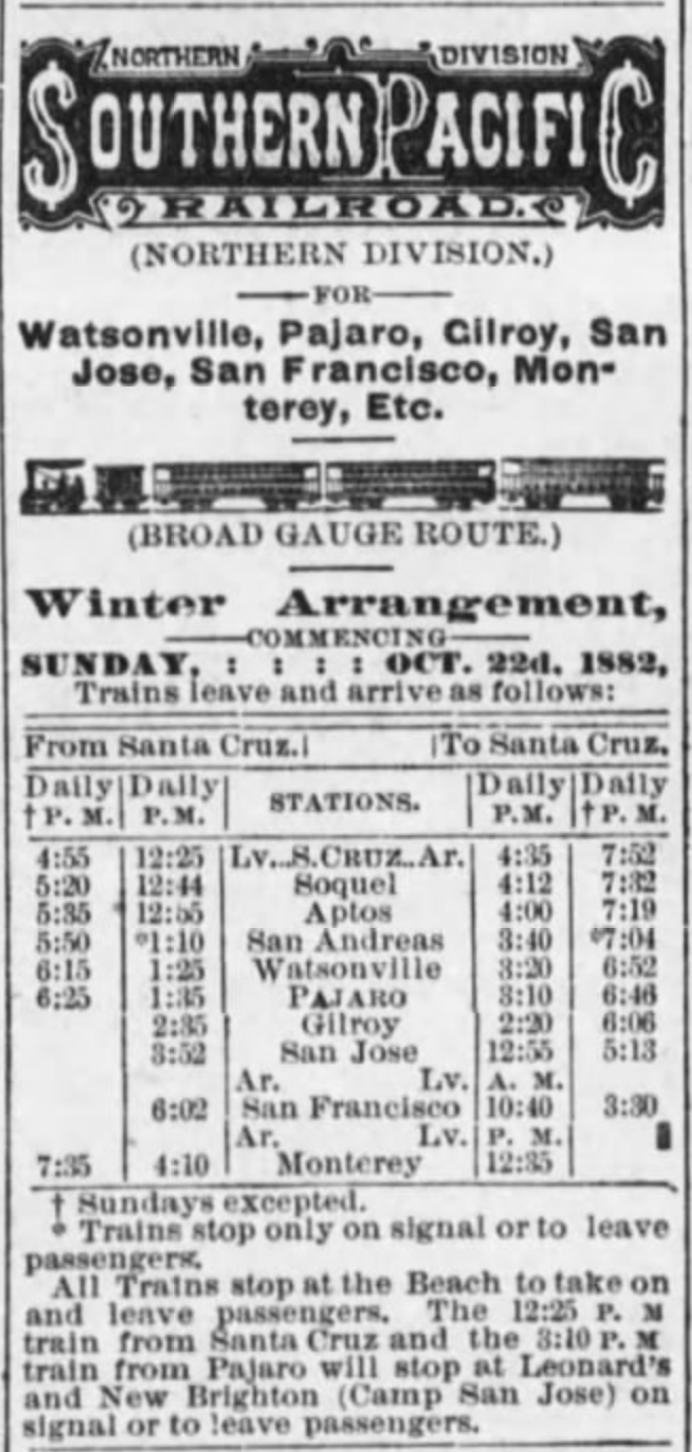
Southern Pacific Railroad schedule published in the Santa Cruz Sentinel, February 10, 1883.

San Francisco to Santa Cruz via Pajaro

The Santa Cruz Railroad was the first system in the county with the ability to connect to the Southern Pacific Railroad's Coast Division mainline at Pajaro, later Watsonville Junction. Once Southern Pacific took over and upgraded the line, a fluid exchange could happen linking Santa Cruz directly to San Francisco, although in reality there was rarely a through line between the points. Most of the time, passengers had to detrain at Pajaro and board a local train.

Passenger travel between Santa Cruz and San Francisco via the Coast Division mainline was never fast. In 1882, travel between the points—a distance of 121 miles—took around 5 hours, 10 minutes. This meant that the average speed of a journey to san Francisco was 23.4 mph. Around 1890, an express option was added that took just over 4 hours, which averaged 30.1 mph.  Over the next twenty years, the time was cut down further, eventually reaching 3 hours, 35 minutes in 1913. That brought the average speed up to 33.8 mph. From there, though, times increased again since all through traffic to San Francisco was directed north along the former South Pacific Coast route and then via the Los Altos Branch, popularly called the Mayfield Cutoff. By the end of passenger service along the Santa Cruz Branch in 1938, travel time from Santa Cruz to San Francisco via Watsonville Junction was 4 hours, 11 minutes, averaging a speed of 28.9 mph. Sun Tan Specials running from 1940 used this line to bring people to the Santa Cruz Beach and its travel time was 3 hours, 30 minutes, essentially the same as the regular passenger trains of the early 1910s.

Santa Cruz & Felton Railroad Time Table No. 2, from the Sentinel, February 10, 1877.

Santa Cruz & Felton Railroad

In some ways, the Santa Cruz & Felton Railroad was the shortest-lived of all the railroads in the county since it was wholly absorbed into the South Pacific Coast Railroad's mainline system in May 1880. It also did not formally engage in passenger service until several months after it began freight service in late 1875. But during the four years that it operated as a passenger railroad, it had a set scheduled that appeared in the local newspapers. Its No. 2 timetable, published in February 1877, gave travel time between Santa Cruz—then located at the Railroad Wharf—and Felton—near the Mountain Community Resources—as 1 hour exactly. This means that the 7-mile-long route transported passengers at a speed of...7 miles per hour. The Santa Cruz & Felton Railroad offered three runs in each direction. Later in the year, this was reduced to two runs, and in mid-1878 only one run each direction. This remained the status until the South Pacific Coast took over.

Cover of South Pacific Coast Railroad time table no. 3, March 28, 1886.

South Pacific Coast Railroad and Railway

The opening of the South Pacific Coast Railroad to Santa Cruz in 1880 heralded the first (nearly) seamless direct service between San Francisco and Santa Cruz. Nearly because a ferry was still required to transfer passengers from San Francisco to the Alameda Mole near Oakland. The South Pacific Coast was a narrow-gauge railroad that ran directly through the Santa Cruz Mountains, passing through Fremont, San José, Los Gatos, and eight tunnels before reaching the seaside town. Little changed along the line even after Southern Pacific acquired it in 1887, by which point it had reincorporated as the South Pacific Coast Railway. The entire line was not standard-gauged until spring 1909, after which most Santa Cruz–San Francisco traffic went via the Mayfield Cutoff rather than by the original Alameda route.

In the nearly thirty years from 1880, travel times between Alameda Junction and Santa Cruz remained remarkably stable. The speed of the train was always fastest between Alameda and Los Gatos, after which trains encountered a meandering track of steeper grades and sharper curves. Nonetheless, the route as a whole made good time. The April 4, 1881 timetable gave the travel time as 3 hours, 37 minutes, which resulted in an average speed of 20.8 miles per hour across 75.3 miles of trackage. Two years later, the time was reduced to 3 hours, 19 minutes leading to an uptick in the average speed to 23 mph. The timetables soon stabilized for the next decade at the slightly faster time 3 hours, 22 minutes, with trains travelling at an average speed of 22.4 mph. Perhaps due to safety concerns or constant repairs along the line, Southern Pacific eventually moved the time up around 1894 to 3 hours, 30 minutes, averaging 21.5 mph, which it retained until the 1906 San Francisco Earthquake shut down the line and it was standard-gauged.

Passengers boarding a South Pacific Coast Railway train at Ben Lomond, ca 1907. [UCSC Digital Collections – colorized using DeOldify]

Felton & Pescadero Railroad and Boulder Creek Branch

Travel time on the 7.30-mile-long Felton & Pescadero Railroad, a subsidiary of the South Pacific Coast Railroad, varied depending on which direction the train was travelling between Felton and Boulder Creek. If the train was heading north, it took 45 minutes to reach Boulder Creek. If it was heading south, possibly because trains needed to use their brakes more, it took 50 minutes to reach Felton. This meant that trains were travelling 9.7 and 8.8 miles per hour respectively. When Southern Pacific took over the line in 1887, it managed to cut the average travel time down to 33 minutes, which more or less remained standard for the next twenty years. Trains, therefore, could transport passengers between the two termini at a speed of 13.3 mph.

In 1908, when the line shifted to standard gauge, trains were finally able to run at a faster clip. For the first year, trains transported passengers between Felton and Boulder Creek in only 22 minutes! This meant the trains were running at an average speed of 19.9 mph. Clearly this was deemed unsafe, or perhaps the company changed to less efficient locomotives, since in 1909 the time was moved back to 30 minutes. Over two decades, the speed bounced between 25 and 30 minutes for the remainder of its time as a passenger line, which ceased around May 1931. Taking an average travel time of 27.5 minutes, the trains during the final years of the Boulder Creek Branch ran at a speed of 15.9 mph.

Ocean Shore Railway timetable no. 19, July 16, 1911.

Davenport-bound Railroads

Two railroads traversed the northern marine terraces of Santa Cruz County: the Ocean Shore Railway, later Railroad, and the Coast Line Railroad, a subsidiary of Southern Pacific. Both standard-gauge railroads were built at about the same time—between 1905 and 1907—and both had the stated, though unrealized, goal of linking Santa Cruz to San Francisco via a coastal route. The Ocean Shore did make it as far north as Swanton, 15.5 miles from Santa Cruz, but the most important destination along the line was Davenport, at least in the earlier years. This location was 10.8 miles from Santa Cruz on the Ocean Shore Railway, and 11.4 miles on the Coast Line Railroad.

The Ocean Shore's short, fourteen-year existence running passengers along the coast was a relatively consistent affair. All of the company's regular trains were mixed and trains took 28 minutes to run between Santa Cruz and Davenport. This resulted in an average speed of 23.1 miles per hour. The Coast Line, in contrast, began running incredibly slow trains. Initially, mixed trains took up to 1 hour, 15 minutes to transport passengers from Santa Cruz to Davenport, probably due to the number of freight stops trains along the way. So much time resulted in a dismal 9.1 mph speed. This soon picked up, though, and Southern Pacific managed to cut the time to 1 hour in late 1909, allowing trains to run at 11.4 miles per hour. By 1913, enough passenger traffic had picked up that dedicated passenger trains could operate, and these only took 30 minutes, matching the Ocean Shore's travel time and running at a far more comfortable speed of 22.8 mph. Both railroads retained this time for passenger trains until each ceased regular passenger service, in 1920 for the Ocean Shore, and in 1932 for Southern Pacific.

Southern Pacific's morning Santa Cruz express train arriving at San Francisco, August 19, 1937. Photo by Wilbur C. Whittaker [Jim Vail – colorized using DeOldify]

The Mayfield Route

The most efficient service that ever ran between Santa Cruz and San Francisco was the direct trains that Southern Pacific ran along the Los Altos Branch, commonly called the Mayfield Cutoff. What it "cut off" was San José, saving trains a major bottleneck of a station and saving several miles of track miles travelled. The Los Altos Branch, between Vasona Junction and Mayfield near Palo Alto, opened in 1908 and allowed through service from Santa Cruz beginning in mid-1909. The route proved so efficient that the mile markers along the Santa Cruz Branch were actually reversed so that they oriented north through the mountains rather than south toward Pajaro. By 1909, the latter route had been reduced to 120.5 miles between San Francisco and Santa Cruz, while the new Mayfield route was a trifling 79.2 miles.

In the early years of the Mayfield route, trains running between the two termini took 3 hours, 20 minutes to reach their destination. That meant they ran at an impressive average speed of 23.8 miles per hour. As with the South Pacific Coast Railway before it, the speed would have been considerably faster north of Los Gatos and slower through the mountains. In the early 1920s, Southern Pacific managed to shave off nearly half an hour from travel, reducing the time to 2 hours, 52 minutes, resulting in trains running at 27.6 mph. Over the subsequent twenty years, this time only got faster. By February 1940, just prior to the sudden shutdown of the route, regular trains travelling on the Mayfield route could reach San Francisco from Santa Cruz in only 3 hours, 9 minutes at a speed of 26.0 mph. But more incredible was the travel time of express trains, which could make the morning commute in 2 hours, 38 minutes at the then-incredible speed of 30.1 mph.

This was the end of regular or express commuter service in the Santa Cruz Mountains. Except for the occasional excursion train and the seasonal Sun Tan Specials, locals who wished to travel anywhere by train first had to drive or take a bus to Watsonville Junction, Los Gatos, or San José. An era of efficient, comparatively rapid transport had ended.

Citations & Credits:

  • Nanney, Duncan. Personal correspondence.
  • Santa Cruz Sentinel. Various articles, 1875-1940.
  • Southern Pacific Railroad Company, various records. California State Railroad Museum.

Friday, September 25, 2020

Railroads: Love Creek Railroad

Logging activity in the Santa Cruz Mountains was on the rise in the 1880s. Redwood mills from south of Felton to north of Boulder Creek and along many of the San Lorenzo River's feeder creeks rapidly expanded following the construction of the San Lorenzo Valley Flume & Transportation Company's v-flume that ran down the valley. It alongside its subsidiary Santa Cruz & Felton Railroad brought millions of board feet of lumber to market via the Railroad and Powder Works Wharves at the Santa Cruz Main Beach. James Pieronett Pierce, a Santa Clara entrepreneur and speculator, wanted in on the local action and approached the task from several angles. Already the founder and president of the Bank of Santa Clara, Pierce used his wealth to embed himself within Santa Cruz County community and industries. He purchased the Pacific Avenue Street Railroad line in 1877 as well as the Santa Cruz Opera House. He became a director in both the railroad and flume projects. But more importantly to Santa Cruz history, he bought the land of Harry Love midway between Felton and Boulder Creek in order to harvest thousands of acres of redwood timber.

A waterfall below a narrow wooden bridge on Love Creek, c. 1900.
[Santa Cruz Public Libraries – colorized using DeOldify]
Captain Harry Love, 1860s.
[Santa Cruz Public Libraries –
colorized using DeOldify]
The California Ranger Harry Love was famous for having tracked down and killed the outlaw Joaquín Murrieta Carrillo on July 25, 1853. In the late 1850s and 1860s, Love lived on a ranch three miles north of Felton along a creek later named after him. At some point in the mid-1860s, Love fell on hard times and sold portions of his ranch to several individuals, including a Captain Staple, who grew Christmas trees on a section and otherwise worked for George Treat's sawmill south of Felton, and Charley Brown, who ran a mid-sized lumber mill somewhere along Love Creek. James Pierce bought Staple's property around 1876. The original tract encompassed the entire west bank of the Love Creek basin, which at the time was estimated to contain between thirty and fifty million board feet of redwood timber. Across from the confluence of Love Creek and the San Lorenzo River, Pierce built his baronial summer residence on a slight rise from where he could view the entire surrounding valley. This property would later evolve into Hotel Rowardennan in the 1890s, but in the meantime, Pierce grew hay for the livestock used in his logging operations.

In 1877, Pierce bought the Enterprise Mill on Love Creek from John Mill, presumably a relative of Harry's. Two years later, he incorporated the Pacific Manufacturing Company. By 1881, he had bought out a former business partner, H. W. McKoy, and took control of his mill as well and shipped this new machinery up the San Lorenzo River. At the confluence of Love Creek and the river, he erected a mid-sized lumber mill, which grew quickly as Pierce added more machinery and expanded the size of the affiliated settlement, initially known as Pacific Mills. During the next few years, he joined many other lumber firms in using the flume that passed through the village to transport lumber to market. When the Felton & Pescadero Railroad snaked through the area in mid-1884 to replace the flume, Pierce jumped at the opportunity to expand his reach up Marshall and Love Creeks, areas which had only lightly been harvested thus far.

County survey map showing parcels for sale in Ben Lomond with all of the Southern Pacific and Pacific Manufacturing Company's trackage in town, September 1887. [Santa Cruz County Records]
From the time that the new railroad passed through his mill town, Pierce planned to install private narrow-gauge railroad tracks to his timber tracts. Other local lumber firms had already done so including the Santa Clara Mill & Lumber Company, the Union Mill, and the F. A. Hihn Company, so its feasibility had already been proven. A September 1887 survey of the town of Ben Lomond shows tracks heading up Hubbard Gulch (then called Paterson Gulch) to the west, another track across the San Lorenzo River beside the vehicular bridge to the south, and a third track up Love Creek to the north, in addition to the mainline track and many spurs that ran through the village. The route up Hubbard Gulch crossed the San Lorenzo River to the west in roughly the same location as the Highway 9 bridge today. It then turned up Hubbard Gulch Road and continued for an unknown length. Pierce hoped that it would eventually run for three miles until reaching the logging community at Pine Flat at the top of Ben Lomond, but this never appears to have happened and the track probably did not extend more than a quarter mile up modern-day Hubbard Gulch Road. The southern track was certainly the shortest and probably catered to Pierce's personal residence just across the river.

The Pacific Manufacturing Company planing mill in Santa Clara, 1898.
[Alice Iola Hare Collection, Santa Clara City Library – colorized using DeOldify]
The third and longest track was installed along Love Creek and this route is much better documented both on maps and in newspapers. From the available evidence, it was in operation from December 1887 until at least 1893. The line's only known track joined the mill company's internal mainline near the junction of Fillmore Avenue and Mill Street in Ben Lomond and then proceeded north, crossing the Southern Pacific Railroad's Felton Branch east of Main Street and continuing until merging with modern-day Love Creek Road at Central Avenue. Beyond Sunnyside Avenue, the crudely-built narrow-gauge railroad entered the redwood wilderness of the Love Creek basin. From this point, there is a good description of the route given in the Surf in 1889:
The cream of the day's enjoyment was a trip on this pocket edition of a railway up the picturesque Love creek canyon to the logging camp. Seated in comfortable chairs upon the flat car, steaming along through the mild spring air, stopping to pick up a few ferns, or remove a fallen branch from the track, crossing Love creek thirteen times in a mile and a half and watching the mountains as they rose height beyond height, this was certainly an ideal way of penetrating the everlasting hills. The "man at the wheel," like the mate of the Nancy Bell, was captain and crew and all, and evidently made a pet of his tiny engine.

A glimpse into the canyon where the great body of timber begins enables one to feebly realize the vastness of Mr. Pierce's four thousand acre tract of timber, which extends nearly to the town of Boulder, and which will be tributary to the mill at Ben Lomond.

The train mentioned in this description was a small locomotive and six flatcars that Pierce purchased in early 1888 for use on his private lines. No photographs of the rolling stock have been found and even the style of the locomotive is unknown.

County survey map of Love Creek properties and the Love Creek Railroad, c 1887.
[Santa Cruz County Records]
The actual length of Pierce's trackage in the area of Ben Lomond is inconsistently reported by newspapers of the time. The article above implies that the Love Creek track was at least a mile and a half and the article elsewhere states that Pierce owned a total of 2.5 miles of trackage in the area. The figures for the tracks in town amount to just short of one mile of additional track, so that may be the maximum extent for the rest of the area. However, logging companies often installed and uninstalled track as needed and it is possible that as much as seven miles of track ran up Love Creek at one point, and more frequently three miles is given for the length of this route. The latter seems more likely since the Love Creek basin in total is only four miles in length. The evidence for where precisely the route went beyond Smith Creek is unclear, although it did continue further along Love Creek for at least a short distance. The logging camp mentioned by the reporter was almost certainly at the confluence of Love and Fritch Creeks, which was the last flat area before continuing up increasingly steep grades.

A waterfall on Love Creek, c 1900. [Santa Cruz Public Libraries]
When precisely the Love Creek Railroad shut down is unknown. Partners Duffey and Simmons began running a mill two miles up Love Creek in October 1890, however, and continued to run the mill on behalf of Pierce until it was destroyed in a boiler explosion in May 1891. Duffey alone rebuilt and shut down for the season in December. It seems likely that this mill continued to use the Love Creek Railroad to get its lumber to Ben Lomond since a December 1892 newspaper report stated that the old locomotive had jumped the track at the southernmost crossing over Love Creek, spilling its lumber into the creek bed. This means that the railroad was still in operation a year later. Following the derailment, horses were used to haul the machinery back onto the grade and the railroad resumed service. 

There are no further mentions of the railroad after December 1892 and it likely was removed before or after the summer 1893 season. By this point, Pierce had incorporated the Ben Lomond Land & Lumber Company in order to consolidate his twin goals of selling his property to interested developers and cutting his remaining timber. The mill in Ben Lomond was also gone and most of the trackage in the town had been consolidated. Whether Pierce even owned the Love Creek Railroad route by 1893 is unclear, but it certainly did not last much beyond that time. In May 1893, the Bank of Santa Clara failed, leaving Pierce short on funds. It was likely this that led to the dissolution of his company and the sale of the remaining land he owned in the region, the remainder of which were sold following his death in 1897. Today, traces of the railroad are occasionally found on the west bank of Love Creek near Smith and Fritch Creeks, where significant bridges were once located. But nothing much remains and that which does is found by chance, usually on private property.

Citations & Credits:
  • Hamman, Rick. California Central Coast Railways. Second edition. Santa Cruz, CA: Otter B Books, 2007.
  • Pepper, George. Personal correspondence.
  • Santa Cruz Sentinel, 1885–1892.
  • Santa Cruz Surf, 1885–1892.
  • Whaley, Derek R. Santa Cruz Trains: Railroads of the Santa Cruz Mountains. Second edition. Santa Cruz, CA: Zayante Publishing, forthcoming.

Friday, June 5, 2020

People: Chinese Railroad Crews

Most railroad companies have their secrets and those that operated in Santa Cruz County were no different. When railroad fever hit California shortly after the Civil War, it coincided with a lack of viable and affordable workers to build the many dozens of planned routes throughout the state. Famously, the Central Pacific Railroad arranged the importation of thousands of Chinese workers to construct its route through the Sierra Nevada and across the Great Basin to Promontory Summit, Utah where it connected with the Union Pacific Railroad, thereby creating the first transcontinental railroad. They were not the first Chinese in the state—several thousand had moved to San Francisco and the Gold Country in the late 1840s and throughout the 1850s—but they were the largest influx in the region's history. As soon as the railroad project was done in 1869, Chinatowns and Chinese villages popped up in every moderate-sized settlement in Central California and cheap manual labor flooded the market.

Chinese workers making a cut along the Monterey Extension Railroad near Pacific Grove, 1889.
[California State Library – Colorized using DeOldify]
Central Pacific quickly realized that their dream of connecting the continent was only the first step in a grand plan to dominate the Western United States, including Santa Cruz County. Acting quickly, Central Pacific bought the Southern Pacific Railroad in 1868 and immediately relocated some of its Chinese workers to San José, where they were employed in building the Santa Clara & Pajaro Valley Railroad to Gilroy between 1868 and 1870. Following that project, they continued on by grading the California Southern Railroad, which became Southern Pacific in October 1870. It was this route that first brought the railroad within range of Santa Cruz County and allowed for the plausible construction of a railroad line along the county's coast to the town of Pajaro.

The Chinese fishing village at China Beach (New Brighton State Beach), 1880s.
[Santa Cruz Public Libraries – Colorized using DeOldify]
Like most California coastal towns, Santa Cruz had Chinese fishermen from early on, and they had a small settlement within modern-day New Brighton State Beach. Chinese laundries popped up in Santa Cruz and Watsonville as well, and at least one Chinese fruit dryer was active in the 1870s in Watsonville. These businesses formed the nascent cores of Chinatowns that arose in Santa Cruz and Watsonville in the 1860s, places where the local Chinese community congregated, traded goods, and often lived. Initially, they were almost entirely composed of working men and prostitutes, but over time families transformed these crude neighborhoods into insular villages within predominantly white towns.

The Front Street Chinatown beside the San Lorenzo River in Santa Cruz, late 1880s. [Colorized using DeOldify]
Racism forced these communities to be transient at times, with them often relocating as necessary to protect their residents. The first community in Santa Cruz was located on Pacific Avenue (Willow Street) between Lincoln and Walnut Streets. When the street was renamed around 1872 and the business district moved down from the Upper Plaza, Chinatown moved to Front Street, where it remained throughout the 1870s and 1880s. Following the relocation of the Santa Cruz railroad depots to the freight yard in 1893, Chinatown relocated beside it, between Chestnut Street and Neary Lagoon. The Watsonville Chinatown was initially located at the corner of Maple and Union, but it was forced to move across the Pajaro River to along Brooklyn Street in 1888.

Chinese workers working along the Monterey Extension Railroad near Pacific Grove, 1889. [California State Library]
California was geographically the nearest state to China and, as such, received the vast majority of Chinese immigrants into the United States. As the numbers of Chinese grew, so too did anti-Chinese sentiment, especially in the Bay Area where the population was the highest. As early as 1850, the Chinese were driven out of the gold industry and in 1858, a law was passed barring the entry of any Asian person into California, but this was overturned by the state Supreme Court in 1862. The depression of the 1870s led to further anger at the Chinese, whom many saw as stealing white people's jobs despite no evidence that this was actually the case. Indeed, the only reason the state government continued to allow Chinese to settle in California was because of their taxable income. By the late 1870s, Asians made up a quarter of California's wage-earning population but used almost no state resources since most were relatively young, healthy men without families. The final straw came in 1879, when California included the exclusion of Chinese in its new constitution, a decision that was expanded by the federal Chinese Exclusion Act of 1882. But this did not stop opportunists like the railroads from employing Chinese workers in their construction efforts. With so many veteran workers of the transcontinental railroad stranded in California, it was worth the risk of fines and public censure for companies to hire cheap Chinese labor to affordably build their railroads.

In 1870, the population of Santa Cruz County was mostly poor and agrarian and had no time or money to build railroads, despite the need. The wealthy were more optimistic, but lacked the clout and money to hire locals to build their dream railroads. Thus, Chinese workers were brought into the county to do the work. It is unknown whether the grading for the San Lorenzo Rail Road, begun in 1868 but halted shortly afterwards due to property disputes, used Chinese laborers, but it seems likely considering the fact that all other railroads built in the county until the end of the century used them. The first railroad to be successfully built in the county, the Santa Cruz Railroad between Santa Cruz and Watsonville, certainly employed Chinese to do the grading and track-laying. A tent city was built beside the right-of-way in the vicinity of Live Oak where crews slept and enjoyed evenings before working long days at the end of track as it slowly progressed southeast toward the Southern Pacific tracks at Pajaro. These workers did not come from the established local Chinatowns and did not live in them, although they would visit them on their days off to buy food and enjoy the pleasures that such a community provided. Lotteries held in the Chinatowns advertised to the workers and runners collected bets in the morning and returned the next day with any prize money, undoubtedly taking a sizeable percentage for the trouble.

The Chinese worker village either along the Loma Prieta line or the Valencia Creek line, 1880s.
[Pajaro Valley Historical Association – Colorized using DeOldify]
Sandy Lydon in his book Chinese Gold outlines the forms of compensation that workers of the Santa Cruz Railroad received. These figures and benefits, with minor variances, can be assumed for all of the local railroads regardless of the company. On average, crews worked ten-hour days, six days a week at a rate of one dollar per day. Two dollars were deducted per week for food and another dollar was usually lost to pay for clothing, recreation, and upkeep, leaving workers with around three dollars per week in income. The railroad companies did provide tents and spaces to pitch them, but offered few other amenities. One benefit—or so it seemed at the time—was that any medical expenses for injuries sustained while on the job were covered by the railroad company and living expenses would also be paid for men unable to return to work. Since workers rarely had families with them at this time, no provisions were given for the care of wives and children.

The second railroad project in the county and the first to be completed was the Santa Cruz & Felton Railroad between Santa Cruz and Felton high along the west bank of the San Lorenzo River. For eight intense months from late 1874 to mid-1875, Chinese workers scaled the sides of San Lorenzo Gorge cutting an at-times tenuous path along the hillside. It was these workers that built the first railroad tunnel in the Santa Cruz Mountains through the Hogsback of Rancho Rincon near today's Paradise Park. No worker died in these endeavors, although minor injuries were common. Since the city of Santa Cruz was staunchly anti-Chinese by this time, it did not allow construction crews to operate within the city limits, so construction of the Mission Hill Tunnel was done by Cornish miners while the Railroad Wharf and other bridges along the line were built by the all-white Pacific Bridge Company. Non-Chinese workers proved costly and a good portion of the overall cost of construction was to pay the wages of these workers.

Even before the Santa Cruz Railroad was completed, construction had begun on the South Pacific Coast Railroad along the East Bay. Like all the other railroads in the state, the company used Chinese workers extensively in the construction of its line from Alameda Point to Santa Cruz. The reason for this was sheer practicality, proven by the recent cost overruns of the Santa Cruz & Felton Railroad: Chinese workers could be employed cheaply and were, in the eyes of their employers, entirely expendable and replaceable. Through political bargaining and Comstock Lode money, the South Pacific Coast was able to safely ignore prohibitions on employing Chinese workers in the railroad industry and push to build its route through the Santa Cruz Mountains.

By 1878, 600 of the South Pacific Coast Railroad's 700 construction workers were Chinese. Crews working for the company were mostly from the Ning Yeung Company of San Francisco, which specialized in finding jobs for out-of-work Chinese manual laborers. Most work crews were composed of twenty to thirty men under a Chinese contractor, with a white site supervisor in charge of relaying tasks from the general manager. Rather than paying workers directly, the South Pacific Coast paid the Ning Yeung Company, which then sent funds to the supervisors to pay to the employees. Attempts by Santa Clara County to tax the workers mostly failed largely due to threats to the tax collectors' lives by the workers. The workers did everything from grading and track laying to tunneling and ballasting. The only thing they didn't do was build the bridges, which was handled by the Pacific Bridge Company.

Injuries were common in railroad construction projects and the Chinese workers received the brunt of the injuries. On the Santa Cruz Railroad in its final months of construction, several workers were maimed and severely injured and one man was killed when the construction train's brakes failed and ran over a group of workers. Indeed, for every mile of railroad built in Santa Cruz County, a Chinese worker died. And the deadliest place to work in the region was in the Summit Tunnel along the South Pacific Coast route along Los Gatos Creek.

A Chinese laborer outside the worker shanty at Wrights, c 1883.
[Bancroft Library – Colorized by Derek R. Whaley]
Wrights had been established around 1877 as a worker camp with around four dozen Chinese living outside the tunnel's north portal. A similar settlement arose on the opposite side along Burns Creek so that the tunnel could be bored from both ends. The tunnel crossed the San Andreas Fault and leaked methane and petroleum from a deep coal vein on the Wrights side. Initially, this threat was dealt with by regular burn-offs of the gas and oil, but more accumulated as crews dug deeper. The first major incident occurred on February 13, 1879, when a burn-off ignited a pocket of oil and fire roared out of the tunnel, singeing worker and timber alike. The intensity of the heat caused the tunnel to act like a cannon, blasting away machinery and structures near the entrance. Around a dozen workers were severely burned and five eventually died from their injuries, with many of the rest sent to San Francisco for treatment.

Chinese workers, white supervisors, and train crew working outside the Summit Tunnel, probably in early 1880.
Fear of returning into the tunnel led to several fights between supervisors and crew. The crews were briefly replaced by Cornish miners in late March, but these workers were even more problematic and new Chinese crews were convinced to work at an increased rate of $1.25 per day. Still, fear and animosity persisted between supervisors and workers, with Nick Borrosey shooting and killing a worker in June 1879. Despite adopting many different techniques to alleviate the gas and oil problem in the tunnel, disaster struck again on November 17. A stick of dynamite unexpectedly exploded igniting a massive cloud of gas and oil. Twenty-one workers and two supervisors were in the tunnel at the time, and another twenty workers ran into the tunnel to rescue their friends following the explosion. But the worst was yet to come. A second explosion followed shortly after the first, and twenty-four Chinese workers were killed instantly. The remainder as well as the supervisors were badly burned as they hobbled out of the tunnel portal into the smokey night air. Seven more workers died from their injuries after being transported by rail to Chinatown in San Francisco.

By January 1880, a permanent fire was alighted at the source of the gas leak in the Summit Tunnel and work resumed. Although new Chinese workers were coaxed into resuming construction, their efficiency and morale were so low that the railroad decided to bring back Cornish workers and reassign the Chinese workers to the other end of the tunnel, which had not experienced the same problems. This finally worked and the two crews raced each other to complete their ends. With the tunnel completed, air could flow through it regularly, dispersing the gas and reducing the risk of further fire and explosions. An out-of-the-way cemetery was established near the tracks at Wrights to mark the graves of the two dozen men who died there in November 1879, but the markers have long since disappeared and the location is now lost. No further workers died while building the line to Santa Cruz.

While the disaster in the Summit Tunnel was certainly the worst felt by Chinese railroad workers in the county, a mudslide in Felton in 1881 was a close second. Following the completion of the South Pacific Coast route, worker camps were established across the line, especially in the mountains, to maintain the trackage, top up ballast, and repair tunnels and bridges. Around twenty workers lived north of Felton, probably along Zayante Creek, when a mudslide fell on their settlement during a winter storm in February 1881. A dozen bodies were found in the slide but many more are thought to have been washed down the creek and river or been left buried.

Chinese crews heading out to work on the Loma Prieta Railroad, 1882.
[California Historical Society – Colorized using DeOldify]
When the Southern Pacific Railroad took over the Santa Cruz Railroad in 1881, it brought in thousands of Chinese workers for the dual task of standard-gauging the railroad and building a new branch line up Aptos Creek for the Loma Prieta Lumber Company. Broad-gauging took two years and in mid-1883, crews were redirected to the redwood forest of Aptos Creek to cut a crude railroad into the heart of the mountains. After reaching the new town of Loma Prieta, crews turned to the northeast and reached the narrow gorge nicknamed Hell's Gate, which proved to be the only obstacle in Santa Cruz County that required workers to hang on ropes from above to cut a grade in the cliffside. While major construction along the line ended in 1888, a reduced crew remained to oversee the continuous expansion of trackage deeper into the mountains.

The slide zone on the Boulder Creek Branch near Brackney were some Chinese workers died cutting the grade, 1885.
At the same time that the Loma Prieta Branch was under construction, the South Pacific Coast Railroad was building a new route up the San Lorenzo Valley from Felton to Boulder Creek. Most of the workers were veterans of the railroad's main route through the Santa Cruz Mountains. The route to Boulder Creek was less troubled than that through the mountains, but the difficult terrain in the Brackney area required careful construction and several Chinese workers died in the effort. These men may have been the last Chinese lives lost for the cause of Santa Cruz railroading. When the branch was completed, most of the crews were transferred to the Almaden Branch.

Chinese crew carving out the Valencia Creek grade, 1886. [Aptos Museum – Colorized using DeOldify]
Three private railroad projects were the last to utilize Chinese labor in the county. In 1886, Frederick Hihn hired Chinese crews to build a narrow-gauge railroad along Valencia Creek between Aptos and his mill three miles to the north, as well as the tracks' extension into the forests beyond the mill. Meanwhile, north of Boulder Creek, the Santa Clara Valley Mill & Lumber Company likely used Chinese labor in early 1888 to build a low-budget narrow-gauge railroad on the San Lorenzo River. And in the Pajaro and Salinas Valleys in the early 1890s, Claus Spreckels employed multiple crews of Chinese workers to construct the Pajaro Valley Railroad along the Monterey Bay so that sugar beet farmers could more easily get their products to the large Western Beet Sugar factory in Watsonville.

Chinese workers on a flatbed car on the Monterey Extension Railroad near Pacific Grove, 1889.
[California State Library]
The mass employment of Chinese by the railroads ended around the turn of the century. By this point, the Chinese Exclusion Act had been in force for two decades and adherence to it had become more societally expected than in the boom days of the 1880s. Most of the Chinese men living in the state had been doing so since the 1860s and were now considered too old to work efficiently. Furthermore, outbreaks of plague in Chinatown in San Francisco beginning in 1898 led to further negativity toward the Chinese which added to the public opinion that the Chinese were unclean and diseased. Thus, when the Ocean Shore Railway and Coast Line Railroad projects to build a route along the coast between San Francisco and Santa Cruz were initiated in 1904, both companies chose not to employ Chinese workers. Chinese men and their families continued to live and work in several industries throughout the county, but their time as a labor force for the railroad was at an end.

Citations & Credits:
  • Lydon, Sandy. Chinese Gold: The Chinese in the Monterey Bay Region. Capitola, CA: Capitola Book Company, 1985.
  • Whaley, Derek W. Santa Cruz Trains: Railroads of the Santa Cruz Mountains. Second edition. Santa Cruz, CA: Zayante Publishing, forthcoming.

Friday, October 18, 2019

Railroads: South Pacific Coast Railroad

With the completion of the first transcontinental railroad across the United States in May 1869, railroading schemes within California reached a fever pitch. Everyone with a little spare money was becoming interested in investing in a railroad line, from tiny short-line routes like the eight-mile Santa Cruz & Felton Railroad to grand transcontinental schemes such as the Denver & Rio Grande Railroad. The people of Oakland especially were excited since the Central Pacific Railroad decided upon their seaside town to be the terminus for the line. But with the head of the Central Pacific-Union Pacific megalith peaking into the Bay Area, others sought ways to both exploit and bypass this new connection to the outside world.

The South Pacific Coast-owned Alameda to San Francisco ferryboat Newark, c. 1890s. [Bancroft Library]
The most significant pioneering local railroad was the San Francisco & San Jose Railroad, which began through operations in 1863. In 1865, the company established a subsidiary, the Southern Pacific Railroad, which was part of an ambitious plan to reach Southern California. But financial troubles in 1867 imperilled both companies and the Central Pacific Railroad's owners, the Big Five, bought them out in 1868. The two were consolidated in 1870 and linked to the Central Pacific line at San José via an extension of the track that ran through Niles Canyon. With this link, the Big Four gained a near-monopoly on South Bay Area railroading.

The combined Central Pacific-South Pacific Coast San Francisco ferry terminal at the end of Market Street, c. 1882. Stereograph by William E. James. [John Hall]
At the same time, a succession of rival narrow-gauge railroads had arisen on the East Bay only to collapse in short order due to funding and bad luck. The California Narrow Gauge Railroad & Transportation Company lasted all of six months before it crashed in the summer of 1875, having done little more than buying some real estate. In its wake, the Santa Clara Valley Railroad was incorporated on October 4 to build a railroad route between Dumbarton Point and the New Almaden quicksilver mines. But winter storms in late 1875 and early 1876 washed out most of the grade work that had been done and the company was on the brink of collapse again. Enter Alfred E. Davis. One of several East Bay rural farmers, Davis had a vision for a great railroad that could rival the Southern Pacific's regional monopoly. He recruited Comstock Lode millionaire James G. Fair, who in turn recruited his friend James C. Flood, and together the three men incorporated the South Pacific Coast Railroad on March 24, 1876. The name was chosen to mirror the recently-founded and similarly narrow-gauge North Pacific Coast Railroad in Marin and Sonoma Counties.

South Pacific Coast locomotive No. 1 on the Telegraph Avenue Branch (technically the Oakland Railroad) at the city limits, late 1880s. From here, horses would take rolling stock through Oakland since the city forbade steam locomotives within its limits. [John Hall]
Davis planned for the railroad to run from Alameda Point near Oakland almost directly south through San José and through the Santa Cruz Mountains to Santa Cruz. At this time, Santa Cruz still sat outside Southern Pacific's control, although that would not remain the case for long. Davis also had a greater vision to extend the line further down the coast and north through Oakland and into the San Joaquin Valley, where it would meet up with the Denver & Rio Grande Railroad. The firm even incorporated a subsidiary in 1883, the San Francisco & Colorado River Railroad, to achieve this goal, but it proved to be one ambition too far. Still, the goals of the railroad were public and achievable. In addition to their direct route between Alameda and Santa Cruz, the firm planned to build branches up the San Lorenzo River to reach the rich old growth redwood strands located there, up the New Almaden valley to reach the mercury mines, and maintain a ferry service across the bay in order to function as a direct rival to Southern Pacific, which at the time had a monopoly on railroad access to San Francisco.

The former South Pacific Coast Railroad station at Santa Clara serving as the new Union Depot for Southern Pacific, 1898. [Santa Clara City Libraries]
The northern three-quarters of the primary route consisted of a fairly gentle grade that smoothly wrapped around the East Bay from Oakland down to San José, where the route turned southwest and paralleled Los Gatos Creek until it reached the foothills. Surveying for the route had begun even before incorporation and grading began right afterwards. Through the second half of 1876 and the first half of 1877, Chinese work crews graded and laid track at a fevered pace, encountering few obstacles that Fair or Flood couldn't overcome with some money or Davis through aggressive negotiating. By June 1, 1877, the track to Los Gatos was opened and the railroad, for all intents and purposes, was open for business.

Andrus Company of the Juvenile Zouaves at Los Gatos Station, 1885. [Museums of Los Gatos]
As regular freight and passenger movement began along the installed track, negotiations began with the Santa Cruz & Felton Railroad to buy or lease their line to serve as the final section of the route. The short-line railroad hedged heavily, briefly incorporating a rival railroad that, if actually built, would have undermined much of what the South Pacific Coast was trying to accomplish. Charles Silent, president of the smaller railroad, also was aware of the larger firm's potential and likely paved the way for the eventual leasing of the smaller line to the larger in 1879.

Postcard showing the rugged terrain along Los Gatos Creek in the foothills, c. 1895. [Ken Lorenzen]
Meanwhile, as the railroad graded its way to Felton, it encountered several predicted obstacles, namely several mountains that needed tunnelling and a few creeks and rivers that needed bridging. The bridges were by far the easier challenge. A total of eight bridges were required to cross Los Gatos Creek, not counting a bridge just north of Los Gatos that was to serve the mainline until the route was rerouted through town due to unstable terrain on the east bank of the creek. This remained in place for use by the local flour mill and for a lime quarry. More bridges, including several half-trestles, were needed along Burns and Bean Creek, while Zayante Creek near Felton had to be crossed twice, as well. Lastly, a substantial composite bridge was required to cross the San Lorenzo River over an especially wide floodplain before the line could connect to the existing Santa Cruz & Felton trackage at Felton Junction. All of the bridges were completed by the end of 1879, including repairs and upgrades to the Santa Cruz & Felton bridges, some of which were filled at the time to provide better support.

South Pacific Coast Railroad train stopped for a photograph along Coon Gulch in San Lorenzo Gorge, c. 1880s.
[Public domain]
More problematic was the need for tunnels through the mountains. Only three of the tunnels were built without difficulty: those between Highland (Laurel) and Glenwood, under Mountain Charley Road, and along Zayante Creek. In Los Gatos Canyon, two tunnels were planned but the first, just south of Los Gatos, collapsed during construction and was subsequently daylighted. The other was completed but its location directly under the Los Gatos flume meant that its construction had to be done with the utmost care, slowing the boring down significantly. In San Lorenzo Gorge, a new tunnel was required to cut through an especially sharp turn beneath Inspiration Point. Because of the unstable land, though, this tunnel was built longer than anticipated and was lengthened even more in the following years to keep debris from falling onto the tracks. An existing tunnel under the Hogsback about two miles to the south had to be widened and the height lifted slightly to support the larger South Pacific Coast locomotives. This also destabilized the tunnel, eventually leading to its daylighting several years later.

Construction crews finishing work on the Summit Tunnel at Wright's Station, early 1880. [Public domain]
Without a doubt, the biggest difficulty was the Summit Tunnel, which cut directly through the San Andreas Fault in its 1.25 mile journey between Wright's Station and Highland. It took two and a half years to build and cost the lives of at least forty-six Chinese workers in total. The reason for the deaths was that the tunnel had a methane leak that was never entirely resolved, and construction tools, lamps, and machinery unexpectedly set off the gas on two disastrous occasions on February 14 and November 17, 1879. When it finally was bored through in March 1880, many people breathed a sigh of relief. The airflow in the tunnel kept it from exploding again, but various remedies were applied over the years to ensure its continued safety.

South Pacific Coast Railroad passenger cars with conductors, 1880s. [John Hall]
The routes of the South Pacific Coast Railroad
and its subsidiary lines, 1887.
The route to Santa Cruz opened on May 10, 1880 and it thrived for the entire seven years that it was under the control of Davis. It became a popular tourist train in the summer, with families from San Francisco and Oakland going on day picnic trips to the redwoods and the beach, or longer summer vacations to the same. Local fruit growers appreciated the easy access to the Bay Area markets the railroad provided, while larger timber, lime, gunpowder, and other industrial patrons enjoyed direct access to San Francisco and beyond.

With an eye toward expansion, the South Pacific Coast established several subsidiary railroads that ran as branches off its main line. The first substantial route was the Felton & Pescadero Railroad in 1883, which in the short term terminated at Boulder Creek, but had plans to hop over to Pescadero Creek and run down to the coast before turning south and wrapping back to Santa Cruz. Had this been completed, the route would have tapped the Pescadero, Butano, Scott Creek, and San Vicente basins, all areas rich in old growth redwoods that would not be fully logged for decades afterwards. Other smaller routes brought the railroad directly into downtown Oakland as well as out to Dumbarton Point and Centerville. The last substantial subsidiary expanded a track out from Campbell and terminated at the bottom of the Almaden Valley, finally achieving the long-sought goal of the original California Narrow Gauge Railroad of connecting Dumbarton with the quicksilver mines in July 1886.

A horse-drawn boxcar and passenger car on the Centerville Branch of the South Pacific Coast Railway, c. 1890s.
[PacificNG]
By this point, however, the local railroading scene was changing fast. Southern Pacific was expanding in all directions and playing dirty with the South Pacific Coast. In Santa Cruz, Southern Pacific purchased the bankrupt Santa Cruz Railroad in 1881 and standard gauged its trackage in 1883. While this didn't significantly compete with the South Pacific Coast—they still had different routes with different freight patrons—it meant that passengers could now choose between crammed narrow-gauge cars or spacious standard gauge cars to get to Santa Cruz. Meanwhile, before the South Pacific Coast line to New Almaden was even completed, Southern Pacific began building a rival line from downtown San José that would equally benefit from being standard gauged. And throughout all this time, the two railroads vied for passengers and freight patronage along the East Bay, especially within Almaden County where the trackage was sometimes so close that train crews could see each other.

Although the South Pacific Coast Railroad was certainly a profitable business, revenues were not as high as anticipated and they were looking to continue to fall over the coming years. Flood wanted out, Fair was tired of his railroading project, and Davis didn't really have much say in the matter. Fair opened negotiations with Leland Stanford and Collis Huntington of Southern Pacific in 1886 and the two companies finally agreed to a long-term lease early the next year. On May 23, 1887, all of the subsidiaries were consolidated into the South Pacific Coast Railway. This was then leased to Southern Pacific on July 1. It remained a separate corporate entity for fifty years, only amalgamating into Southern Pacific on December 3, 1937, but Fair sold out his share in the company by the early 1890s.

Company logo after leasing
the line to the Southern Pacific
Railroad in 1887.
In many ways, nothing changed for two decades. Portions of the route, especially around Oakland, were standard-gauged but the bulk of the network remained narrow-gauge into the late 1890s. Southern Pacific continued to operate it as its own subdivision and it had its own fleet of rolling stock to cater to the tighter track width. But by the time of the April 18, 1906 earthquake, the route between Alameda Point and Wright had been dual-gauged with plans to throw off the center rail imminent. The earthquake delayed plans for the rest of the line by three years but also allowed the railroad to finish widening tunnels and replacing bridges, as needed. The route reopened as entirely standard gauge in Spring 1909 and the last real vestige of the South Pacific Coast was gone. Its name ceased to appear in any marketing and the fires in San Francisco after the earthquake had destroyed much of the company's records and history. South Pacific Coast was little more than a paper railroad after 1909, representing nothing except a long-forgotten lease between long dead dead men.

Citations & Credits:

Friday, August 16, 2019

Curiosities: Boulder Creek-Area Resorts

From its earliest years as a community, Boulder Creek and its predecessors—Boulder and Lorenzo—was more of an industrial town than a resort destination. Throughout the five decades that the railroad operated in the community, the driving purpose of the settlement was the lumber industry, and it should come as no surprise that much of the timber in the surrounding hills were logged out, leaving little space or scenery for resorts. Nonetheless, resorts did develop from early on and the town was known to host several hotels throughout these years. Below are just some of the hotels and resorts that operated in the vicinity of Boulder Creek during the period 1884-1934.

Boulder Creek House (1872 – 1933)
The first commercial hotel to open in the vicinity of Boulder Creek was the Boulder Creek House, erected along modern-day Park Avenue near where the public library sits today. The hotel was built by John Alcorn, a native of Indiana who moved to the area in 1865. His wife and a Mrs. Eygler ran the day-to-day operations and the hotel was open year-round, which testifies to its industrial clientele. The Weekly Sentinel stated that the building was "two stories high, with a porch the entire length, from which a flight of stairs leads to the dancing hall above. The lower part is divided into dining room and sleeping apartments, and arrangements for the necessaries and comforts of dwellers and travelers."

Boulder Creek House, c. 1877. Photo by R. E. Wood. [California State University, Chico]
Alcorn soon sold the property to Demicrius Crediford, who turned around and sold it to J. S. Carter in 1874. When the San Lorenzo Valley Flume & Lumber Company was founded the next year, Carter sold the hotel to serve as a boarding house for local lumbermen. It passed to the South Pacific Coast Railroad in 1879 and probably remained under their—as well as Southern Pacific Railroad—ownership for nearly thirty years. Several managers were brought on during this time to handle daily operations, including George Denison (1883), Joseph Ball (1886), Samuel D. Morgan, (1894, who briefly renamed the hotel the Morgan House), and George and Albert Denison (1905). During this time, most of the excess property of the hotel was sold to Winfield Scott Rodgers.

J. M. Fuller's Cash Grocery with the Boulder Creek House in the background, c. 1910.
Photo by Cheney Photo Advertising Company. [WorthPoint]
In 1905, Patrick and Fannie Welch purchased the property and it remained in their family for twenty-eight years. In most years, the Welches personally supervised the hotel, but Helen Jeter was brought on to assist in 1913. After Fannie's death, the hotel passed to her son-in-law, Frank Murphy, who leased it to William D. Alexander. Alexander tried to rebrand the hotel the White House in 1924, but the name never took off. Soon afterwards, he tried again by naming it the Alexander House and he opened an Italian restaurant under the name Alec's Boulder Creek House.  Unfortunately, an explosion in the kitchen in the twilight hours of August 14, 1933, quickly turned into an inferno and consumed the entire building except for a few pieces of furniture.

Lorenzo Hotel (1875 – 1897)
Joseph Peery was an entrepreneur and visionary and wanted to create a small city high up the San Lorenzo Valley. He founded the town of Lorenzo in 1875 and built the San Lorenzo Hotel along the main county road as a part of his plan. The two-story hotel was a rather no-nonsense structure composed of roughly twenty guest rooms and a stable. Management was initially given to the Elliott family, but it later passed to James T. Taylor, owner of the Big Tree Hotel in Felton, in 1880. George M. Day took over in 1882 and began selling wine, liquor, and cigars downstairs, profiting from the alcohol ban in nearby Boulder. Management of the hotel proved unstable over the following years, though. In quick succession, the hotel was run by Taylor (1884), the Hartman Brothers (1885), W. G. Randall (1886), and Samuel Hubbs (1887). Some time over the next decade, H. E. Gardner purchased the property and hired H. H. Morrell to manage it. Little else is known from this decade, though, except that the hotel appeared as a casualty of the April 14, 1897 fire that destroyed most of the commercial block of Lorenzo. The town was soon absorbed into Boulder Creek and the hotel was never rebuilt. The hotel was located on State Route 9 near Mountain Street.

Hartman Hotel (1883 – 1897)
Another early hotel and possibly a spin-off of or companion to the Lorenzo Hotel, the Hartman Hotel was located where the Boulder Creek laundromat now sits. Dan Hartman founded the hotel in 1883 and it was run by himself and his brothers. During its years in existence, it hosted several VIPs including Grover Cleveland, Ulysses S. Grant, and an entire circus troupe. Like its neighbor, the Lorenzo Hotel, the Hartman Hotel burned to the ground on April 14, 1897. Dan Hartman sustained minor injuries escaping the inferno.

Rex Hotel (1884 – 1932)
For being one of the oldest standing buildings in Boulder Creek, surprisingly little is known about the Rex Hotel, largely because it has a confused and conflated history with another hotel that was located two buildings over: the Basham House. The current building called the Basham House has historically always been the Rex Hotel. Established as early as 1884 as a bordello, the hotel did not gain any respectability until the early 1920s after Newton Ernest Raymer took over the building. He ran a barber shop and general store on the first floor while renting rooms upstairs and in the back. But Raymer was no angel. The hotel barely survived Prohibition and Raymer was arrested for illegal possession of liquor on at least two occasions. On February 2, 1932, Raymer shot himself in a drunken rage while attempting to murder his wife. It was not the first violent attack by Raymer, but it was his last. The hotel shut down for several years but was eventually purchased by P. Giacosa in March 1937, who undertook a remodeling of the hotel. But then it disappeared from records once again. It was taken over by the Boulder Club, run by Jack and Frances Gaultier, in 1973 and after several years servicing local workers, it became a popular gathering place for Hell's Angels and other biker gangs. Drunken fights became an almost daily occurrence and the business ran afoul of the Alcoholic Beverage Control (ABC) several times. In 1990, the club shut down permanently. Three years later, the building was purchased by Wes Felts, who renovated it into a restaurant and opened in October 1993 as the Basham House, mistaking the building with the earlier structure that had stood two buildings to the north. After only a year in business, Felts put the restaurant up for sale where it languished for over a year. At some point since then, it was purchased and renovated and now serves as the home of the Psychic Temple at 13133 Central Avenue.

The Rex Hotel as it appeared in 1990 while hosting the Boulder Club. [Santa Cruz Sentinel]
South Pacific Hotel (1886)
As soon as the Felton & Pescadero Railroad came to town in 1885, property speculators came in. And one such speculator was J. W. Billings, who in 1886 erected the South Pacific House on Central Avenue, a clear reference to the new railroad's parent, the South Pacific Coast Railroad. Within months of opening, Billings was adding new rooms and upgrading facilities. However, tragedy struck early in the life of this hotel. On July 30, 1886, just months after opening, a fire ravaged the town and severely damaged the hotel, injuring both J. and his wife in the process. Nothing more is mentioned of this hotel after the fire.

Wildwood Home (1886 – 1932)
The Wildwood Home was another hotel that sprang up in the wake of the Felton & Pescadero Railroad's arrival to Boulder Creek in 1885. Situated at the corner of Lomond and Pine Streets, Wildwood Home was built, owned, and managed by Mrs. L. E. Paschall when it first opened in May 1886. The twenty-room hotel was notable for its creeping vines and ivy that flowed off the second story balcony toward the ground. Management passed through several hands over the years, including to Mrs. Jerome Goerecke (1890) and Mrs. Kenneth Ferguson (1891). Paschall sold the hotel in 1896 to Mrs. M. C. Cumming (née Roundtree) of Fresno, who continued to operate the hotel for several more years. Little is reported on the hotel for the next decade. In 1905, after years of neglect, the hotel was taken over by Julia A. Glenn, who refurbished it completely and added new rooms. She hired Mae Chambers as the manager, who took over in early 1906.

Wildwood Home, sans its iconic vines, c. 1900. [San Lorenzo Valley Museum]
Ownership passed to Mrs. Emma E. Hutchings in the early 1920s and, during this time, several films crews and celebrities stayed at the hotel while filming movies in the vicinity of Big Basin. In 1930, she handed day-to-day management to A. H. Lindsey, his wife, and their three sons, all of Kettleman, California. But the hotel declined while under their care. Hutchings returned in 1932 with plans to either sell or improve the building when a fire struck early in the morning of May 14, 1932. The hotel did not have any guests at the time, owing to the renovation, and there were no injuries, but the building was destroyed outright and never rebuilt.

Alpine House (1890 – c. 1915)
What began life as the Morgan House first opened its doors around 1890 under the ownership of Dr. Sam D. Morgan. The Sentinel describes the hotel in 1894 as "conducted in first-class style, the dining-room and cuisine department being under the able supervision of Mrs. Morgan, whose reputation as a hostess is already well established. The table is supplied with the best the market affords, and everything about the hotel has an air of cleanliness, every detail tending to the comfort of the guests being attended to. Mr. Morgan is considering the enlargement of his hotel, in order to accommodate increasing business." In 1893, L. E. Paschall of Wildwood Home was bought on to manage daily operations at the hotel. When the Alpine House first opened in 1895, it was founded as a separate hotel from the Morgan House, but the two were intricately entwined from the beginning with Sam Morgan in charge of both. As he oversaw the new Alpine House, he hired William Branch to run the Morgan House. Whether the two merged together after 1896 or the Morgan House was demolished is unclear and Sanborn Fire Insurance Company maps of the time do not provide clarity, but the Morgan House is never mentioned again by the Sentinel after 1896.

The Alpine House sat prominently at the corner of Central Avenue and Big Basin Way (State Route 236), c. 1900.
[San Lorenzo Valley Museum]
In 1899, Otto Ausman became a partner in the business, but sold his share to a relative, Emma L. Ausman, in 1904. That same year, W. S. G. Todd became the manager, but he was replaced in 1905 by Frederick G. Troy, a nephew of the McAbee Brothers who owned a mill on Two Bar Creek. However, scandal hit Troy in 1907 when he was found allowing a minor to gamble in the hotel. The hotel shut down for the remainder of the year. In 1908, the hotel was purchased by the Koepkes, who installed the final stretch of cement sidewalks in town. All record of the hotel disappears around 1910. It was located across State Route 236 from Johnnie's Supermarket where the Boulder Creek American Gas is today.

Basham House and Baldwin Lodging House (1891 – c. 1920s)
The real Basham House, not to be confused with the former Rex Hotel now called the Basham House, was built around 1891 by William Basham. For the first several years of its existence, it served as a boarding house for seasonal lumbermen. As such, it was rather small, with only eight upstairs rooms for guests, while the downstairs was used as a restaurant and store. Basham soon sold the boarding house to Andrew J. Baldwin and the latter renamed it the Baldwin Boarding House. Baldwin, in turn, sold it or transferred it to his relative, Rachel F. Baldwin, in 1896. She only kept the hotel for a few years, selling it to Lizzie Brickmore in 1902. Brickmore followed suit and the hotel passed to William F. Pierce in 1905. He was responsible for adding the second-story covered veranda and remodeling the boarding house into a proper hotel with twenty guest rooms in 1911. A few years later, Jacob Hartman purchased the hotel and ran it until 1920, when it was sold to Annie Dexter. After this date, the hotel is never mentioned again in newspapers. It sat midway between the Rex Hotel and the Alpine House, roughly where the alleyway between Boulder Creek Liquors and the Brandy Station is located today.

A trio of hotels on Central Avenue, c. 1912. In the foreground is the Rex Hotel, next to it sits the original Basham House, and in the distance is the palatial Alpine House. [San Lorenzo Valley Museum]
Commercial Hotel and Alpine Inn (1897 – 1956)
The structure that would later be known as the Big Basin Hotel was appropriately founded by the original owner of Big Basin, Henry L. Middleton. Middleton built the Commercial Hotel at the corner of Central Avenue and the future State Route 236 in 1897. He hired as manager George Denison, who once ran the Boulder Creek House and whose brother, Albert, ran it for several years. The structure was a long boarding house with a mid-sized restaurant on the first floor and fifteen rooms for guests.


Commercial Hotel on Central Avenue in Boulder Creek, 1901. Photo by Andrew Hill. [History San José]
A dozen years after the opening of California Redwood Park—now Big Basin Redwoods State Park—the hotel was run by Middleton's California Timber Company, the successor to many of the local lumber firms that ran out of usable timber at the beginning of the twentieth century. In 1914, the company was looking for new sources of revenue since their operations on Waterman and Newell Creeks were running out of usable timber. Their hotel in downtown Boulder Creek held some potential, at least for the short term, so they tried to capitalize on the Big Basin name by renaming the hostelry the Big Basin Hotel. The gambit failed. After a few seasons, the hotel shut down. It was reopened in February 1919 as the George Hotel under the management of George Honold, but the new name didn't stick and the Honold only ran the hotel for a single season.

A big change occurred in 1920, when Adelaide T. Gibbs purchased the hotel and rebranded it the New Alpine Hotel, undoubtedly in reference to the Alpine House. Her death later that year passed ownership to her son, A. W. J. Gibbs. For several years, little was said of the hotel in newspapers and it may have served more as a private home for Gibbs and his family, who also owned Gibbs Ranch Resort above Zayante. The hotel did not become a popular destination until Doris Martin purchased the property in 1925 and tweaked the name into the Alpine Inn. The Martins were popular with the citizens of Boulder Creek and hosted several sold-out dances during the first year that they ran the hotel. They famously installed the first neon lighting on the side of their building in April 1925, signalling a technological change for the rural town. Within a few months, the hotel was completely electrified and well-lighted. However, the Martins did not remain patrons of the hotel for long. In early 1926, Howard W. West took over, but by June, M. S. Griffin was in charge. The next year, West's brother-in-law, Charles Jones, was brought on as manager and remained in that capacity for three seasons. The Martins finallysold the hotel in December 1929 to Ida Lietzow-Chamberlain, who saw its potential as a tourist hub with the impending completion of Skyline Boulevard.

The Alpine Inn situated prominently on Central Avenue, late 1930s. [Santa Cruz Sentinel]
Lietzow immediately began remodeling the hotel and hired her daughter, J. W. Pfeifer, as manager.  In 1931, she brought in a new manager, Lewis Williams, who continued the renovations and improved the restaurant. Like most hotels in the area, the Alpine Inn suffered from prohibition raids, but its next manager, Louis Wenger, was arrested when a large quantity of alcohol was discovered at the hotel in 1932. Lietzow returned in 1934 to manage the hotel and continue renovations. By this point, Lietzow was living in Los Angeles most of the time and the hotel was becoming a hassle. She hired Lynn Upton and Emma West to run the hotel in 1935, giving them the option to buy. They converted the entire hotel into what would today be termed a bed-and-breakfast. Still, Upton and West were not interested in buying so Lietzow brought on J. A. White in 1936. Finally, in November 1936, Lietzow was able to sell the hotel to C. E. Cadigan, a San Francisco hosteller and property investor. Cadigan immediately installed a cocktail lounge downstairs and convinced Greyhound to establish him as the local agent and the Alpine Inn the bus station. And yet Cadigan's ownership lasted less than two years.

One of the last photographs of the Alpine Inn, taken in February 1956 just months before the building was demolished to make way for Johnnie's Supermarket. [Santa Cruz Sentinel]
In July 1938, the Locatelli family—Poldina, Gery, Peter, and Emilia—took over the hotel. They split the downstairs into a restaurant and liquor store while retaining the upstairs as a hotel. Around 1943, they sold the hotel to Robert and Bessie Burns, who in turn sold it to John R. and Lena Montanari and Marceau and Marie Louise Paulian in 1948. The next year, the Paulians left the partnership and were replaced by William H. and Carmen Sohr. The Sohrs oversaw the conversion of the restaurant into a Chinese Village Dining Room, specializing in Chinese food. The final owner of the hotel was Gene Engle, who purchased the hotel around 1953. After running the business for three years, Engle sold the hotel back to John Montanari in April 1956, who demolished it and built Johnnie's Supermarket in its place. Johnnie's opened on June 7.

Locatelli's Inn and Scopazzi's (1906 – Present)
The early history of the Locatelli Inn—today's Scopazzi's Restaurant—on State Route 236 is not entirely clear. As early as 1906, an Italia Hotel run by Alessandro Musitelli was operating in Boulder Creek, as reported by the Sentinel when Musitelli was caught selling liquor without a license. But whether this Italia Hotel was the same as the latter Locatelli Inn is unknown, although a Sentinel article published in 1955 certainly connects the two. Giuseppe M. "Joseph" Locatelli did not enter the industry until 1915, when he applied for and was granted a liquor license, signalling the start of his business. Interesting, the license he received only allowed liquor to be sold with meals, so this also marks the start of his restaurant. Unfortunately, he was arrested in 1917 for selling liquor without a license (the laws had changed in the meantime) and was forced to simply sell food without liquor, which became a national law when Prohibition arrived in 1920.

Locatelli's Inn, with the hotel barely visible at the far left, c. 1950.
Locatelli made an important addition to his hotel in 1924 when he added the well-known dining room beside the hotel. Soon afterwards, he renamed the hotel and restaurant Locatelli's Inn. Indeed, the 1920s transformed the workmen's hostelry into a prime locale for the Hollywood glitterati, who used the location on Big Basin Way as a base station for several movies that were filmed in and around Big Basin, especially at Poverty Flat. Unlike so many other businesses in the area, Locatelli's Inn survived the Great Depression and World War II, and the whole time remained under the ownership and management of the Locatelli family, even after Joseph's death in 1951. Catherine L. Locatelli took over and ran the restaurant throughout the first half of the 1950s, although the hotel seem to have shut down by this time. She finally sold the hotel and restaurant to John, Albino, and Guido Scopazzi on May 4, 1956. Within a few years, the Scopazzis built a connecting hall between the restaurant and hotel, using the old hotel for extra seating, an expanded kitchen, and office space. Scopazzi's remains in business as one of the oldest and most popular restaurants in Santa Cruz County.

Piedmont Hotel (1913 – 1920)
As the lumber industry north of Boulder Creek collapsed, the town became more of a tourist destination. As a result, several hotels appeared in the 1910s that catered to outdoors adventures and picnickers, such as the Piedmont Hotel at the corner of Mountain Street and Central Avenue. Built by Peter Ricca in 1913, the hotel fell into disrepute only a year later when Ricca was charged with the sale of liquor in the temperance-friendly town. Although he dodged the charges, Ricca's business lost its liquor license in 1918 due to a failure to renew it. Ricca threw up his arms and abandoned the business the next year, selling to Ugo Giomi and W. D. Alexander, who renamed it the Big Basin Inn. Giomi and Alexander renovated the hotel in early 1920 and opened it in April. The hotel featured a dining hall with am expansive dance floor and a grand fireplace. The outdoors were re-arranged into gardens with scenic pathways meandering through them. After only three months, Alexander left the partnership leaving it entirely to Giomi. Perhaps to avoid confusion with the small hotel at Big Basin, Giomi renamed his venue Ugo's Tavern in 1921, at which time the hostelry functions of the business began winding down. The restaurant closed in the early 1930s due to the Great Depression but reopened under the management of Faith Garibaldi in December 1940 as the Boulder Creek Lodge. The main structure of the Piedmont Hotel still sits at its original location, now branded as White House, across from the Boulder Creek Veterinary Clinic.

Citations & Credits:
  • McCarthy, Nancy F. Where Grizzlies Roamed the Canyons. Palo Alto, CA: Garden Court Press, 1994.
  • Robinson, Lisa A. Images of America: The San Lorenzo Valley. Charleston, SC: Arcadia Publishing, 2012.
  • Santa Cruz Sentinel, Evening Sentinel, Weekly Sentinel, and Evening News, 1870-1940.
  • Whaley, Derek R. Santa Cruz Trains: Railroads of the Santa Cruz Mountains. Santa Cruz, CA, 2015.