
Showing posts with label Events. Show all posts

Thursday, April 13, 2023

Events: The Train Wreck of May 23, 1880

While train rides in the Santa Cruz Mountains were sometimes fun affairs and more usually just a part of a person’s daily commute, in the afternoon of Sunday, May 23, 1880, an excursion trip became the stuff of nightmares. That morning, a fourteen-car South Pacific Coast Railroad excursion train arrived at Big Trees, today's Henry Cowell Redwoods State Park. In it were members of the San Francisco Bohemian Club, the Alameda Harmonie Verein, and the Independent Rifles, among others, about 300 people in total. Picnickers enjoyed the early afternoon walking through the redwood groves and picking wild flowers. Some fished while others just relaxed under the mid-Spring sun. A number of Santa Cruzans had travelled to Felton earlier in the day to join the excursion group. Included among these were Duncan McPherson, editor of the Santa Cruz Sentinel, and Santa Cruz County Sheriff Elmer Dakan.

Original chromolithograph of the May 23, 1880 wreck commissioned by and published in The San Francisco Illustrated Wasp on June 5. Art by Mr. Keller.

At around 3:00 p.m., Felton Depot received a request from a group of excursionists for a train to take them to Santa Cruz, where they hoped to enjoy the last hours of the day at the beach. The train of George L. Colegrove, a man experienced with the route through San Lorenzo Gorge, was initially assigned the duty, but this was rescinded and a different crew was tasked with the duty headed by engineer Robert J. Elliott and his fireman, Frank R. Thompson, neither of whom had ever taken the train down the grade. Elliott's train was larger than Colegrove's, which meant that it had to be controlled with more caution as it navigated San Lorenzo Gorge. Colegrove quickly coached Elliott about the dangers of the route, and provided him with his brakeman, Howard D. Anthrum, who knew the line well. Sam Davis, the younger brother of the railroad’s president, Alfred Davis, also insisted on joining the crew in the cab of South Pacific Coast Railroad Locomotive No. 3. Other crew members included Alfred Withers, an attaché of the railroad, and M. D. McLean, the brakeman.

Early view of Big Trees before the addition of a siding for passenger cars, 1880s. Photo by Alfred J. Perkins. [WorthPoint – colorized using MyHeritage]

Rather than use formal passenger cars, Elliott chose to bring flatcars that had bench seats and four-foot guard rails installed, similar in style to the Santa Cruz Big Trees & Pacific Railway excursion cars uses today, though more crudely constructed. Elliott’s train arrived at Big Trees at around 3:15 and the engineer sounded the whistle for all aboard. Conductor William D. Bones crowded the picnickers onto three of the open-air excursion cars, which only measured 24 feet in length. By the time the train was ready to go ten minutes later, many passengers were standing precariously or shoved against the poor-quality railings of the cars. For whatever reason, Elliott had decided against turning the locomotive at the Felton turntable and instead planned to back the train down the seven miles of track through San Lorenzo Gorge to Santa Cruz.

The area known as Summit, later Rincon, with a South Pacific Coast Railway train approaching on the main line, ca 1900. [UC Santa Cruz Digital Collections – colorized using MyHeritage]

Three miles along the route, at around 4:00, the train reached Summit, the highest point along the line. The three miles beyond Summit were steep with tight turns, precarious bridges, and a tunnel through the Hogsback above the California Powder Works. Elliott and his crew, looking over the tender of their locomotive, began to back down the grade from Summit and passed into Tunnel No. 7. It was here that all accounts agree things began to go wrong. The train began to gain speed as it curved out of the tunnel toward the grade crossing of West San Lorenzo Drive (Highway 9). Elliott blew the whistle alerting Bones and McLean to begin braking the cars. McLean later claimed that he had already tightened the brakes on the first car, but Bones admitted that he could not get to the brake wheel on the third car because it was overloaded with passengers and he was busy collecting money.

The sharp curve on the railroad tracks at the West San Lorenzo Drive grade crossing, May 24, 1880. [Alan Young – colorized using MyHeritage]

Elliott looked through the cab window toward the back of the train and watched as the three flatcars began swaying heavily. He slammed on the engine’s brakes and put the drive wheels of the locomotive in reverse, but this did little to slow the train. A minor buckle in the track, probably caused by heat expansion from the unusually warm Spring day, caused the locomotive to rock severely and lift off the outside rails as the train curved around a tight bend. Centrifugal force pulled the passengers toward the hillside, adding a heavy weight to a poorly-built railing. The railing gave way in the second car when it brushed against a rock outcropping. As the car derailed, passengers began spilling into the hillside and onto the tracks below. The third car also derailed, falling down the opposite embankment toward the road below. More passengers were dumped over the side of the car. Elliott braked as hard as he was able from the front of the train and it slowly rolled to a stop just before the bridge over Shady Gulch. But it was too late.

The deadly rock outcropping where the car derailed, crushing passengers into the hillside, May 24, 1880. [Alan Young – colorized using MyHeritage]

Scattered across the rails were bodies everywhere. Nearly sixty passengers from the two cars were littered across the tracks. Those from the third car were thrown down the hill, where many of them were badly injured but most survived. The passengers from the second car, though, were less lucky. Dashed against the hillside, many were crushed or, worse, run over by the car that followed. As Elliott, Anthrum, and Davis ran back to the cars, all they heard were screams as the severity of the incident became obvious. It was a massacre. Never in Santa Cruz County history was there such a railroad disaster before or after, and it proved to be the second-worst rail accident in the state to date.

South Pacific Coast Railroad Locomotive No. 3, 1880s. [ebay – colorized using MyHeritage]

Realizing that they could do little to help the people, Elliott and Anthrum uncoupled the locomotive and carefully rode it to Santa Cruz to seek help. They quickly gathered medical supplies, doctors, and others and returned to the site of the accident about thirty minutes later. By this point, thirteen people were declared dead and over fifty other passengers were severely injured. The railroad crew quickly recoupled the cars and put the flatcars back on the track. Those dying or grievously wounded were placed on the cars and rushed to Santa Cruz where they were taken up by most of the local hotels including the Ocean House, Germania Hotel, and Wilkins House. Colegrove’s train was brought in from the north and took less injured people and the remaining excursionists back to Felton, where they were loaded onto a larger train bound for the Bay Area.

South Pacific Coast Railroad Locomotive No. 3 parked at the scene of the wreck for the inquest committee to inspect, May 20, 1880. [Alan Young – colorized using MyHeritage]

Before dusk, two more passengers had died. Two final passengers would die on their journey back to San Francisco, resulting in a total of seventeen dead from the accident. These included Santa Cruzans, San Franciscans, and other men and women of the Bay Area. The full list of deaths included Frank Butler, William Costello, Jeremiah Darcy, Louis Falk, Patrick Gallagher, Frank Herringer, George C. W. Huer, Walter Hoyt, Mrs. C. S. Hussey, Ernest R. Jasper, Clayton F. Merrill, Frederick William Opitz, John Ripon, Joseph Salinger, Henry W. Stahle, and John Straub. The South Pacific Coast Railroad paid for all costs incurred by the passengers due to the accident.

Faced with few options, Dakan arrested Elliott under charges of gross incompetence and manslaughter, although it may also have been for his protection since many of the surviving passengers wished him harm. The sheriff had been on the train in the first car and witnessed the entire affair. While survivors tried to sleep off their injuries and forget the nightmare they had just experienced, crews working for the South Pacific Coast Railroad snuck up to the site of the accident and cleaned up before the full extent of their culpability could be determined.
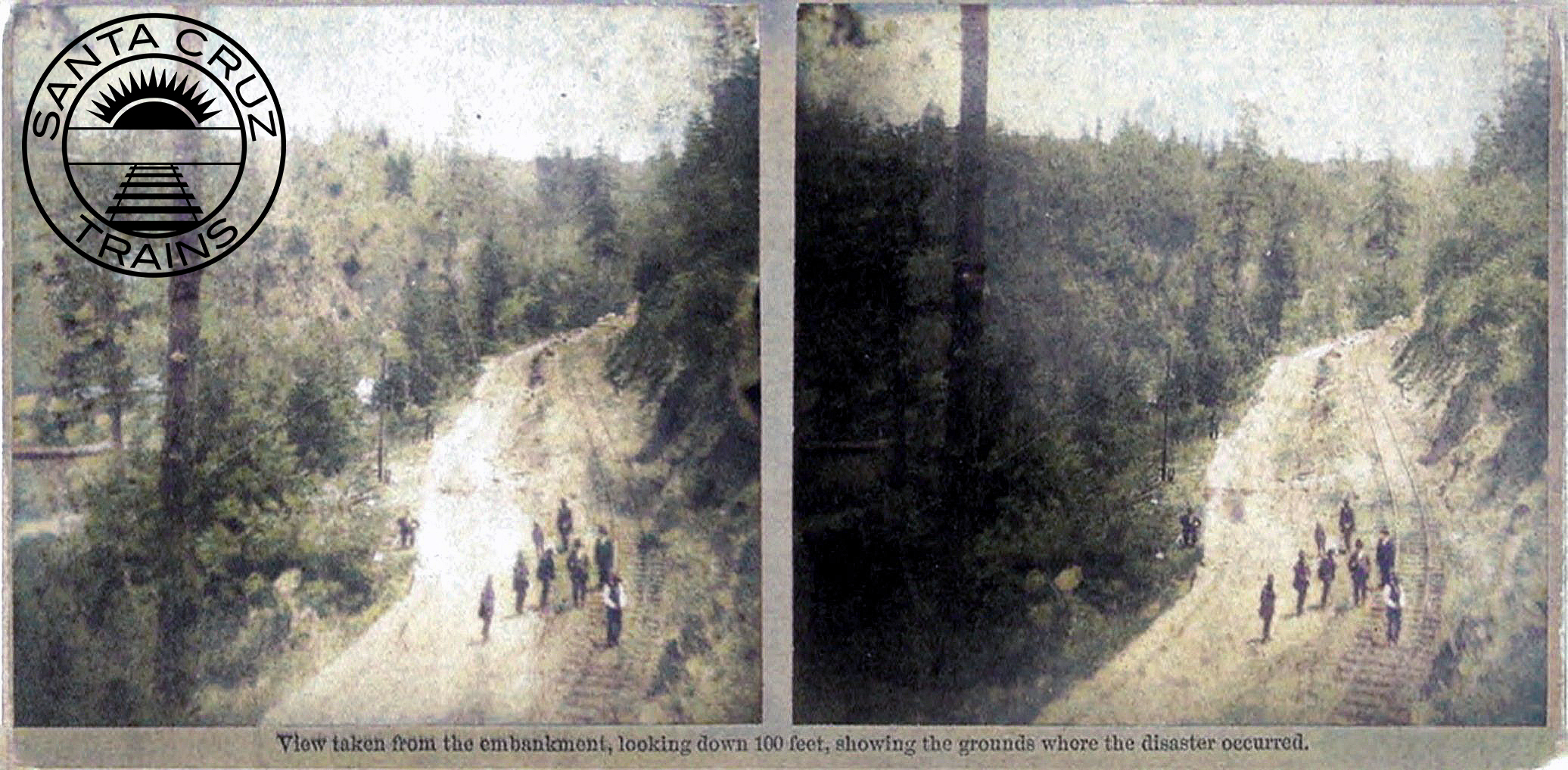
Members of the inquest committee inspecting the tracks, May 24, 1880. [Alan Young – colorized using MyHeritage]

That night, Judge John Pope Davenport ordered the coroner’s inquest board to investigate the incident. Early the next morning, the nine-member board headed out to the site of the accident. They found to their annoyance that the entire site had been stripped of evidence, with the flatcars gone, the rails and ties repaired, and the grade raised and freshly ballasted. Almost all evidence of the accident had been erased. While there, a photographer captured at least seven stereographs of the scene, showing where the accident had occurred and several of the surrounding geographic and railroad features. Perhaps surprisingly, these stereographs, with captions explaining their purpose, were sold commercially after first serving as evidence in the inquest.

On Tuesday, May 25, Davenport and the inquest board began to hear testimony from forty witnesses to the event. Elliott’s competence as an engineer was called into question as it was revealed that he had also failed to adequately control the train when he took it from Alameda to Felton on May 22. The poor quality of the couplers used on the train were also noted. Still others emphasized the poorly-ballasted track with rails that had inadequate anchors and joints, all of which may have been further impacted by the unusually hot afternoon on May 23. The board took a week to come to a verdict, presenting a split decision on Monday, May 31.

The inquest committee investigating the site of the wreck, May 24, 1880. [Alan Young – colorized using MyHeritage]

Three members of the board declared the railroad at fault for assigning an inexperienced crew to the train and not properly notifying the engineer of the sharp curves along the route. Another member blamed the engineer for the entire disaster. And the remining five members refused to place blame at all, claiming that accidents happen and the reasons cannot always be known. Besides the railroad’s cover-up efforts, a considerable reason for this split decision was the different stories told by the forty witnesses, few of whom could agree on specifics.

The disaster made worldwide news, with newspapers mentioning it as far away as Australia. An inaccurate color sketch based on initial reports of the accident was produced by Mr. Keller for the June 5 issue of The San Francisco Illustrated Wasp. Bay Area newspapers continued to report on the coroner’s inquest for the following two weeks. The wreck led to several changes. The South Pacific Coast Railroad began a program of straightening curves and reducing grades across its lines. It also changed the couplers used in its trains and improved its efforts at ballasting track. More importantly, crews operating along the former Santa Cruz & Felton Railroad’s grade had to receive special training and were expected to follow rules closely to ensure that such an incident as that of May 23, 1880 never occurred again.

Citations & Credits:

  • Secrest, William B., Jr., and William B., Sr. California Disasters, 1812–1899: Firsthand accounts of fires, shipwrecks, floods, epidemics, earthquakes and other California tragedies. Sanger, CA: Word Dancer Press, 2006.
  • MacGregor, Bruce. “Stereo Forensics: An Investigation into the May 23, 1880 South Pacific Coast Railroad Accident,” Stereo World 25:5 (Nov/Dec 1998), 10-15.
  • Various newspapers from throughout California and the world, May–June 1880. 

Thursday, November 26, 2020

Events: The Earthquake of April 18, 1906

On the evening of April 17, 1906, the Central Coast of California was on the brink of big changes for local railroads. After nearly twenty years, the Southern Pacific Railroad was finally upgrading its narrow-gauge route along the old South Pacific Coast Railway line from Alameda Point to Santa Cruz. Meanwhile, the Loma Prieta Lumber Company's mill in the Hinckley Basin off Soquel Creek had just started up again for a new season and the F. A. Hihn mill at Laurel was revving up for its fifth full season. Along the North Coast, the Ocean Shore Railway had just reached Davenport where the Santa Cruz Portland Cement Company was busy building its new refinery, while the Coast Line Railroad, owned by Southern Pacific, was lagging behind with its tracks through the West Side still under construction. Southern Pacific crews elsewhere in the county had recently finished a substantial survey for a route north of Boulder Creek into the Pescadero Creek basin, where they hoped to build a new connecting loop line that would eventually wrap back south to Davenport and allow access to millions of board feet of lumber in the Pescadero valley. The Ocean Shore was also interested in such a loop route, as well as an electric streetcar line into Big Basin. At around the same time, the Western Shore Lumber Company, owned by Loma Prieta Lumber Company executives, was founded to harvest these tracts as soon as possible. The vision for local railroading ventures was boundless.

A stretch of three-rail track displaced by the earthquake above Los Gatos Creek near Wrights, 1906. [Bancroft Library – colorized using DeOldify]
Earthquakes were not a new phenomenon in California—the indigenous Awaswas people were keenly familiar with them and even the earliest Spanish settlers experienced them somewhat frequently. Every generation of Californian eventually came to terms with the fact that the San Andreas Fault was more unpredictable and temperamental than your average fault line. But the temblor that struck the Bay Area on the morning of April 18, 1906, was unlike any the state had felt since it became a United States possession. Most of the Central Coast was still either sleeping or just emerging from rest when it struck. Railroad workers were just beginning their morning shifts, with construction crews preparing to toss off the third rail between San José and Los Gatos, their work of upgrading the line nearly complete. People in the mountains were lighting fireplaces and stoves for their morning coffee and tea. Mill donkey engines were warming up, too, preparing for a long day of sawing cut logs into lumber. None of them anticipated the destruction that would violently interrupt their peace and destroy all plans for the foreseeable future.

An Ocean Shore Railway train assisting in clearing debris from the ruins of San Francisco, 1906. [Bancroft Library – colorized using DeOldify]
The sun was only minutes from rising over the distant Sierra Nevada at 5:12 a.m. when the world first shifted. Frederick A. Hihn, who was staying at the Palace Hotel in San Francisco that day, recounted:
I felt the earthquake coming—much harder than I had ever experienced. The plaster from all around the sides of the room fell in large pieces, while in the middle of the room where my bed was, only sand and dust came down. The quake seemed to continue more than five minutes though it really lasted less than two minutes. It seemed to try its best to shake me out of bed, but I succeeded in staying in. As soon as it subsided I arose and turned on the electric light. Its unsteadiness proved there was an interference which indicated danger to the house being set afire.

He was right to fear the unsteady flames of his lamp—much of San Francisco would burn over the next week due to broken gas lines and open flames causing an inferno through the heart of downtown. The palatial mansions of the Big Four on Nob Hill were among the victims of the fires as were the corporate offices of the Ocean Shore Railway and some of the offices of the Southern Pacific. Over 80% of the city was damaged or destroyed in the temblor and inferno.

A displaced fence caused by a rift through a person's property near Wrights, 1906. [Bancroft Library – colorized using DeOldify]

The earthquake hit in waves, with an initial rumble at 5:12 that woke up much of the Bay Area, and a more severe blast about 30 seconds later, that would later be estimated at about 7.9 on the Richter scale. It was the single greatest earthquake in the recorded history of the West Coast. As few as 700 and as many as several thousand people perished in the quake and ensuing fires, making it also the deadliest natural disaster in California. Aftershocks continued for weeks, causing mayhem and straining nerves. The dispersion of energy from the fault led to earthquakes elsewhere in the state, as well, as far south as the Imperial Valley and as far north as Eureka, where a 6.7 magnitude earthquake struck on April 23. Nobody in California rested easy in the month after April 18, 1906.

Twisted rails caused by the earthquake along the viaduct at Moss Landing, 1906. [Bancroft Library – colorized using DeOldify]

Further south, outside Los Gatos at a station named Bermingham, the powder warehouse for the New Almaden quicksilver mines, operated by the California Powder Works, erupted in a massive explosion, although it appears nobody was killed in the incident. Throughout the Bay Area, including along Los Gatos Creek and as far south as the Pajaro Valley Consolidated Railroad's track at Moss Landing, rails were twisted and grades shifted. Even the course of the Salinas River moved from Elkhorn Slough to an old channel northeast of Marina. In truth, the integrity of the entire network of rails that spanned the Central Coast was questioned with surveyors needed to verify that trackage was still stable and reliable. In many places, it was not and required sometimes substantial repairs before rolling stock could pass over it again. For example, the Southern Pacific bridge over the Pajaro River south of Chittenden shifted over three feet off its piers, ultimately destabilizing the bridge. The bridge spanned the San Andreas Fault.

Cracked piers under the Pajaro River bridge near Chittenden, with temporary trestling to maintain the integrity of the span, 1906. [Bancroft Library – colorized using DeOldify]

Overall, the damage in Santa Cruz County was substantially less than in San Francisco, largely because no fires swept through the cities and towns. After Hihn returned from San Francisco he recounted his observations:

At Watsonville I found the damage by the earthquake light comparative to San Francisco and San Jose. There I took another team which brought me to Santa Cruz about five o’clock where I was received with great pleasure by many of my friends and family, who had feared I was lost.

The loss by earthquake at Santa Cruz is comparatively light. Our office building suffered perhaps the most although it was the strongest building. The Court house seems to have been considerably injured and a few other places.
Wreckage at the site of the Hinckley mill, 1906. [Popular Science Monthly]

Eleven people died in the county as a direct result of the earthquake, all but two of whom were killed in a massive landslide that completely buried the Loma Prieta mill on Hinckley Gulch. The Surf reported:

Here both sides of the canyon walls appeared to crush together and a mass of earth estimated at a hundred feet in depth filled the canyon, crushing in and burying the workmen who were living in cabins at work on the new mill

Mill, buildings and road were all submerged. Mr. Williams, the resident representative of the company, sent doctors to the scene, and dispatched laborers by the wagonload as fast as they could be obtained, but on arrival at the scene it was found impossible to reach the men or to make much progress in rescue work. The stream is completely choked by the debris, and the impounded water will form a menace to all the valley below.

The entombed men, as far as known, are believed to be Foreman [James] Walker; J. O. Dunham (the engineer); H. E. Estrada; Alex Morrison; Gus Vollandt; Frank Jones; Fred Peaslee; A. Buckley; and Charley June (the Chinese cook).

Part of the landslide that cost the lives of nine millworkers on Hinckley Creek, 1906. [Popular Science Monthly]

David Starr Jordan, president of Stanford University, added that the "mill was completely buried, with nine mill hands, and a redwood tree over a hundred feet high was set erect and unhurt over the place where the mill stood. The bodies of six men were recovered. One of these, the foreman, was found erect, smothered in mud, standing with extended arms and limbs in the act of running from the mill. With him, equally erect and in the act of running, was the body of a Siberian mastiff." The other two deaths in the county were two men who were caught in a similar slide at the Hartman and McNabb mill on Deer Creek north of Boulder Creek.

The slide on Deer Creek that cost the lives of two millworkers, 1906. [Bancroft Library – colorized using DeOldify]

Jordan wrote a detailed forensic analysis of the earthquake's geomorphic impact to the Monterey Bay, explaining:

The crack went on across the hills, always in the same direction, southeast by south, till it came to the Chittenden Ranch in the Pájaro Valley. Here it tore off the hillside, destroying the highway at its base; then descended to the Pájaro River, shifting a pier of its railroad bridge about eighteen inches to the northwest. Here it met the Pájaro cross-fault. But here the straight line from Point Arena came to an end. A series of short breaks creeps off to the southeast, ending two miles southwest of San Juan, the last act being the final, almost complete, wreck of the beautiful and venerable Mission of San Juan Bautista.

Rift through the road caused by the earthquake at the entrance to Watsonville's Chinatown, 1906. [Pajaro Valley Historical Association]

A letter by a member of Hihn's staff, dated the day after the quake, gave more particulars regarding damage to downtown Santa Cruz and to the operations of the Hihn company:

Very heavy earthquake here. Court House badly damaged. Office building [of F. A. Hihn] — rear wall down above second story and side walls cracked. Other buildings of the Company were on lines injured. Two thirds of the chimneys in the entire town off. Might have been worse but bad enough. We suppose you have received reports from the Hinckley Mill. Nine lives being lost and two at Boulder Creek.

Watsonville badly shaken. San Jose, several buildings down. San Francisco reports the earthquake did not do much damage but the fire has burned from the Ferry to Seventeenth Street and Larkin Valley. Lick House reported burnt so the fire must have crossed Market as the report also says Battery Street building is on fire.

Fix up the water works first and clear creek of lumber. Do not think advisable to do more than necessary to place things in order until Mr. F. A. Hihn returns. Have sent four different parties to San Francisco but have not been able to receive any information in regard to Mr. Hihn. Party reports leaving Palace at 9 o’clock after earthquake and the Palace Hotel not injured a great deal, thus was greatly relieved in regard to Mr. Hihn being injured.

Can order meat sent to Glenwood if advisable. Think advisable not to build fire under boilers or run any portion of the Mill until F. A. Hihn returns as every portion should be inspected. Think advisable to stop all other operation to skid road and other work until we secure some information in regard to time it will take to clear tunnels for operation.

Instruct all tenants not to build fires in chimneys where broken below the roof. Do not delay in fixing water mains.
The shifted wall within the Summit Tunnel, the town of Wrights visible through the portal at right, 1906. [Bancroft Library – colorized using DeOldify] 
In the end, much of the damage around the Monterey Bay and in the Santa Cruz Mountains was relatively easy to repair. The biggest problem, however, was the damage to the Southern Pacific route through the Santa Cruz Mountains. Besides small landslides, sinks, washouts, shifts in the grade, and twisted rails, the route had suffered a monumental blow to the Summit Tunnel, which experienced an internal lateral shift of five feet at about 400 feet inside from the Wright's side. In the weeks after the quake, Southern Pacific Engineer Everett P. Carey assessed the tunnel, concluding:
The damage to the tunnel itself consisted in the caving in of overhead rock; the crushing in toward the center of the tunnel of the lateral upright timbers, and the heaving upward of the rails, due to the upward displacement of the underlying ties. In some instances, these ties were broken in the middle. In general the top of the tunnel was carried both north or northwest with reference to the bottom.
This should have been predicted—the San Andreas Fault passed directly through the tunnel on its northern side and a coal vein linked to this fault line had released methane and oil into the tunnel in 1879, prompting a deadly explosion. Repairs after a massive landslide in 1893 had led to the upgrading of the portal on the Wright's side, which also addressed more definitively the methane leak but not the potential problem of the fault line, which engineers had positively identified as such as early as the 1880s.

Work crews inside the Summit Tunnel, ca 1907. [Derek Whaley – colorized using DeOldify]
With the Summit Tunnel out of commission, work on standard-gauging the line came to a halt, as did all traffic along the line. Any railroad traffic into Santa Cruz would have to go via Pajaro once those tracks were repaired. Indeed, for several days, Santa Cruz County was almost entirely cut off from the outside world, with telegraph and telephone wires severed and transportation difficult across ruined bridges and suddenly uneven roads. The Laurel-Glenwood Tunnel and the smaller tunnels along the southern portion of the mountain line mostly survived the quake and were back in working order within weeks. As a result, Hihn opened up a shingle mill at Laurel to cut crossties, bents, and posts to repair the railroad lines, while he relocated the rest of the mill's machinery to King's Creek north of Boulder Creek, where he produced lumber for the rebuilding of downtown Santa Cruz, San Francisco, and the other more severely hit Bay Area towns.

Derailed fruit boxcars that were awaiting shipment at Chittenden, 1906. [Graniterock – colorized using DeOldify]
The Railroad Wharf, which had only occasionally been used for the past decade, once more became a primary means of shipping goods and steamships called in regularly in the months after the quake to collect lumber, lime, and blasting powder, and other products for use in San Francisco and elsewhere. Meanwhile, the mountain tracks remained narrow-gauge and would continue to be so for the foreseeable future until the tunnels and existing infrastructure were repaired. Much of the old rolling stock had already been sold, meaning that operations relied heavily on California Timber Company stock and locomotives and other long-outdated machinery.

Closeup of the temporary trestlework done to the Pajaro River bridge near Chittenden to reinforce the structure, 1906. [Bancroft Library – colorized using DeOldify]
Relying on old machinery and obsolete track gauges meant that Southern Pacific had to work fast to restore access to Santa Cruz County. The Pajaro River bridge was restored to functionality via a complex wooden trestle frame installed around the collapsed piers. The remainder of the coastal route was repaired over late spring and operating again by summer. The next step was to standard-gauge the track from Santa Cruz to Boulder Creek to facilitate the easy transfer of lumber between the two points. Unfortunately, this required replacing the bridge over the San Lorenzo River south of Felton and several other bridges on the way to Boulder Creek. The tight curves along San Lorenzo Gorge, as well as the tunnels, delayed progress more since the curves had to be lessened and the tunnel enlarged. The route only opened to standard-gauge traffic in June 1907, although narrow-gauge tracks still existed to Old Felton, from the Newell Creek Mill, and along the Dougherty Extension.

Repair camp at Wrights outside the Summit Tunnel, February 22, 1907. Photograph by Frank Herman Mattern. [Greg De Santis – colorized using DeOldify]
Meanwhile, repairs to the narrow-gauge track from Felton to Laurel, including to the tunnels, was completed by July, allowing wood products produced in Laurel to get to market. In early 1907, Southern Pacific announced that it did not intend to reopen the mountain route at all until the route was broad-gauged, meaning that the line would remain out of commission for at least another year. In reality, it took over two years, largely because of the economic Panic of 1907, which was partially caused by the earthquake. Reconstruction efforts in San Francisco brought in millions of dollars of funds from the East Coast but this led to an imbalance in investing in the market. From January 1906 to July 1907, the stock market became increasingly unstable culminating in a crisis in October 1907. These financial issues caused Southern Pacific to become more cautious with its spending, in effect delaying the upgrading of the mountain route and shelving plans for a Pescadero route or an extension of the Coast Line.  The panic also led to the temporary closure of several mills due to a lack of funds for building projects and a surplus of building materials.

Washout out Ocean Shore Railway tracks at Devil's Slide, 1906. [Huntington Library – colorized using DeOldify]
Following a year of uncertainty and little progress, Southern Pacific resumed upgrading in late 1908. On the North Coast, the Coast Line to Davenport was completed and the Ocean Shore Railway, which had suffered heavy financial loses in the earthquake and the panic, resumed work on a line from its temporary terminus at Scott to Swanton, where it had received a contract from the San Vicente Lumber Company in 1908 to use its line to transport logs. At Wright, Laurel, and Glenwood, Italian, Greek, and Japanese workers were brought in to finish the standard-gauging of the mountain route and enlarge the four tunnels still in need of upgrading. On May 29, 1909, the route was finally opened to standard-gauge trains and the last physical impairment caused by the earthquake in Santa Cruz County was removed.

Destroyed crushing plant along the tracks at the Graniterock quarry at Logan, 1906. [Graniterock – colorized using DeOldify]
The earthquake, however, had a long shadow and its long-term impact on the people of Santa Cruz County was felt in several ways. The hit to the tourism industry in the San Lorenzo Valley was permanent. Places like the Hotel de Redwood near Laurel, the various Glenwood resorts, Brookdale, and even Big Trees suffered and never full recovered since people were more weary and also had less cash to spend on travel. By the time the economy had recovered, the Model T Ford had arrived and people decreasingly spent their entire summers in one place as they had prior to the earthquake. While Fred Swanton's Neptune Casino and Plunge at the Santa Cruz waterfront survived the earthquake, both burned down only two months later and the economic fallout from the Panic of 1907 was one of the primary reasons why Swanton became increasingly desperate from 1908 to turn a profit with his rebuilt Casino and Natatorium. 

Debris blocking the flow of Los Gatos Creek creating a pond beside the three-rail tracks of the Southern Pacific Railroad, 1906. [Derek Whaley – colorized using DeOldify]
Meanwhile, Southern Pacific shelving most of its ambitious plans for the region meant that all of the local lines were doomed to a slow abandonment once their principal industries closed down. Indeed, the need for lumber to rebuild San Francisco greatly expedited the timber harvesting efforts at the headwaters of Pescadero Creek, on Bear, Deer, Two Bar, and King's Creeks, in the Aptos and Soquel Creek basins, within Rancho San Vicente, and in the Newell Creek basin, leading to the decimation the county's remaining old-growth redwood by about 1920. With these sources of timber gone, branch lines began to shut down—the Newell Creek Branch in 1913, the Dougherty Extension in 1917, the Ocean Shore-San Vicente line in 1923, the Loma Prieta Branch in 1927, the Boulder Creek Branch in 1934, and the mountain section in 1940.

Hay barn and stable damaged by the earthquake at Scaroni's Ranch on the North Coast near Davenport, 1906. [Santa Cruz Museum of Art & History – colorized using DeOldify]
Lastly, the costs associated with recovering from the earthquake's damage to its lines around Devil's Slide near Pacifica, as well as from the fallout of the panic in 1907 and further damage caused by destructive storms in January 1909, led to the financial collapse of the Ocean Shore Railway by December 1909. In January 1911, a new company, the Ocean Shore Railroad, was formed to revive the dream, but its scope was narrower and its dreams more realistic. In the end, it too failed to connect with the northern line that abruptly stopped just south of Tunitas. The Coast Line, with no functional competition and a ready customer in the Santa Cruz Portland Cement Company at Davenport, abandoned its plans to continue the line north to San Francisco or even to Pescadero, permanently ending the dream of a railroad line along the North Coast.

The Santa Cruz County Court House (Cooper House) undergoing repairs following the earthquake, 1906. [UCSC Legacy Digital Collections – colorized using DeOldify]
There are moments in history when everything changes in a moment. For California, that moment was the San Francisco Earthquake. Even though the Central Coast quickly recovered and most of the quake's visible scars were wiped away through new construction and renewed economic activity, the delay of roughly five years of progress stripped San Francisco of its central position in California politics. During this time, San Pedro Harbor opened in Los Angeles, slowly displacing San Francisco as the state's primary industrial port. The film industry also settled in the Los Angeles basin rather than the Bay Area during this time, partially due to a lack of space and facilities caused by the lingering impact of the earthquake. And the expansion of the automobile meant that people could travel farther and control their destination more acutely, which led to the slow abandonment of many formerly-popular vacation spots along the Central Coast. While the earthquake alone did not cause the diminution of the Bay Area, its timing was poor and certainly eased the shifting of political power to the rapidly-developing south.

Citations & Credits:
  • Hamman, Rick. California Central Coast Railways. Second edition. Santa Cruz, CA: Otter B Books, 2007.
  • Hihn, Frederick A. Letter written by F. A. Hihn regarding the San Francisco earthquake and fire of Wednesday, April 18, 1906. Santa Cruz, CA: University of California, Santa Cruz, Library.
  • Jordan, David Starr. "The Earthquake Rift of 1906," Popular Science Monthly 69 (Oct. 1906).
  • Powell, Ronald G. The Shadow of Loma Prieta: Part Three of the History of Rancho Soquel Augmentation. Santa Cruz, CA: Zayante Publishing, forthcoming.
  • Whaley, Derek R. Santa Cruz Trains: Railroads of the Santa Cruz Mountains. Second edition. Santa Cruz, CA: Zayante Publishing, forthcoming.