Showing posts with label Santa Cruz & Felton Railroad. Show all posts

Thursday, April 13, 2023

Events: The Train Wreck of May 23, 1880

While train rides in the Santa Cruz Mountains were sometimes fun affairs and more usually just a part of a person’s daily commute, in the afternoon of Sunday, May 23, 1880, an excursion trip became the stuff of nightmares. That morning, a fourteen-car South Pacific Coast Railroad excursion train arrived at Big Trees, today's Henry Cowell Redwoods State Park. In it were members of the San Francisco Bohemian Club, the Alameda Harmonie Verein, and the Independent Rifles, among others, about 300 people in total. Picnickers enjoyed the early afternoon walking through the redwood groves and picking wild flowers. Some fished while others just relaxed under the mid-Spring sun. A number of Santa Cruzans had travelled to Felton earlier in the day to join the excursion group. Included among these were Duncan McPherson, editor of the Santa Cruz Sentinel, and Santa Cruz County Sheriff Elmer Dakan.

Original chromolithograph of the May 23, 1880 wreck commissioned by and published in The San Francisco Illustrated Wasp on June 5. Art by Mr. Keller.

At around 3:00 p.m., Felton Depot received a request from a group of excursionists for a train to take them to Santa Cruz, where they hoped to enjoy the last hours of the day at the beach. The train of George L. Colegrove, a man experienced with the route through San Lorenzo Gorge, was initially assigned the duty, but this was rescinded and a different crew was tasked with the duty headed by engineer Robert J. Elliott and his fireman, Frank R. Thompson, neither of whom had ever taken the train down the grade. Elliott's train was larger than Colegrove's, which meant that it had to be controlled with more caution as it navigated San Lorenzo Gorge. Colegrove quickly coached Elliott about the dangers of the route, and provided him with his brakeman, Howard D. Anthrum, who knew the line well. Sam Davis, the younger brother of the railroad’s president, Alfred Davis, also insisted on joining the crew in the cab of South Pacific Coast Railroad Locomotive No. 3. Other crew members included Alfred Withers, an attaché of the railroad, and M. D. McLean, the brakeman.

Early view of Big Trees before the addition of a siding for passenger cars, 1880s. Photo by Alfred J. Perkins. [WorthPoint – colorized using MyHeritage]

Rather than use formal passenger cars, Elliott chose to bring flatcars that had bench seats and four-foot guard rails installed, similar in style to the Santa Cruz Big Trees & Pacific Railway excursion cars uses today, though more crudely constructed. Elliott’s train arrived at Big Trees at around 3:15 and the engineer sounded the whistle for all aboard. Conductor William D. Bones crowded the picnickers onto three of the open-air excursion cars, which only measured 24 feet in length. By the time the train was ready to go ten minutes later, many passengers were standing precariously or shoved against the poor-quality railings of the cars. For whatever reason, Elliott had decided against turning the locomotive at the Felton turntable and instead planned to back the train down the seven miles of track through San Lorenzo Gorge to Santa Cruz.

The area known as Summit, later Rincon, with a South Pacific Coast Railway train approaching on the main line, ca 1900. [UC Santa Cruz Digital Collections – colorized using MyHeritage]

Three miles along the route, at around 4:00, the train reached Summit, the highest point along the line. The three miles beyond Summit were steep with tight turns, precarious bridges, and a tunnel through the Hogsback above the California Powder Works. Elliott and his crew, looking over the tender of their locomotive, began to back down the grade from Summit and passed into Tunnel No. 7. It was here that all accounts agree things began to go wrong. The train began to gain speed as it curved out of the tunnel toward the grade crossing of West San Lorenzo Drive (Highway 9). Elliott blew the whistle alerting Bones and McLean to begin braking the cars. McLean later claimed that he had already tightened the brakes on the first car, but Bones admitted that he could not get to the brake wheel on the third car because it was overloaded with passengers and he was busy collecting money.

The sharp curve on the railroad tracks at the West San Lorenzo Drive grade crossing, May 24, 1880. [Alan Young – colorized using MyHeritage]

Elliott looked through the cab window toward the back of the train and watched as the three flatcars began swaying heavily. He slammed on the engine’s brakes and put the drive wheels of the locomotive in reverse, but this did little to slow the train. A minor buckle in the track, probably caused by heat expansion from the unusually warm Spring day, caused the locomotive to rock severely and lift off the outside rails as the train curved around a tight bend. Centrifugal force pulled the passengers toward the hillside, adding a heavy weight to a poorly-built railing. The railing gave way in the second car when it brushed against a rock outcropping. As the car derailed, passengers began spilling into the hillside and onto the tracks below. The third car also derailed, falling down the opposite embankment toward the road below. More passengers were dumped over the side of the car. Elliott braked as hard as he was able from the front of the train and it slowly rolled to a stop just before the bridge over Shady Gulch. But it was too late.

The deadly rock outcropping where the car derailed, crushing passengers into the hillside, May 24, 1880. [Alan Young – colorized using MyHeritage]

Scattered across the rails were bodies everywhere. Nearly sixty passengers from the two cars were littered across the tracks. Those from the third car were thrown down the hill, where many of them were badly injured but most survived. The passengers from the second car, though, were less lucky. Dashed against the hillside, many were crushed or, worse, run over by the car that followed. As Elliott, Anthrum, and Davis ran back to the cars, all they heard were screams as the severity of the incident became obvious. It was a massacre. Never in Santa Cruz County history was there such a railroad disaster before or after, and it proved to be the second-worst rail accident in the state to date.

South Pacific Coast Railroad Locomotive No. 3, 1880s. [ebay – colorized using MyHeritage]

Realizing that they could do little to help the people, Elliott and Anthrum uncoupled the locomotive and carefully rode it to Santa Cruz to seek help. They quickly gathered medical supplies, doctors, and others and returned to the site of the accident about thirty minutes later. By this point, thirteen people were declared dead and over fifty other passengers were severely injured. The railroad crew quickly recoupled the cars and put the flatcars back on the track. Those dying or grievously wounded were placed on the cars and rushed to Santa Cruz where they were taken up by most of the local hotels including the Ocean House, Germania Hotel, and Wilkins House. Colegrove’s train was brought in from the north and took less injured people and the remaining excursionists back to Felton, where they were loaded onto a larger train bound for the Bay Area.

South Pacific Coast Railroad Locomotive No. 3 parked at the scene of the wreck for the inquest committee to inspect, May 20, 1880. [Alan Young – colorized using MyHeritage]

Before dusk, two more passengers had died. Two final passengers would die on their journey back to San Francisco, resulting in a total of seventeen dead from the accident. These included Santa Cruzans, San Franciscans, and other men and women of the Bay Area. The full list of deaths included Frank Butler, William Costello, Jeremiah Darcy, Louis Falk, Patrick Gallagher, Frank Herringer, George C. W. Huer, Walter Hoyt, Mrs. C. S. Hussey, Ernest R. Jasper, Clayton F. Merrill, Frederick William Opitz, John Ripon, Joseph Salinger, Henry W. Stahle, and John Straub. The South Pacific Coast Railroad paid for all costs incurred by the passengers due to the accident.

Faced with few options, Dakan arrested Elliott under charges of gross incompetence and manslaughter, although it may also have been for his protection since many of the surviving passengers wished him harm. The sheriff had been on the train in the first car and witnessed the entire affair. While survivors tried to sleep off their injuries and forget the nightmare they had just experienced, crews working for the South Pacific Coast Railroad snuck up to the site of the accident and cleaned up before the full extent of their culpability could be determined.
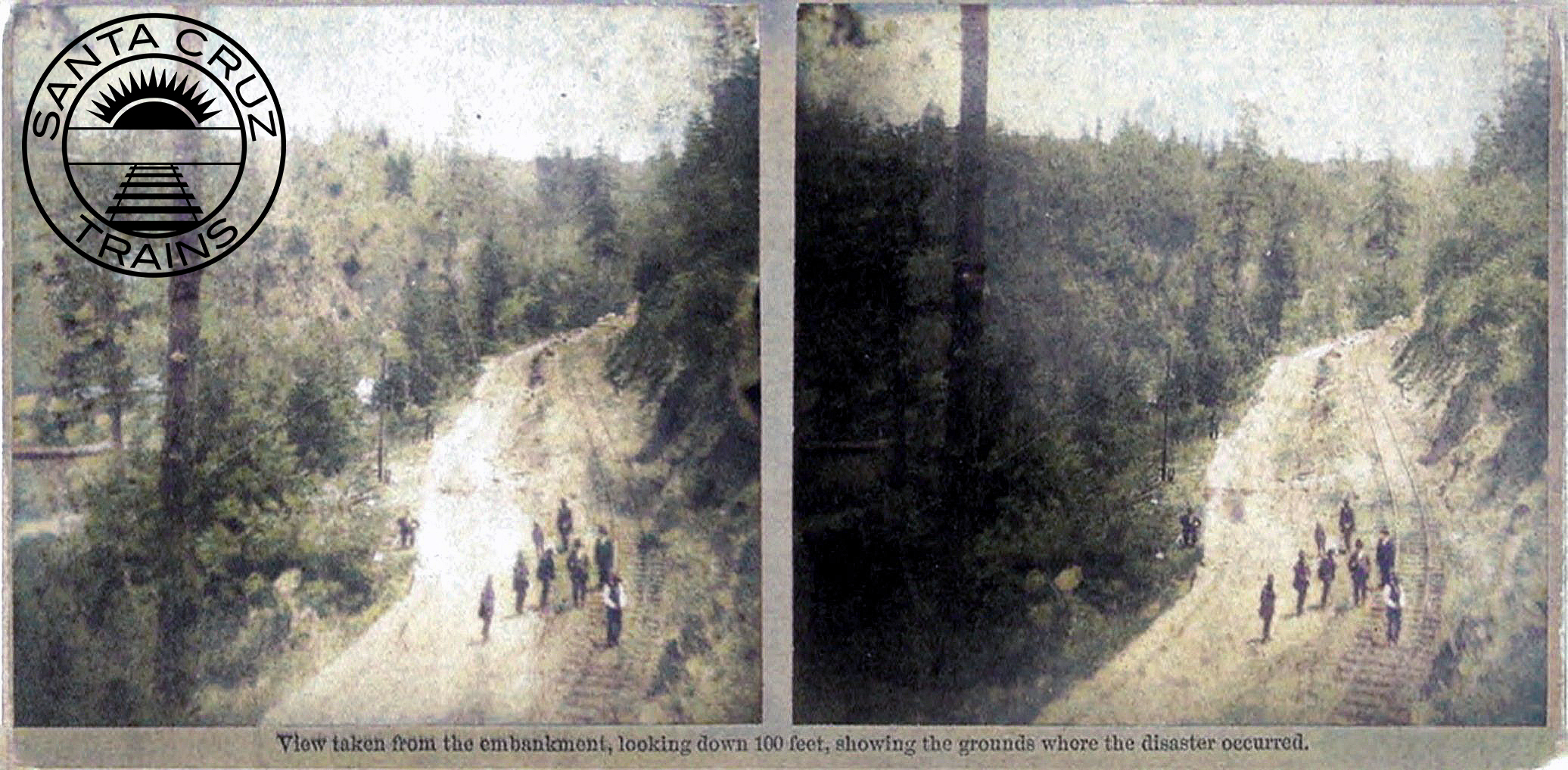
Members of the inquest committee inspecting the tracks, May 24, 1880. [Alan Young – colorized using MyHeritage]

That night, Judge John Pope Davenport ordered the coroner’s inquest board to investigate the incident. Early the next morning, the nine-member board headed out to the site of the accident. They found to their annoyance that the entire site had been stripped of evidence, with the flatcars gone, the rails and ties repaired, and the grade raised and freshly ballasted. Almost all evidence of the accident had been erased. While there, a photographer captured at least seven stereographs of the scene, showing where the accident had occurred and several of the surrounding geographic and railroad features. Perhaps surprisingly, these stereographs, with captions explaining their purpose, were sold commercially after first serving as evidence in the inquest.

On Tuesday, May 25, Davenport and the inquest board began to hear testimony from forty witnesses to the event. Elliott’s competence as an engineer was called into question as it was revealed that he had also failed to adequately control the train when he took it from Alameda to Felton on May 22. The poor quality of the couplers used on the train were also noted. Still others emphasized the poorly-ballasted track with rails that had inadequate anchors and joints, all of which may have been further impacted by the unusually hot afternoon on May 23. The board took a week to come to a verdict, presenting a split decision on Monday, May 31.

The inquest committee investigating the site of the wreck, May 24, 1880. [Alan Young – colorized using MyHeritage]

Three members of the board declared the railroad at fault for assigning an inexperienced crew to the train and not properly notifying the engineer of the sharp curves along the route. Another member blamed the engineer for the entire disaster. And the remining five members refused to place blame at all, claiming that accidents happen and the reasons cannot always be known. Besides the railroad’s cover-up efforts, a considerable reason for this split decision was the different stories told by the forty witnesses, few of whom could agree on specifics.

The disaster made worldwide news, with newspapers mentioning it as far away as Australia. An inaccurate color sketch based on initial reports of the accident was produced by Mr. Keller for the June 5 issue of The San Francisco Illustrated Wasp. Bay Area newspapers continued to report on the coroner’s inquest for the following two weeks. The wreck led to several changes. The South Pacific Coast Railroad began a program of straightening curves and reducing grades across its lines. It also changed the couplers used in its trains and improved its efforts at ballasting track. More importantly, crews operating along the former Santa Cruz & Felton Railroad’s grade had to receive special training and were expected to follow rules closely to ensure that such an incident as that of May 23, 1880 never occurred again.

Citations & Credits:

  • Secrest, William B., Jr., and William B., Sr. California Disasters, 1812–1899: Firsthand accounts of fires, shipwrecks, floods, epidemics, earthquakes and other California tragedies. Sanger, CA: Word Dancer Press, 2006.
  • MacGregor, Bruce. “Stereo Forensics: An Investigation into the May 23, 1880 South Pacific Coast Railroad Accident,” Stereo World 25:5 (Nov/Dec 1998), 10-15.
  • Various newspapers from throughout California and the world, May–June 1880. 

Thursday, September 8, 2022

Curiosities: Travel Times and Speeds

Railroads do not operate in a vacuum—they run according to schedules. For large-scale railroad companies such as Southern Pacific, these are extraordinarily complex schedules that must take into account hundreds of its own trains as well as the schedules of other railroad companies and various bus systems. Thus, it should be unsurprising that railroad timetables, both public and internal-use, are invaluable sources of information to railroad historians. Yet, in the end, the primary purpose of any timetable is to keep a schedule. In fact, the entire standarization of time itself into zones was done for this precise purpose: to make it possible for railroads to run on time. And like all railroads, those that operated in and around the Santa Cruz Mountains ran according to these published schedules.

Men at the ticket window of the Santa Cruz Union Depot, 1911. [University of California, Santa Cruz, Digital Collections – colorized using MyHeritage]

Travel times for regularly-scheduled trains can vary greatly depending on the length of the route, the terrain, the gauge of rail, and the type of train. In the Santa Cruz Mountains, the terrain was a major factor, with many sharp curves and steep grades. Travel speeds through the forest were also often quite slow due to the risk of debris falling on the track that could potentially derail the train. As a result, Southern Pacific passenger train speeds were limited by 1940 to:

• 30 miles per hour between Vasona Junction and Los Gatos
• 20 mph between Los Gatos and Eva
• 25 mph between Eva and Santa Cruz, with a brief 15 mph section between Wright and Glenwood
• 20 mph between Santa Cruz and Davenport
• 30 mph between Santa Cruz and Watsonville Junction (Pajaro)
• 20 mph between Felton and Boulder Creek
• Between 40 and 75 mph (depending on locomotive type) between Gilroy and Watsonville Junction

In the earliest days of travel in Santa Cruz County, most trains ran as mixed, which means they carried both passenger and freight cars. On the other hand, the South Pacific Coast Railroad and the Southern Pacific Railroad both ran dedicated, regularly-scheduled passenger trains from the early 1880s. They did continue to operate mixed trains, but many of their trains were either regular or express passenger trains. Regular trains could stop at any registered station or flag-stop, as well as various recognized but unrecorded stops. These are, therefore, the slowest trains. Express trains, in contrast, usually only stop at a few locations along a line in order to achieve a faster travel time. Some express trains, such as the Del Monte Limited, Santa Cruz Limited, San Francisco Limited, and the seasonal Sun Tan Special were given names due to their popularity.

Early Santa Cruz County railroads, namely the Santa Cruz Railroad and the Santa Cruz & Felton Railroad, were narrow-gauge and rather crudely-built. This meant that they had slow travel times and often experienced delays or outright cancellations of service due to problems with the line or mechanical failures. When the railroads were operating normally, though, they were much better means of conveyance than the alternative of wagons or walking between destinations.

Santa Cruz Railroad's Santa Cruz depot on Park Street (now Chestnut Street), ca 1880. [Harold van Gorder Collection, Santa Cruz Museum of Art & History – colorized using DeOldify]

Santa Cruz Railroad and Branch

The earliest schedule that exists for a county railroad is that of the Santa Cruz Railroad, published in the Santa Cruz Sentinel on May 15, 1875. At this time, the line was only completed between Santa Cruz (Park Street Station) and Aptos on a journey that took about 50 minutes to cover 8.7 miles of track resulting in a train running at about 10.4 miles per hour. The first full timetable for the 21.5-mile-long Santa Cruz Railroad from Santa Cruz to Pajaro was released on June 10, 1876. At the time, an express train from Santa Cruz to Pajaro took 1 hour, 50 minutes, which translates to an average speed of 11.7 mph. The regular mixed train, in contrast, took 1 hour, 55 minutes, resulting in an average speed of 11.2 mph. Both of these trains were scheduled to meet with Southern Pacific passenger trains travelling along the Coast Division line between San José and Salinas. By 1879, the schedules had become drastically reduced, with the regular having a 1 hour, 45-minutes run and the express 1 hour, 25 minutes, resulting in speeds of 12.3 mph and 15.2 mph respectively.

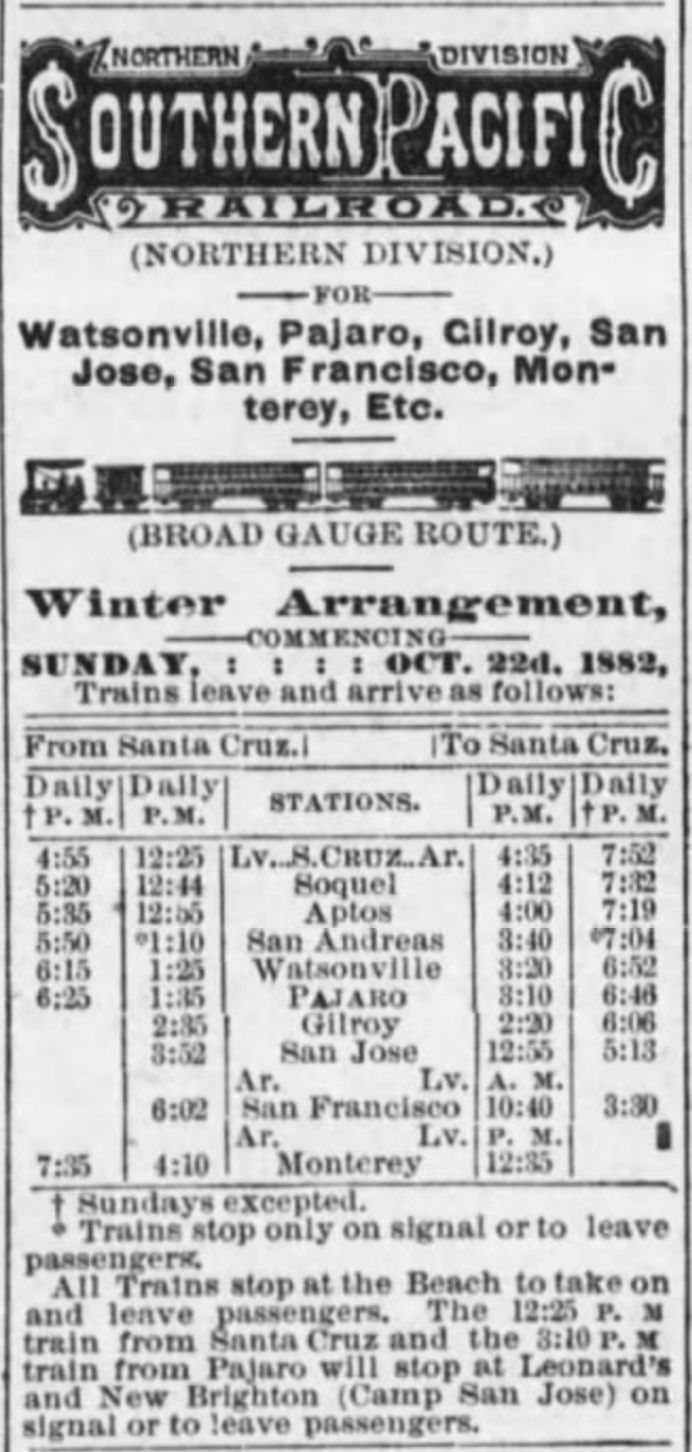
When Southern Pacific took over in 1881, it immediately set about streamlining the system. The regular passenger train's time was reduced to 1 hour, 40 minutes run, while the express train was reduced to 1 hour, 3 minutes. On the final timetable before the line was standard-gauged in 1883, the time of the regular train was reduced further to 1 hour, 30 minutes, while that of the express increased slightly to 1 hour, 10 minutes. These meant that regular trains were running at 14.3 mph and express at 20.5 mph at the end of the narrow gauge era.

The upgrade to standard gauge tracks made trains larger but slightly safer to operate. Over time, this led to a gradual reduction in travel times across the Santa Cruz Branch. In 1890, regular trains took 1 hour, 25 minutes to travel from Pajaro to Santa Cruz, but express trains could make the distance in only 53 minutes. That resulted in speeds of between 15.2 and 24.3 mph. These were reduced further to 1 hour, 10 minutes for regular trains and 50 minutes for express trains by 1909. The speeds by this time, therefore, reached an average of 18.4 mph and 25.8 mph. These times remained the standard for the next 29 years, until regular passenger service ended along the Santa Cruz Branch.

Southern Pacific Railroad schedule published in the Santa Cruz Sentinel, February 10, 1883.

San Francisco to Santa Cruz via Pajaro

The Santa Cruz Railroad was the first system in the county with the ability to connect to the Southern Pacific Railroad's Coast Division mainline at Pajaro, later Watsonville Junction. Once Southern Pacific took over and upgraded the line, a fluid exchange could happen linking Santa Cruz directly to San Francisco, although in reality there was rarely a through line between the points. Most of the time, passengers had to detrain at Pajaro and board a local train.

Passenger travel between Santa Cruz and San Francisco via the Coast Division mainline was never fast. In 1882, travel between the points—a distance of 121 miles—took around 5 hours, 10 minutes. This meant that the average speed of a journey to san Francisco was 23.4 mph. Around 1890, an express option was added that took just over 4 hours, which averaged 30.1 mph.  Over the next twenty years, the time was cut down further, eventually reaching 3 hours, 35 minutes in 1913. That brought the average speed up to 33.8 mph. From there, though, times increased again since all through traffic to San Francisco was directed north along the former South Pacific Coast route and then via the Los Altos Branch, popularly called the Mayfield Cutoff. By the end of passenger service along the Santa Cruz Branch in 1938, travel time from Santa Cruz to San Francisco via Watsonville Junction was 4 hours, 11 minutes, averaging a speed of 28.9 mph. Sun Tan Specials running from 1940 used this line to bring people to the Santa Cruz Beach and its travel time was 3 hours, 30 minutes, essentially the same as the regular passenger trains of the early 1910s.

Santa Cruz & Felton Railroad Time Table No. 2, from the Sentinel, February 10, 1877.

Santa Cruz & Felton Railroad

In some ways, the Santa Cruz & Felton Railroad was the shortest-lived of all the railroads in the county since it was wholly absorbed into the South Pacific Coast Railroad's mainline system in May 1880. It also did not formally engage in passenger service until several months after it began freight service in late 1875. But during the four years that it operated as a passenger railroad, it had a set scheduled that appeared in the local newspapers. Its No. 2 timetable, published in February 1877, gave travel time between Santa Cruz—then located at the Railroad Wharf—and Felton—near the Mountain Community Resources—as 1 hour exactly. This means that the 7-mile-long route transported passengers at a speed of...7 miles per hour. The Santa Cruz & Felton Railroad offered three runs in each direction. Later in the year, this was reduced to two runs, and in mid-1878 only one run each direction. This remained the status until the South Pacific Coast took over.

Cover of South Pacific Coast Railroad time table no. 3, March 28, 1886.

South Pacific Coast Railroad and Railway

The opening of the South Pacific Coast Railroad to Santa Cruz in 1880 heralded the first (nearly) seamless direct service between San Francisco and Santa Cruz. Nearly because a ferry was still required to transfer passengers from San Francisco to the Alameda Mole near Oakland. The South Pacific Coast was a narrow-gauge railroad that ran directly through the Santa Cruz Mountains, passing through Fremont, San José, Los Gatos, and eight tunnels before reaching the seaside town. Little changed along the line even after Southern Pacific acquired it in 1887, by which point it had reincorporated as the South Pacific Coast Railway. The entire line was not standard-gauged until spring 1909, after which most Santa Cruz–San Francisco traffic went via the Mayfield Cutoff rather than by the original Alameda route.

In the nearly thirty years from 1880, travel times between Alameda Junction and Santa Cruz remained remarkably stable. The speed of the train was always fastest between Alameda and Los Gatos, after which trains encountered a meandering track of steeper grades and sharper curves. Nonetheless, the route as a whole made good time. The April 4, 1881 timetable gave the travel time as 3 hours, 37 minutes, which resulted in an average speed of 20.8 miles per hour across 75.3 miles of trackage. Two years later, the time was reduced to 3 hours, 19 minutes leading to an uptick in the average speed to 23 mph. The timetables soon stabilized for the next decade at the slightly faster time 3 hours, 22 minutes, with trains travelling at an average speed of 22.4 mph. Perhaps due to safety concerns or constant repairs along the line, Southern Pacific eventually moved the time up around 1894 to 3 hours, 30 minutes, averaging 21.5 mph, which it retained until the 1906 San Francisco Earthquake shut down the line and it was standard-gauged.

Passengers boarding a South Pacific Coast Railway train at Ben Lomond, ca 1907. [UCSC Digital Collections – colorized using DeOldify]

Felton & Pescadero Railroad and Boulder Creek Branch

Travel time on the 7.30-mile-long Felton & Pescadero Railroad, a subsidiary of the South Pacific Coast Railroad, varied depending on which direction the train was travelling between Felton and Boulder Creek. If the train was heading north, it took 45 minutes to reach Boulder Creek. If it was heading south, possibly because trains needed to use their brakes more, it took 50 minutes to reach Felton. This meant that trains were travelling 9.7 and 8.8 miles per hour respectively. When Southern Pacific took over the line in 1887, it managed to cut the average travel time down to 33 minutes, which more or less remained standard for the next twenty years. Trains, therefore, could transport passengers between the two termini at a speed of 13.3 mph.

In 1908, when the line shifted to standard gauge, trains were finally able to run at a faster clip. For the first year, trains transported passengers between Felton and Boulder Creek in only 22 minutes! This meant the trains were running at an average speed of 19.9 mph. Clearly this was deemed unsafe, or perhaps the company changed to less efficient locomotives, since in 1909 the time was moved back to 30 minutes. Over two decades, the speed bounced between 25 and 30 minutes for the remainder of its time as a passenger line, which ceased around May 1931. Taking an average travel time of 27.5 minutes, the trains during the final years of the Boulder Creek Branch ran at a speed of 15.9 mph.

Ocean Shore Railway timetable no. 19, July 16, 1911.

Davenport-bound Railroads

Two railroads traversed the northern marine terraces of Santa Cruz County: the Ocean Shore Railway, later Railroad, and the Coast Line Railroad, a subsidiary of Southern Pacific. Both standard-gauge railroads were built at about the same time—between 1905 and 1907—and both had the stated, though unrealized, goal of linking Santa Cruz to San Francisco via a coastal route. The Ocean Shore did make it as far north as Swanton, 15.5 miles from Santa Cruz, but the most important destination along the line was Davenport, at least in the earlier years. This location was 10.8 miles from Santa Cruz on the Ocean Shore Railway, and 11.4 miles on the Coast Line Railroad.

The Ocean Shore's short, fourteen-year existence running passengers along the coast was a relatively consistent affair. All of the company's regular trains were mixed and trains took 28 minutes to run between Santa Cruz and Davenport. This resulted in an average speed of 23.1 miles per hour. The Coast Line, in contrast, began running incredibly slow trains. Initially, mixed trains took up to 1 hour, 15 minutes to transport passengers from Santa Cruz to Davenport, probably due to the number of freight stops trains along the way. So much time resulted in a dismal 9.1 mph speed. This soon picked up, though, and Southern Pacific managed to cut the time to 1 hour in late 1909, allowing trains to run at 11.4 miles per hour. By 1913, enough passenger traffic had picked up that dedicated passenger trains could operate, and these only took 30 minutes, matching the Ocean Shore's travel time and running at a far more comfortable speed of 22.8 mph. Both railroads retained this time for passenger trains until each ceased regular passenger service, in 1920 for the Ocean Shore, and in 1932 for Southern Pacific.

Southern Pacific's morning Santa Cruz express train arriving at San Francisco, August 19, 1937. Photo by Wilbur C. Whittaker [Jim Vail – colorized using DeOldify]

The Mayfield Route

The most efficient service that ever ran between Santa Cruz and San Francisco was the direct trains that Southern Pacific ran along the Los Altos Branch, commonly called the Mayfield Cutoff. What it "cut off" was San José, saving trains a major bottleneck of a station and saving several miles of track miles travelled. The Los Altos Branch, between Vasona Junction and Mayfield near Palo Alto, opened in 1908 and allowed through service from Santa Cruz beginning in mid-1909. The route proved so efficient that the mile markers along the Santa Cruz Branch were actually reversed so that they oriented north through the mountains rather than south toward Pajaro. By 1909, the latter route had been reduced to 120.5 miles between San Francisco and Santa Cruz, while the new Mayfield route was a trifling 79.2 miles.

In the early years of the Mayfield route, trains running between the two termini took 3 hours, 20 minutes to reach their destination. That meant they ran at an impressive average speed of 23.8 miles per hour. As with the South Pacific Coast Railway before it, the speed would have been considerably faster north of Los Gatos and slower through the mountains. In the early 1920s, Southern Pacific managed to shave off nearly half an hour from travel, reducing the time to 2 hours, 52 minutes, resulting in trains running at 27.6 mph. Over the subsequent twenty years, this time only got faster. By February 1940, just prior to the sudden shutdown of the route, regular trains travelling on the Mayfield route could reach San Francisco from Santa Cruz in only 3 hours, 9 minutes at a speed of 26.0 mph. But more incredible was the travel time of express trains, which could make the morning commute in 2 hours, 38 minutes at the then-incredible speed of 30.1 mph.

This was the end of regular or express commuter service in the Santa Cruz Mountains. Except for the occasional excursion train and the seasonal Sun Tan Specials, locals who wished to travel anywhere by train first had to drive or take a bus to Watsonville Junction, Los Gatos, or San José. An era of efficient, comparatively rapid transport had ended.

Citations & Credits:

  • Nanney, Duncan. Personal correspondence.
  • Santa Cruz Sentinel. Various articles, 1875-1940.
  • Southern Pacific Railroad Company, various records. California State Railroad Museum.

Thursday, December 24, 2020

Bridges: San Lorenzo River Mouth

On the eastern edge of the Santa Cruz Main Beach, the San Lorenzo River meanders gently, pulsing with the tides as it exits into the Monterey Bay. After the Santa Cruz Railroad incorporated in June 1873, the river would prove to be one of its greatest obstacles. Most of the problem was funding, but the geographic terrain at the river's mouth was always going to be an issue. A large sandbar ends the beach, jutting in between the bending river and the relentless sea. The beach was smaller then and the river was wider and deeper. At the time, there were no developments at the eastern end of the beach, with only grass and ice plants keeping the sand from washing away with the tide. The task of conquering this tenuous terrain was difficult but not impossible, but it was a constant struggle between human ingenuity and the tireless power of nature.

A Southern Pacific freight train steaming across the second bridge over the San Lorenzo River at the Santa Cruz Main Beach towards the Boardwalk, August 1946. Photograph by Ed Webber. [Fred Stoes – colorized using DeOldify]

The first railroad bridge over the river required a monumental feat of construction and funding to accomplish since it was erected by the ever cash-strapped Santa Cruz Railroad. Begun in November 1874, it was completed on April 17, 1875. Once done, the bridge was approximately 600 feet in length, with around 350 feet comprised of a trestle viaduct and the remainder an elevated, wooden double-intersecting Warren truss span through which trains could pass. The span was anchored on the eastern side by an abutment installed on the cliff, while the western side sat atop a large wooden pier. Like the other bridges along the line, the San Lorenzo River bridge was painted white using a lime and oil blend in hopes of protecting it from rot and fire.

The first bridge over the San Lorenzo River at the Santa Cruz Beach, ca 1890. [University of California, Santa Cruz, Legacy Digital Collections – colorized using DeOldify]

For two years, the bridge served its purpose while the railroad route was completed and regular service began. But the poorly-built structure was destined to fail, especially during the harsh Santa Cruz winters when powerful waves lashed the coast. The first such failure happened in late 1877, when part of the trestlework collapsed. Railroad investors were asked to hand over their profits from the previous year to fund repairs. They did so begrudgingly and the bridge was repaired. In late 1878, to protect the bridge's single pier from being undercut, wooden cladding was attached to all sides of it and the pier was weighted down with heavy rocks to give it more weight.

The first bridge viewed from the north showing severe damage following a winter storm in January 1881. [UCSC Legacy Digital Collections – colorized using DeOldify]

Winter storms struck again on January 27, 1881, and over fifty feet of the viaduct collapsed. The Santa Cruz Weekly Courier on May 4, 1881, explained: "The violence of the elements last winter was more than a match for his [Frederick A. Hihn's] patient investments, and when the bridge across the San Lorenzo went out to sea, it was the death knell of the Santa Cruz Railroad." The damaged pieces were not actually washed out, but rather were collected and taken to a warehouse awaiting reassembly. However, Hihn, the chief promotor of the railroad, was unable to convince investors to pay for the repairs. It marked the end for the Santa Cruz Railroad, which struggled to compete with the recently-opened South Pacific Coast Railroad.

The first bridge viewed from the south following the storm of January 27, 1881. [UCSC Legacy Digital Collections – colorized using DeOldify]

In May 1881, the Southern Pacific Railroad bought a controlling interest in the Santa Cruz Railroad and set to work repairing the line. The bridge was quickly restored and reopened on June 4, 1881. Over the next two years, the structure was reinforced and repaired repeatedly, and it was eventually expanded and heavily reinforced to allow it to carry standard-gauge trains. The core structure of the bridge—the truss span over the river—appears to have survived all of these storms and crises unscathed, so the real trouble was the viaduct, which was more exposed. Initially, the railroad seems to have simply driven additional piles into the sand. This allowed the upgraded standard-gauge bridge to reopen on November 15, 1883 along with the rest of the route.

People posing at the beach along the river with the first bridge and the vehicular bridge over East Cliff Drive visible in the background, ca 1895. [UCSC Legacy Digital Collections – colorized using DeOldify]

Over time, Southern Pacific replaced all of the piles with heavy-duty redwood logs and installed stronger bents to keep them stable. At some point in the 1890s, the railroad also belatedly added claddings to the entire truss span, turning it into a covered bridge.

The first bridge with the truss span covered in wood cladding, ca 1900. [UCSC Legacy Digital Collections – colorized using DeOldify]

As activity at the beach warmed up, interest in a new bridge arose. In February 1904, Fred Swanton, promotor of what would become the Santa Cruz Beach Boardwalk and a major investor in the Santa Cruz, Capitola & Watsonville streetcar line, hoped to complete the extension of his line to Capitola and beyond. He viewed a route across the river mouth as the best option and began negotiations with the city and Southern Pacific to install a parallel track beside the existing railroad bridge. In addition, he hoped to have a pedestrian bridge installed to provide easy pedestrian access to Seabright from the Main Beach.

The first bridge over the San Lorenzo River viewed from the south, with the truss in wood cladding, ca 1900. [UCSC Legacy Digital Collections – colorized using DeOldify]

Although the streetcar bridge was never built, Southern Pacific apparently took the initiative and began upgrading the former Santa Cruz Railroad bridge. On May 5, the Sentinel reported that a train was dumping gravel on either side of the viaduct at the beach to turn it into a fill. On May 15, news broke that the railroad intended to replace the old wooden truss with a modern steel bridge. Similar projects were announced across the county. Speculators hoped that Santa Cruz would become the main route of the Coast Division for San Francisco—Los Angeles traffic once the route through the mountains was standard-gauged and the Mayfield Cut-off was completed. Nothing so grand would come, but the new bridge would be built.

Earliest known photograph of the second bridge over the San Lorenzo River at the Santa Cruz beach, with not structures in the immediate vicinity and a pedestrian walkway beside the bridge, ca 1906. [UCSC Legacy Digital Collcetions – colorized using DeOldify]

The actual construction was a prolonged affair since neither local businesses nor Southern Pacific wished to negatively impact summer traffic to the beach. While the fill work was completed before the start of the summer season, most of the supplies for the new bridge only came in the Autumn. Loads of cement for the piers and abutments arrived on October 4 and it took over three months for the piers to be completed. The job was still not done by May, when the Sentinel reported that construction continued with trains using the older wooden bridge in the meantime. This is the only mention of both bridges coexisting during this period, and it means that their alignments were not identical. Even as construction was wrapping up, Seabright residents came to an agreement with Southern Pacific to install a permanent steel foot-bridge beside the new bridge.

Boaters beneath the second bridge over the San Lorenzo River with the L. A. Thompson Scenic Railway in the distance and some structures at right, ca 1915. [UCSC Legacy Digital Collections]

The structure, which was completed around mid-July 20, 1905, was approximately 305 feet in length, with the remainder of the old bridge completely buried in fill. Approximately 65 feet of the new bridge was a prefabricated steel plate girder open deck span that was anchored on one side by a concrete abutment and the other by a concrete pier. The pier also served as the western foundation for a 120-foot-long prefabricated Warren truss span with verticals. This was anchored to another concrete pier after which an identical truss connected to the eastern cliffside via a concrete abutment. The two truss bridges were open deck bridges through which trains could pass, as with the previous bridge. Southern Pacific officially designated the bridge #119.67 (based on the mile marker) on the Santa Cruz Branch.

A Southern Pacific excursion train heading to Watsonville over the second bridge over the San Lorenzo River. Below the bridge, the tracks for the miniature Sun Tan Jr. Railway head to the Shoot-the-Chutes at River Park, ca 1930. [UCSC Legacy Digital Collections – colorized using DeOldify]

Since it was built, the bridge has become a popular object for photography, with photos of the bridge spanning its entire history. Indeed, the very history of the lower end of the Boardwalk and the river mouth can be followed partially through photographs of this bridge. Most famously, the bridge featured in the 1987 film The Lost Boys, although it has appeared in other less well-known films and has become an iconic feature on the Santa Cruz waterfront. Every summer, thousands of people use the bridge and its adjacent pedestrian walkway to walk to and from the Boardwalk and Seabright.

The lower end of the Boardwalk in the 1930s with beachgoers lounging beside the San Lorenzo River and the second bridge in the distance. [UCSC Legacy Digital Collections – colorized using DeOldify]

Today, the second bridge across the river remains intact, but in a decreasing state of repair. A report delivered on August 31, 2012 commissioned by the Santa Cruz County Regional Transportation Commission, which owns the bridge, noted the bridge to be in poor condition with potentially high rehabilitation costs. That being said, it also noted that the bridge was in surprisingly good condition for its age and is cheaper to repair than to replace. The primary concern relates to long-term damage from two earthquakes. Built in 1905, the bridge sustained minor damage in both the 1906 San Francisco Earthquake and the 1989 Loma Prieta Earthquake. These two events caused the bridge to shift northward slightly in relation to its piers and anchors, although thus far these have not negatively impacted its stability. Ultimately, the bridge will need to be replaced in no more than 25 years even if repaired.

A Southern Pacific passenger train crossing the second bridge over the San Lorenzo River at the beach with beachgoers watching from below, ca 1920. [UCSC Legacy Digital Collections – colorized using DeOldify]

Until that time, the railroad bridge over the mouth of the San Lorenzo River remains a legacy of the Southern Pacific at its height and the Santa Cruz Main Beach right at the moment that it evolved from a scattering of bath houses into a full amusement park. The bridge is old and deteriorating, but represents an earlier age of rail and tourism. And to the many people who cross it legally on the adjacent footpath or illegally by hopping the crossties, it represents a core component of the Santa Cruz waterfront.

Citations & Credits:
  • Hamman, Rick. California Central Coast Railways. Second edition. Santa Cruz, CA: Otter B Books, 2002.
  • MacGregor, Bruce. South Pacific Coast: A Centennial. Boulder, CO: Pruett Publishing, 1980.
  • Santa Cruz Sentinel, 1904-1905.
  • Whaley, Derek R. Santa Cruz Trains: Railroads of the Santa Cruz Coast. Santa Cruz, CA: Zayante Publishing, forthcoming.

Friday, September 11, 2020

Maps: Downtown Santa Cruz

The 1.9 miles of trackage between the eastern portal of the Mission Hill tunnel and the bridge over the San Lorenzo River saw much change of the decades. The first track through this area was probably set in early 1875 by the Santa Cruz & Felton Railroad and since that time the section has undergone five distinct phases in development, each demonstrating its own unique characteristics.

A Southern Pacific excursion train on Chestnut Street with the remnants of the second track recently paved over at left, c 1950s. Photography by L. L. Bonney. [Jim Vail – Colorized using DeOldify]
The first phase was the brief period from 1876 to 1883 when the city hosted two narrow-gauge railroads and all of its horsecar lines were owned by or derived from those two lines. The Santa Cruz & Felton Railroad maintained a track initially down Pacific Avenue and, following the completion of its tunnel under Mission Hill in 1876, later down Chestnut Street. Its former Pacific Avenue track was subsequently spun-off as the Pacific Avenue Street Railroad, a horsecar line that ran up Mission Street on one side and ultimately to the San Lorenzo River at the beach on the other. The Santa Cruz & Felton was also responsible for building the Railroad Wharf—it's southern terminus—and a connection to the adjacent Powder Works Wharf, which was soon afterwards demolished in 1882. The railroad supported a small selection of customers north of Beach Hill including the Centennial Flour Mills and Olive & Foster, but otherwise was mostly focused on delivering lumber and lime products from Felton. When the South Pacific Coast Railroad took over the line in 1880, it added a new passenger depot outside the portal of the tunnel and expanded the freight yard beside Neary Lagoon to add more sidings for Grover & Company and later lumber customers. Little else changed for the company until 1893.

A short South Pacific Coast Railway train outside the Santa Cruz Union Depot, late 1890s.
[Harold van Gorder Collection, Santa Cruz Museum of Art & History – Colorized using DeOldify]
The division between the first two phases was really more represented by the other railroad in town, the Santa Cruz Railroad. Completed in 1876, the system began as a narrow-gauge route and operated its own City Railroad horsecar line using its existing trackage between Cherry Street and the bathhouses at the beach. It likely had at least one crossover with the Santa Cruz & Felton near Cherry Street, where the two tracks began their parallel route down Chestnut Street, but there appears to have been little cooperation between the two lines. Focused more on customers further to the east, the Santa Cruz Railroad had no freight customers in the Lower Plaza of Santa Cruz. Fiscal and natural disasters in 1881 led to the railroad's sale to Southern Pacific, which promptly ended the City Railroad and standard-gauged the route to Watsonville.

Map showing Santa Cruz city trackage, including horsecar lines, c 1892. [Derek R. Whaley]
This prompted the second phase, which lasted 1883 until 1892, where rival gauge track crisscrossed downtown. The South Pacific Coast, which was leased to Southern Pacific in 1887, maintained a narrow-gauge alongside the Pacific Avenue Street Railroad, the East Santa Cruz Horse Railroad, and the Santa Cruz, Garfield Park & Capitola Railroad, while the Santa Cruz Branch of the Southern Pacific had a standard gauge. Two separate passenger depots for the railroads faced each other across Cherry Street and rolling stock could not properly interchange between the tracks, leading to transfers of cargo and the Railroad Wharf becoming dual-gauge. Meanwhile, no standard-gauge traffic could go north of Mission Hill while no narrow-gauge traffic could head east.

The Santa Cruz Union Depot after the tracks were standardized, 1910s.
[M. Jongeneel Collection, Santa Cruz MAH – Colorized using DeOldify]
The opening of the Santa Cruz Union Depot in 1893 inaugurated the third and least known phase. Most of the trackage between the Mission Hill tunnel and the Railroad Wharf were dual-gauged and the old depots opposite Cherry Street both closed and were replaced with a new combined depot at the end of Washington Street beside the old Santa Cruz & Felton freight yard. A few new freight customers moved in including the Santa Cruz Lumber Company, formed from a merger of several other companies, the Loma Prieta Lumber Company, and the Union Ice Company. Meanwhile, the trackage was simplified somewhat with the main track migrating from the Beach Hill cut to the Neary Lagoon outlet.

Excursion train on the Davenport leg of the wye at Santa Cruz, July 21, 1951. Photograph by Wilbur C. Whittaker.
[Jim Vail – Colorized using DeOldify]
During this time, standard-gauge tracks to Davenport via both the Coast Line Railroad—a Southern Pacific subsidiary—and the Ocean Shore Railroad led to the expansion of the maintenance and turning yard to facilitate the addition of a wye and switchback from the Lower Plaza to the marine terrace to the west. A spur was also added at the beach for the Cowell Lime & Cement Company, ostensibly to serve the company but obviously to block the Ocean Shore's ability to build a pier into the Monterey Bay.

Map showing Santa Cruz city trackage, including streetcar lines, c 1920. [Derek R. Whaley]
When the route reopened in 1909, all of the trackage in Santa Cruz was standard gauge and the entire freight yard around the Union Depot was reorganized, prompting the fourth and longest phase of trackage within the city. From 1904 to 1926, the Union Traction Company held a monopoly on the local streetcar services, standard-gauging, simplifying, and electrifying all of its lines. When the company finally replaced its streetcars with buses, it pulled all of its municipal trackage. Meanwhile, from 1909 to 2003, the layout of the freight yard only changed a little, despite many customers coming and going over the decades and the depot itself closing in 1973.

A double-headed excursion train on Chestnut Street with the remnants of the second track recently paved over at left, April 25, 1948. Photograph by Wilbur C. Whittaker. [Jim Vail – Colorized using DeOldify]
A few substantial changes occurred, though, including the closure of the Ocean Shore Railway in 1920 followed by its track abandonment three years later, the removal of tracks from the Municipal Wharf in 1931, and the demolition of the turntable and engine house in 1942. The end of scheduled passenger service to Watsonville in 1938 and to San José in 1940, followed later by the end of the Suntan Special in 1959 and all special excursion trains in 1965, also marked an important turning point for the city. Slowly, structures began to disappear, largely due to fire, but the tracks remained down Chestnut Street, there was still siding space for sand hoppers at the depot, and the iconic wye is a fixture even today.

An excursion train turning onto Beach Street, June 25, 1939. Photograph by Wilbur C. Whittaker.
[Jim Vail – Colorized using DeOldify]
The fifth phase of Santa Cruz trackage history began approximately in 1985 when the Santa Cruz Big Trees and Pacific Railway began running tourists between Felton and the Santa Cruz Beach Boardwalk. By this point, only a few freight customers remained at the Santa Cruz yard and most other than the Santa Cruz Portland Cement Company only used the trackage sporadically. A more formal start to this final period came in 2003, seven years after Union Pacific took over the line, when the municipal trackage was completely removed with the exception of the three main tracks to Davenport, Felton, and Watsonville and a single short spur. Freight and the Big Trees train continued to pass through the area but no longer stopped there for any reason except allowing trains to pass.

The Routes Today:
The primary arteries of the routes through the city still exist and can largely be followed legally. The track begins near the junction of Chestnut Street and Green Street just west of downtown and continues down Chestnut Street for nearly a mile. Along the way, a few century-old wigwags still can be found and they continue to operate when a train runs down the street. The dual tracks down Chestnut Street have long since been removed and replaced with a single track down the middle. After crossing Laurel Street to the south, the old freight yard area is entered and can be followed along either of its branches.

A view down Chestnut Street today, 2020. [Google Streetview]
Nothing substantial remains except the spur and three ends of the wye, although a few foundation blocks and a maintenance area still occupy the former site of the turntable. While there is no trespassing allowed within the yard, a new trail will soon open allowing people to parallel the tracks. The tracks continue under West Cliff Drive to the San Lorenzo River, and this entire area is paralleled with pedestrian footpaths. No remnant of the wharf spur remains. Similarly, the former Ocean Shore right-of-way above the marine terrace to the west has also been built up and is no longer discernible nor should exploration in this area be attempted. All evidence of the former Union Traction Company trackage has long since disappeared.

Citations & Credits:

Friday, August 28, 2020

Freight Stops: Santa Cruz Wharves

The Santa Cruz Main Beach has hosted a total of six piers—all but one erroneously called wharves—since California statehood, and four of them functioned in some capacity as a railroad wharf, although only two were purpose-built as such. Behind many of these structures was an ill-fated dream that Santa Cruz would become one of the primary seaports on the Pacific Coast. The idea was not entirely far-fetched. Santa Cruz was located on the less exposed side of the Monterey Bay, with the strong currents striking Monterey but largely missing Santa Cruz. But the protection was slight and the owners of each pier realized quickly that the current was too strong, the tide too extreme, and the swells too high to safely convert Santa Cruz into a major seaport. Nevertheless, the people of Santa Cruz tried time and again to accomplish the improbable.

View of Santa Cruz, 1876, showing the three piers at the Santa Cruz Main Beach. Painting by Leon Trousset.
[Santa Cruz Museum of Art & History]
The first wharf to eventually support rail was built by David Gharky at the end of Main Street in 1857. It was erected in part to counter the coastal dominance of Isaac E. Davis and Albion P. Jordan from their pier at the end of Bay Street, which was the first to be built along the shore in 1849. Initially, it shipped general goods including the lime products made from kilns not owned by Davis and Jordan. Soon, however, it also became the primary passenger port in the city, stealing that honor away from the older pier. It's bigger victory, however, was gaining the shipping contract for the California Powder Works in 1865, the same year that Henry Cowell bought out Jordan's share in the lime company. Commercial conflict between Cowell and the Powder Works quickly pushed the Powder Works into buying Gharky's wharf, turning it into the Powder Works Wharf. Around 1867, the company also gained the steamship franchise of Goodall, Nelson and Perkins—the Pacific Coast Steamship Company from 1876—which led to many people naming the pier the Steamship Wharf.

Map showing all six Santa Cruz Main Beach piers superimposed atop each other with their dates.
[Lime Kiln Legacies]
From 1865 to 1875, Gharky's wharf was the closest thing Santa Cruz had to a public wharf. It became a major destination point for anybody arriving in Santa Cruz via tall ship or steamship. The town's small fishing community operated along the wharf and at its base. A small village developed on Beach Hill above it, with homes owned by sailors, venture capitalists, as well as port workers, fishermen, and ranchers. Powder Works wagons rolled precariously up Pacific Avenue and over Beach Hill to reach the wharf, endangering everyone but fortunately never once exploding. At the base of the wharf, the Powder Works built a warehouse to store the powder while it awaited final shipment. As the years passed, the waterfront became increasingly industrialized, but the arrival of the railroad in 1875 made the change permanent for half a century.

The Railroad Wharf connected to the Powder Works Wharf via a short, curving length of track, with the Cowell Wharf's tramway in the immediate foreground, c 1880. [Lime Kiln Legacies – colorized using DeOldify]
The backers of the Santa Cruz & Felton Railroad had one singular goal in mind when it built its combined flume and railroad network: to get timber cut from Boulder Creek shipped from Santa Cruz to eager markets. But neither the Cowell nor the Powder Works wharves were in convenient locations for the railroad. Thus, the company decided to erect a third pier at the Santa Cruz Main Beach midway between the two existing piers. Charlie and Winfield Gorrill of the Pacific Bridge Company were responsible for building all eleven bridges on the line, as well as the pier, but the pier had to wait until the rest of the line was completed. Presumably lumber was initially shipped out on the Powder Works Wharf before the new pier was completed. Throughout late 1875, the Bridge Company worked on installing pilings and decking, eventually producing a 1,278-foot-long structure that was slightly longer than those of its neighbors. Befitting a railroad wharf, track was installed across its entire length. At the end of Bay Street near the foot of the pier, yet another warehouse was erected.

Abstract sketch of the Santa Cruz waterfront from 1879 showing the Railroad Wharf and its connection to the Powder Works Wharf, with a Pacific Avenue Streetcar at left and a Santa Cruz Railroad train at right.
[W. W. Elliott, Santa Cruz County Illustrations with Historical Sketch]
From 1875 to 1880, Santa Cruz reached its peak as a seaport. Railroad and steamship traffic reached such a high point that in October 1877, a new short S-shaped wharf outfitted with narrow-gauge railroad tracks was extended from the base of the Railroad Wharf to the end of the Powder Works Wharf, effectively converting the latter into a second railroad wharf. This allowed the California Powder Works to move its goods directly onto a waiting steamship and ensured that there were three viable docking locations available with railroad access at any time—two on the Railroad Wharf and one on the east side of the Powder Works Wharf. All of Santa Cruz's commercial products were shipped from the piers and received at them, including lumber, lime, leather, black and white powder, agricultural products, and mail and parcels. Passenger traffic, meanwhile, shifted to the Railroad Wharf after it opened. The piers became so busy at times that the switching horse was brought over from the railroad's freight yard to help shift rolling stock.

Postcard of a South Pacific Coast Railway train on the Railroad Wharf, probably temporarily parked to clear the yard of rolling stock, c late 1880s. [Bill Wulf and Finescale Railroader]
The Santa Cruz & Felton Railroad's takeover by the South Pacific Coast Railroad in 1879 and, more importantly, the latter's completion of its route over the Santa Cruz Mountains in May 1880 signalled the end of Santa Cruz's time as a premier seaport. The new railroad almost immediately moved to hauling lumber, lime, and powder over the new route, with lumber delivered primarily to the yards at Santa Clara and powder delivered to Lovelady (Campbell) for use in the New Almaden Quicksilver mines. The South Pacific Coast had little interest in continuing to service the increasingly dilapidated Powder Works Wharf or its precarious connection to the Railroad Wharf, so it arranged for its removal in 1882. This inadvertently allowed for the expanded commercial development of the beach area east of Main Street. The Pacific Coast Steamship Company continued to operate off the Railroad Wharf for the following twenty years but freight revenue decreased annually.

The Railroad Wharf alone on the waterfront with the Sea Beach Hotel looming above, c 1900.
[Santa Cruz MAH – colorized using DeOldify]
The takeover of the South Pacific Coast line by the Southern Pacific Railroad in 1887 signalled a small change on the Railroad Wharf. With two gauges now operated by a single company, Southern Pacific decided to add a third rail to the pier in 1893 during its restructuring of the freight area to unify its local depots. In practice, however, this changed very little since so little freight traffic left from the pier. From the late 1880s, Italian fishermen had begun moving into small fishing shacks and lean-tos on the Railroad Wharf, earning it the nickname Fishermen's Wharf. These structures multiplied throughout the pier's final thirty years. The pier was largely forgotten by Southern Pacific by the turn of the century and all railroad traffic to it was by request only.

Opening day of the Santa Cruz Municipal Wharf, December 5, 1914, by Ravnos. Note the Railroad Wharf beside it at right with fishing shacks dotting the pier. [Santa Cruz MAH – colorized using DeOldify]
Aerial photograph showing the new Municipal Wharf beside the Railroad Wharf, c 1915.
[Santa Cruz MAH – colorized using DeOldify]
The drastic fall in commercial shipping in Santa Cruz prompted the City of Santa Cruz to lay out a plan for a new, longer municipal pier that would kickstart a new era of Santa Cruz as a seaport. Put on hold due to the 1906 earthquake and the recession that followed, movement on the project finally resumed around 1910 and construction ran throughout 1913. Hoping to attract rail customers and passengers, the city situated the new pier directly adjacent to the existing Railroad Wharf, wrapping around the structure as it stretched out to sea. It also installed standard-gauge tracks on the pier with a substantial warehouse at the end to store goods for shipment. Fixing two problems of earlier piers, the Municipal Wharf was long enough to allow for deep-water steamships and curved at the end to better respond to tidal patterns. The final structure, which opened in 1914, was 2,745 feet long, well over twice the length of the piers that existed before it.

Boxcars and refrigerator cars beside fishing boats at the end of the Municipal Wharf, 1920s.
[Santa Cruz MAH – colorized using DeOldify]
The Municipal Wharf from the roof of the warehouse, 1920s. Locomotive smoke is visible in the distance at left.
[Unknown source – colorized using DeOldify]
For the first decade of its existence, the Municipal Wharf did decent business. Steamships docked and delivered passengers and goods, and goods and passengers shipped out from there. The railroad delivered boxcars, refrigerator cars, and other stock to the end for shipment, although most of the customers were smaller local businesses rather than the large freight shippers. The pier also proved to be a more favored home for the myriad Italian fishermen, who began migrating to the new pier in the late 1910s. By 1922, the old Railroad Wharf had outlived its usefulness and Southern Pacific demolished it. The remaining fishermen relocated to the Municipal Wharf en masse and became the virtual lords of the pier in lieu of other commercial and industrial customers. With so little freight traffic on the pier, the railroad finally petitioned for the spur's abandonment in September 1931, quietly ending fifty-six years of railroading on the piers at the Santa Cruz Main Beach.

Geo-Coordinates & Access Rights:
Railroad Wharf base: 36.9624N, 122.0237W
Powder Works Wharf base: and 36.9631N, 122.0220W
Municipal Wharf base: 36.9625N, 122.0234W

The Municipal Wharf remains today, the last of the six piers that once populated the Santa Cruz waterfront. Long since a railroad pier, its popularity slumped throughout the 1930s and 1940s until tourism and the commercial restaurant industry led to a boom in the post-World War II years. The increased popularity of the pier led to its widening several times to support parking and additional buildings. Most of the restaurants and stores on the pier still are owned by the Italian families that first populated it a century ago. It also still serves a few fishermen with two small boat docks along its eastern side. The large warehouse at the end of the pier was removed at some point in the 1940s and, although the railroad tracks still pass beside the foot of the pier, all remnants of the old spur is gone.

Citations: